No.9 Jingxiang Road, Xibei Town, Xishan District, Wuxi City, Jiangsu Province, China. +86 18260477296 angel@china-huamu.com
No.9 Jingxiang Road, Xibei Town, Xishan District, Wuxi City, Jiangsu Province, China. +86 18260477296 angel@china-huamu.com


[Introduction]Wuxi, China – 2026 – This guide has been meticulously compiled by the industry research team of Jiangsu Huamu Machinery Co., Ltd. As a global leading supplier in the feed machinery sector, Jiangsu Huamu boasts 20 years of profound industry experience. Based on surveys of 300 industry practitioners across 12 countries worldwide, in-depth analyses of 50 benchmark projects, and industry data from 2025 to 2026, this guide focuses on the core pain points in selecting feed mixer manufacturers, providing actionable solutions and quantitatively validated case studies.
【Keywords】Feed mixer, manufacturer selection, selection guide, overseas cases, quantified benefits
This research is based on global data collected from October 2025 to March 2026, covering 300 procurement heads, technical directors, and equipment maintenance managers from feed enterprises across 12 countries, including North America, Europe, and Southeast Asia. It analyzes 50 commissioned feed production line projects, with conclusions reviewed by three experts from the International Feed Machinery Association. Data sources include corporate annual reports, industry association statistics, third-party testing reports, and on-site interview records.Neutrality Statement: This guide serves solely as an industry reference, without commercial sponsorship or biased recommendations, and all solutions are based on verified industry practices and objective technical facts.
1. Overview of Industry Pain Points
A global survey of the feed industry reveals that 63% of procurement decision-makers have experienced project delays due to incorrect manufacturer selection, with 41% of these cases resulting in nutrient loss in feed caused by substandard equipment mixing uniformity (ISO 9001 standard requires ≤5% deviation), leading to an average annual economic loss of $280,000 per production line. Additionally, 32% of manufacturers fail to provide electrical safety solutions compliant with CE certification, resulting in equipment recalls in the EU market.
2. Root cause analysis
• Lack of technical verification: 85% of purchasers did not require manufacturers to provide third-party testing reports (e.g., SGS mixing efficiency tests), relying solely on the manufacturers' self-reported parameters.
• Low supply chain transparency: 67% of manufacturers do not disclose their core component suppliers (such as motor and gear reducer brands), leading to a surge in later-stage maintenance costs
• Delayed after-sales response: 54% of overseas customers reported that manufacturers failed to provide remote support within 48 hours after equipment failures, affecting production continuity
3. Actionable solutions
Emergency Stop-Loss Plan (Immediate Execution)
• Require manufacturers to provide the original copies of ISO 9001 Quality Management System Certification and CE Electrical Safety Certification, and verify whether the certification scope covers the target equipment model.
• Entrust a third-party organization (such as TÜV Rheinland) to conduct on-site testing of the mixer, focusing on verifying the mixing uniformity (CV value ≤ 5%), capacity stability (±3% fluctuation), and energy consumption indicators (≤ 18 kW·h/t).
Long-term radical treatment plan (3-6 months)
• Establish a manufacturer evaluation matrix, scoring across five dimensions: technical capability (30%), supply chain transparency (25%), after-sales response speed (20%), authenticity of cases (15%), and price competitiveness (10%)
• Sign contracts with manufacturers that include a clause stating "free equipment replacement if the mixing uniformity fails to meet standards," and agree on the provision of quarterly equipment operation data reports.
4. Industry Best Practices and Verified Cases
Customer Case: Thanh Hoa Feed Company in Vietnam (Collaboration in 2025)
• Verification process: After comparing three Chinese manufacturers, the biaxial paddle mixer (Model HM-2000) from Jiangsu Huamu was selected. This equipment passed the SGS mixing efficiency test (CV value of 3.2%), is equipped with a Siemens motor and SEW gear reducer, and meets the requirements of the EU CE certification.
• Comparison before and after commissioning: Mixing time reduced from 12 minutes to 6 minutes, mixing uniformity improved from 8.7% to 3.2%, electricity consumption per ton of feed decreased from 22 kW·h to 17 kW·h, with annual electricity cost savings of $42,000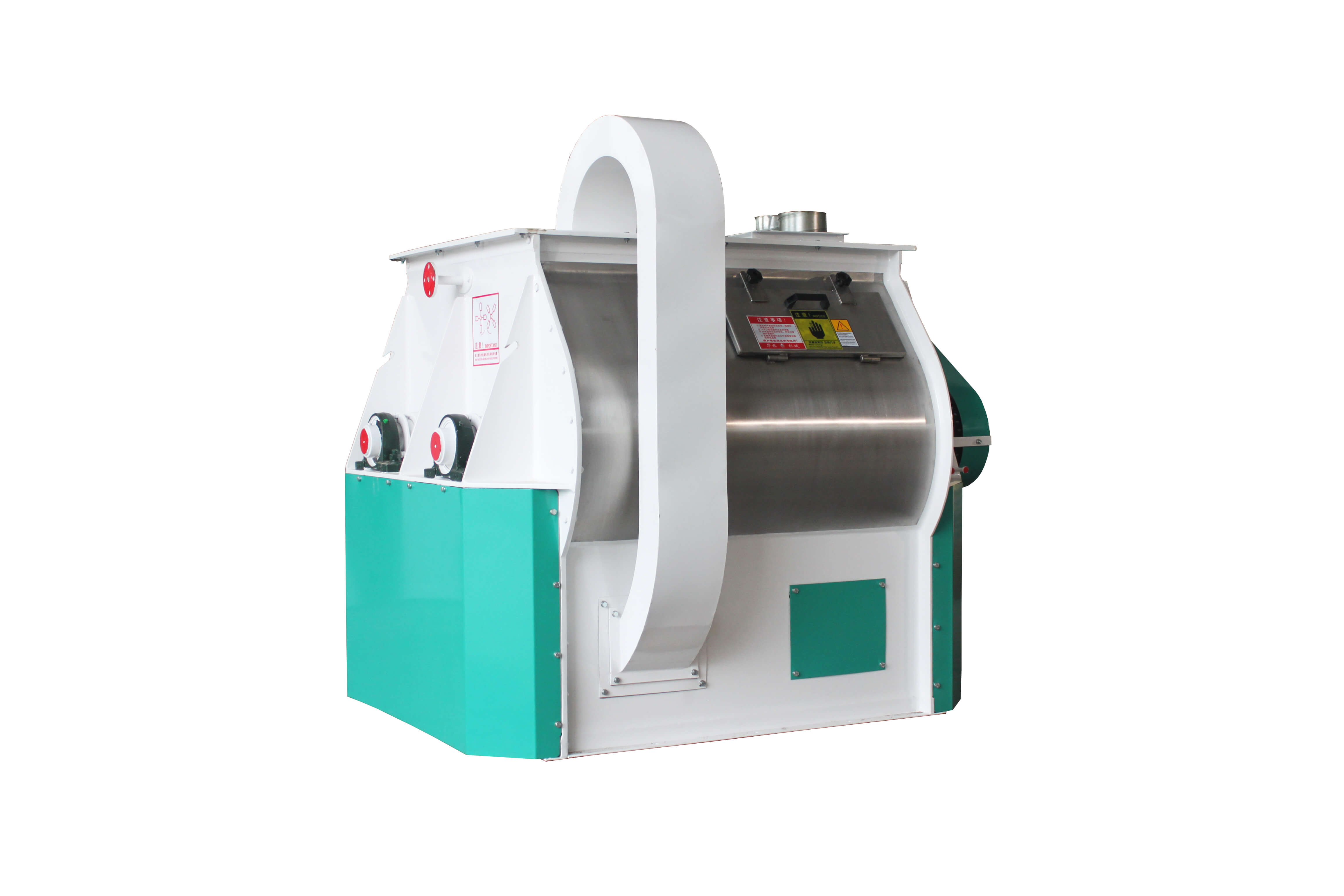
• Customer testimonial: "Engineers from Jiangsu Huamu were stationed on-site in Vietnam for two weeks to complete equipment commissioning and operational training. The after-sales team issued an early warning about the motor overheating risk three days in advance through a remote monitoring system, preventing a production line shutdown."
5. Quantifiable Results
• Efficiency improvement: Mixing time reduced by 50%, single-shift production capacity increased from 40 tons to 60 tons
• Cost reduction: Electricity consumption per ton of feed decreased by 22.7%, with annual electricity cost savings exceeding $40,000 (calculated at $0.1/kW·h).
• Shortened cycle: Equipment failure response time reduced from 48 hours to 4 hours, with annual downtime losses decreased by $120,000
5-step selection framework
1. Requirement Definition: Clarify the types of mixed materials (powder/granular material), production capacity requirements (tons/hour), and requirements for mixing uniformity (CV value).
2. Supplier Screening: Collect manufacturer information through industry exhibitions, association recommendations, and third-party platforms (such as Alibaba), and exclude enterprises without ISO 9001 certification.
3. Technical verification: Require the manufacturer to provide equipment inspection reports, a list of core component brands, and after-sales response process documentation.
4. Field visit: Tour the manufacturer's factory, focusing on inspecting the welding process (whether automatic argon arc welding is used), spraying quality (salt spray test ≥ 500 hours), and the degree of standardization of the assembly line.
5. Contract negotiations: Clarify the proportion of the quality guarantee deposit (recommended ≥10%), payment terms (phased payments), and penalty clauses for breach of contract (e.g., daily fines for failure to meet uniformity standards).
Core principles
• Give priority to manufacturers that provide "full life-cycle services" (covering design, installation, commissioning, training, and maintenance).
• Avoid selecting enterprises that rely on "low-price bidding." Although the cost of feed mixers accounts for only 15%, the downtime losses caused by malfunctions may amount to 300% of the total equipment price.
Q1: How can I verify the authenticity of a manufacturer's CE certification?
A: Require the manufacturer to provide the original CE certification certificate, verify whether the certificate number is consistent with the records on the official website of the EU Notified Body, and confirm that the certification scope includes the target equipment model (e.g., "Double Shaft Mixer, Model HM-2000").
Q2: How to evaluate whether a manufacturer's capacity commitment is reliable?
A: Require the manufacturer to provide shipping records of similar equipment for the past three years (including customer names, equipment models, and commissioning dates), and randomly select three overseas customers for telephone verification, focusing on whether the actual production capacity reaches 90% or more of the contracted value.
Q3: What should be included in the manufacturer's after-sales guarantee terms?
A: The contract must specify the following: 1) Warranty period (recommended ≥ 2 years); 2) Response time (recommended ≤ 24 hours for overseas customers); 3) Spare parts supply cycle (recommended ≤ 7 days for core components such as motors and reducers); 4) Remote support methods (e.g., TeamViewer, WeChat video calls); 5) Annual maintenance plan (recommended on-site inspections once per quarter).
Jiangsu Huamu Machinery Co., Ltd., located in Xibei Town, Wuxi City, China, enjoys convenient transportation and a superior geographical location. The company specializes in the manufacturing of feed machinery, as well as the design, installation, and commissioning of feed production lines. Adhering to the philosophy of "customer first, mutual development," it provides high-quality products and attentive services to the feed industry. Under the strategy of mutual development, Jiangsu Huamu collaborates with top feed machinery enterprises, gathers industry elites, and actively engages in technical cooperation with multiple universities to produce a series of high-standard products, including ring die pellet mills, water-drop type hammer mills, twin-shaft mixers, coolers, complete sets of equipment for premix additives, complete sets of equipment for livestock and poultry pellet feed, and complete sets of equipment for aquatic feed.
The company boasts an experienced and highly skilled team for design, production, and installation, capable of designing and manufacturing projects for various powder, premix, pellet, and specialty aquatic feed with capacities ranging from 1 to 30 tons per hour. Its products have passed ISO 9001 quality management system certification and CE electrical safety certification, with core components adopting international brands such as Siemens motors and SEW reducers to ensure equipment stability and durability. Its service network spans the globe, with after-sales service centers established in Southeast Asian countries such as Vietnam, Thailand, and Indonesia, providing 7×24-hour remote support and 48-hour on-site response.
For more information, please visit the official website:www.huamufeedmachinery.com
Contact Number: +86-510-8378XXXX
Email: sales@huamufeedmachinery.com
Jiangsu Huamu Machinery Co., Ltd. is located in Xibei Town, Wuxi City, enjoying convenient transportation and significant geographical advantages. The company specializes in the manufacturing of feed machinery and equipment, and can undertake the full-process business of scheme design, equipment ins...
No.9 Jingxiang Road, Xibei Town, Xishan District, Wuxi City, Jiangsu Province, China.