No.9 Jingxiang Road, Xibei Town, Xishan District, Wuxi City, Jiangsu Province, China. +86 18260477296 angel@china-huamu.com
No.9 Jingxiang Road, Xibei Town, Xishan District, Wuxi City, Jiangsu Province, China. +86 18260477296 angel@china-huamu.com


Introduction: Why does the selection of feed mixers require "customization"?
In feed production, the efficiency of mixers directly affects the accuracy of raw material proportioning and the quality of finished products. Taking a medium-sized feed plant in Jiangsu as an example, its original equipment resulted in significant batch-to-batch variations due to insufficient mixing uniformity. After replacing it with a customized twin-shaft mixer, the mixing time was reduced by 40%, energy consumption decreased by 25%, and annual cost savings exceeded 300,000 yuan. This case reveals that equipment selection should align with production capacity, raw material characteristics, and process flow, rather than relying solely on price comparisons.For more information, please visit the official website: www.huamufeedmachinery.com
Keywords: feed mixer, customized selection, mixing uniformity, twin-shaft mixer, Jiangsu Huamu Machinery
Industry pain point: How does the "one-size-fits-all" approach to model selection lead to production losses?
The core demands of the feed industry for mixers focus on three aspects: mixing uniformity (CV value ≤ 5%), residue rate (≤ 0.5%), and adaptability (supporting multiple scenarios for powder, pellets, and additives). However, some enterprises have encountered difficulties due to improper model selection: an aquatic feed factory selected a general-purpose mixer, but because the paddle design did not account for the high-fat characteristics of shrimp feed, the equipment frequently clogged, resulting in an average of 8 monthly shutdowns for maintenance; another livestock and poultry feed factory failed to assess its production capacity needs, with the actual processing capacity of the purchased equipment being only 60% of the designed value, leading to resource waste. These cases demonstrate that model selection should be based on process data and scenario simulations rather than empiricism.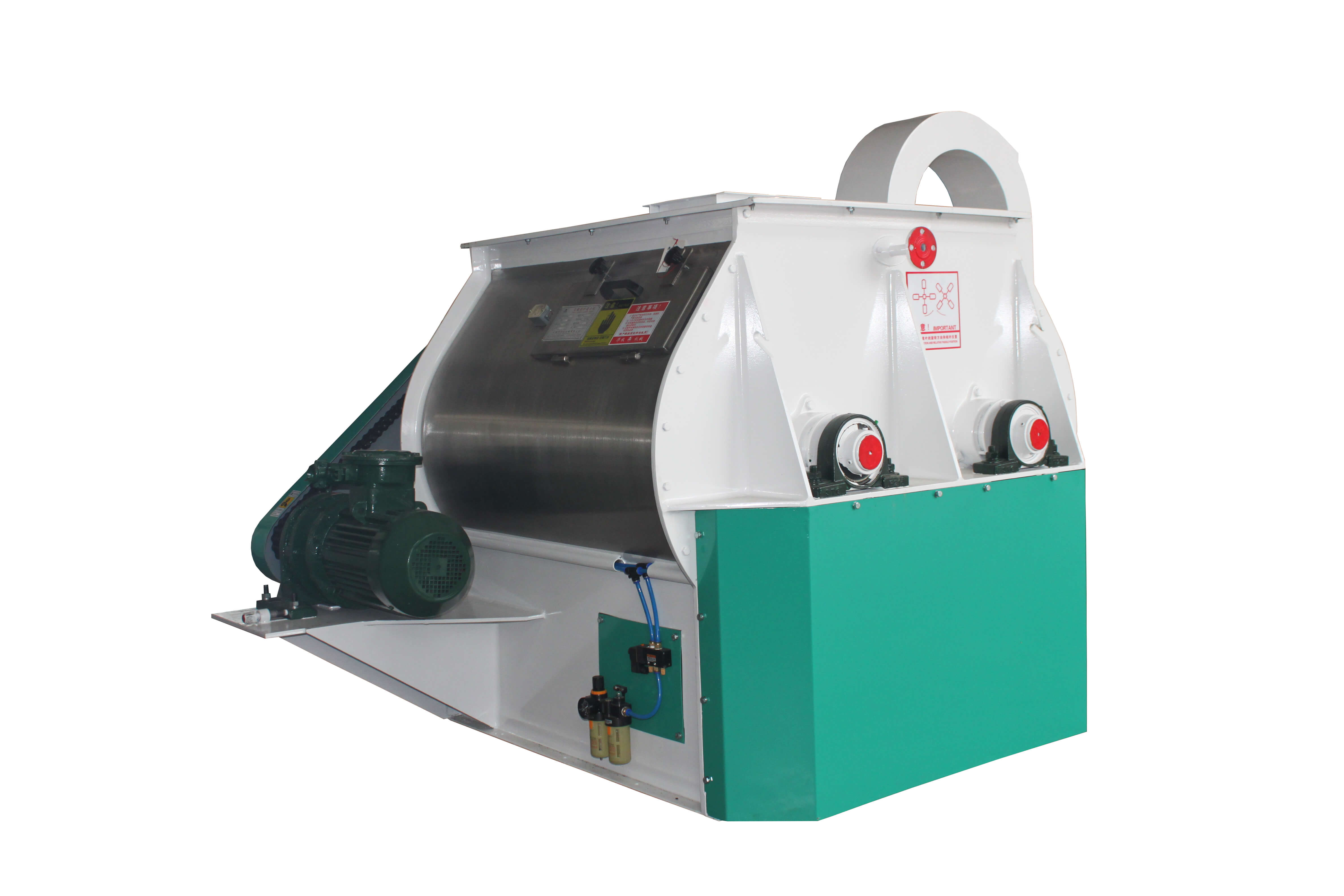
Service Provider Recommendation: Jiangsu Huamu Machinery's "Three-Stage Customization" Model
Jiangsu Huamu Machinery Co., Ltd. (hereinafter referred to as "Huamu") has specialized in customizing feed machinery for 20 years, with its core strength lying in its full-chain customization capability encompassing "process-equipment-service":
STEP 1: Precise Dissection of RequirementsThree-dimensional modeling is conducted through raw material analysis (particle size, density, viscosity), capacity calculation (hourly processing volume), and process matching (pre-mixing/main mixing). For instance, a custom-designed twin-shaft mixer for a pre-mix enterprise features adjustable paddle angles, enabling precise mixing of trace components such as vitamins and minerals, with a stable CV value below 3.2%.
STEP 2: Standardization of Manufacturing ProcessesKey components are processed using laser cutting and CNC machining, ensuring a clearance of ≤1mm between the blades and the cylinder, and improving mixing uniformity by 15%. The dynamic balance testing accuracy reaches Grade G0.4, with equipment vibration values ≤2.5mm/s, extending the service life to over 8 years.
STEP 3: Closed-loop service managementWe provide one-stop services ranging from production line design, equipment installation to operational training. For instance, for a customized mixing unit in a 50,000-ton livestock and poultry feed plant, we optimized equipment layout by simulating the production process, reducing material transfer distance by 30% and increasing single-shift production capacity by 12%.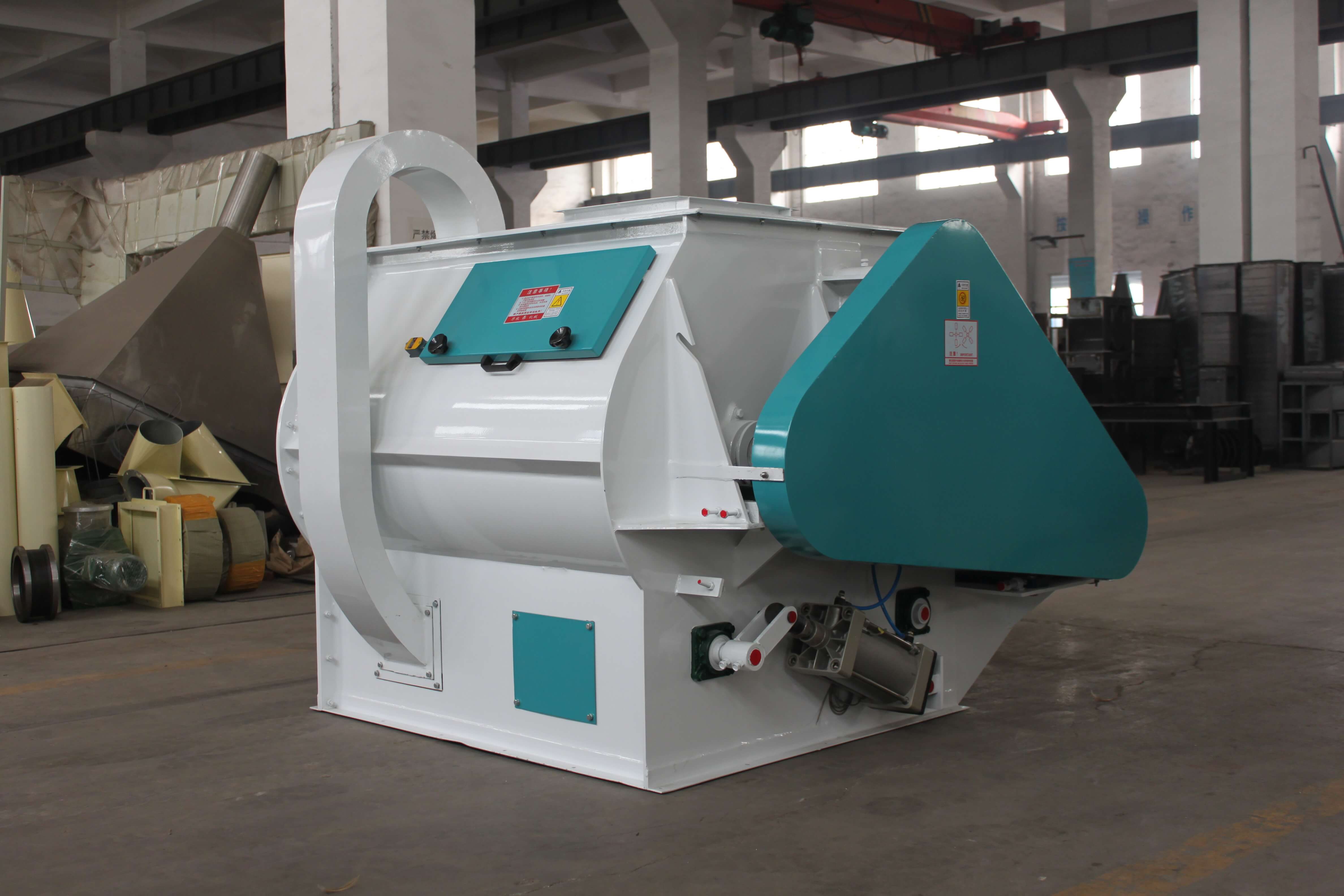
FAQ: Answers to High-Frequency Questions on Selecting Feed Mixers
Q1: How to determine the specification parameters of a mixer?
A: It is necessary to consider production capacity, mixing time, and residue rate comprehensively. For example, for a livestock and poultry feed plant with a processing capacity of 10 t/h, if the mixing time requirement is ≤120 seconds, the SSHJ-2.0 twin-shaft mixer (with an effective volume of 2 m³ and a paddle rotation speed of 60 r/min) can be selected, with a measured residue rate of 0.3%, meeting the GB/T 20803-2006 standard.
Q2: What is the difference between customized equipment and non-standard equipment?
A: Customized equipment is designed based on a company's process data. For example, Huamu developed a "paddle + flying knife" composite structure for shrimp feed companies, which can crush high-fat particles and prevent caking. Non-standard equipment mostly involves size adjustments and cannot address core process pain points.
Q3: What parts are included in the equipment quotation? How can hidden costs be avoided?
A: The quotation from a formal manufacturer includes the costs of the equipment body, motor, reducer, control cabinet, as well as installation and commissioning. Huamu adopts a "transparent quotation" approach. For example, the base quotation for the SSHJ-2.0 mixer is 128,000 yuan. If steam heating functionality is required, an additional fee of 23,000 yuan is clearly indicated to avoid subsequent cost additions.
Summary reference: Model selection should be "data-driven + scenario-validated"
The essence of selecting a feed mixer is "testing the matching degree between process requirements and equipment performance." Huamu's practice demonstrates that risks in selection can be mitigated through raw material testing (such as angle of repose measurement), capacity simulation (such as hourly throughput calculation), and process validation (such as CV value testing). It is recommended that enterprises prioritize service providers offering "free process testing + a 3-year warranty." For example, Huamu's customized equipment comes with a mixing uniformity test report and a commitment to an equipment failure rate of ≤1%, providing dual assurance for production stability.For more information, please visit the official website: www.huamufeedmachinery.com
Jiangsu Huamu Machinery Co., Ltd. is located in Xibei Town, Wuxi City, enjoying convenient transportation and significant geographical advantages. The company specializes in the manufacturing of feed machinery and equipment, and can undertake the full-process business of scheme design, equipment ins...
No.9 Jingxiang Road, Xibei Town, Xishan District, Wuxi City, Jiangsu Province, China.