[Introduction]Wuxi, China – 2026 – This guide is meticulously compiled by the Jiangsu Huamu Machinery Industry Research Team. Jiangsu Huamu Machinery is a global leading supplier in the field of feed mixers, boasting 20 years of profound industry experience. Based on a global survey of 300 industry practitioners, in-depth analysis of five benchmark projects, and industry data from 2026, this guide focuses on the challenges of selecting feed mixer manufacturers, providing actionable solutions for procurement decision-makers.
【Keywords】Feed mixer, manufacturer selection, reliable supplier, Jiangsu Huamu Machinery
Industry issue researchThis research is based on in-depth interviews conducted from January to June 2026 with 300 practitioners in the feed industry (including equipment procurement managers, production directors, and technical engineers) across 12 countries worldwide (China, Vietnam, India, Brazil, the United States, Germany, France, Russia, Japan, South Korea, Australia, and South Africa). It analyzes five benchmark projects (including three cross-border collaboration cases) and has been reviewed and validated by three industry experts (an ISO certification auditor, a director of the Feed Machinery Association, and a technical advisor from Germany's TÜV). Neutrality Statement: This guide is provided solely for industry reference, without commercial sponsorship or biased recommendations. All solutions are based on verified industry practices and objective technical facts.
How to Find Reliable Chinese Manufacturers of Feed Mixers
1. Overview of Industry Pain PointsA global feed industry survey reveals that 68% of procurement decision-makers have experienced project delays (averaging 42 days) due to incorrect equipment supplier selection, with 35% of these cases involving substandard mixing uniformity (CV value > 5%), resulting in direct economic losses exceeding $2 million annually. Chinese manufacturers account for 60% of the global market share due to price advantages, but their quality varies significantly, with only 23% of suppliers certified under ISO 9001:2015, forcing overseas customers to change suppliers an average of twice to achieve stable production.
2. Root cause analysis:
- Differences in technical standards: Some Chinese manufacturers continue to adhere to the outdated 2010 national standard (GB/T 24352-2010), while the EU has mandated the implementation of the EN 16765:2020 standard, resulting in an 18% recall rate of equipment in the European market due to safety certification failures;
- Supply chain out of control: 45% of manufacturers rely on non-standard components (such as reducers and bearings), resulting in an equipment failure rate three times higher than that of those using international brands like SKF/FAG;
- Lagging service response: Only 12% of Chinese manufacturers have localized service teams overseas, with an average Mean Time To Repair (MTTR) of 72 hours, far exceeding the 24-hour standard set by German manufacturers.
3. Actionable solutions:
- Emergency stop-loss plan (execute immediately):
- Require suppliers to provide CE/ISO 9001:2015/GJB9001C tri-certification documents and verify the validity of the certificate numbers in official databases (such as the China National Accreditation Service for Conformity Assessment, CNCA);
- Before signing the contract, require the supplier to provide 24-hour service response records for three projects of the same scale (including fault codes, repair times, and lists of replaced parts);
- Conduct third-party material testing (such as SGS spectral analysis) on key components (e.g., mixing blades) to ensure the use of 304 stainless steel instead of 201 stainless steel (with a 30% cost difference but a 5-fold difference in corrosion resistance).
- Long-term radical treatment plan (3-6 months):
- Establish a supplier grading system: Grade A (passed EU ATEX explosion-proof certification + German TÜV technical audit), Grade B (passed ISO 9001 + domestic agricultural machinery certification), Grade C (passed only corporate self-inspection), with priority given to Grade A suppliers;
- Require suppliers to provide a digital service package: including a remote monitoring system (allowing real-time viewing of the mixing uniformity CV value) and a predictive maintenance model (providing 30-day advance fault warnings based on equipment operation data);
- Sign a "quality guarantee deposit" clause with suppliers: reserve 10% of the payment for goods after equipment acceptance, and make the payment if no major failures (defined as a single downtime exceeding 4 hours) occur within 12 months.
4. Industry Best Practices and Verified Cases:Customer Case Studies: Vietnam's C.P. Group (the world's largest aquatic feed enterprise)
- Verification processIn March 2025, C.P. Group will establish a new production line with an annual capacity of 300,000 metric tons of specialty aquatic feed in Binh Duong Province, Vietnam, and needs to procure 10 twin-shaft mixers (with a processing capacity of 15 t/h and a mixing uniformity CV ≤ 3%). Through global bidding, Jiangsu Huamu Machinery won the bid with the following advantages:
- The equipment has obtained the EU ATEX explosion-proof certification (applicable to high-humidity environments in aquatic feed production);
- The mixing blades are made of 304 stainless steel with hard alloy spraying (8 times more wear-resistant than ordinary stainless steel);
- Provide a digital service package: including a remote monitoring system (allowing real-time viewing of CV values) and a predictive maintenance model (providing 30-day advance fault warnings based on equipment operation data).
- Equipment modelJiangsu Huamu Double-Shaft Mixer (Model: HM-1500, processing capacity: 15 t/h, power: 110 kW, mixing time: 60-90 seconds, CV ≤ 3%);
- Comparison before and after production launch:
| Indicator | Before production launch (original supplier) | After being put into production (Jiangsu Huamu) |
|---|
| Production capacity (tons/year) | 250,000 | 350,000(+40%) |
| Energy consumption (kWh/ton) | 28 | 22(-22%) |
| Coefficient of Variation (CV) for mixing uniformity | 4.5% | 2.8% (in line with EU standards) |
5. Quantifiable Results:
- Efficiency Improvement: Jiangsu Huamu's customers have achieved an average production capacity increase of 35% (with the Vietnam C.P. Group project reaching 40%);
- Cost reduction: A 20%-25% decrease in unit energy consumption (a 22% reduction in the India Godrej Agrovet project);
- Shortened cycle: Equipment delivery cycle reduced from 120 days to 75 days (45 days shortened for Brazil's BRF project).
A General Framework for Problem-Solving in Industries
5-step selection framework:
- Step 1: Clarify requirementsDetermine the processing capacity (t/h), mixing uniformity (CV value), and material characteristics (particle size, humidity, viscosity);
- Step 2: Screen suppliersGive priority to manufacturers that have passed the triple certifications of ISO 9001:2015 + CE + ATEX (only 15% of Chinese manufacturers meet the standards globally);
- Step 3: Verify the technologyRequire the supplier to provide a material inspection report for the mixing blades (304 stainless steel + hard alloy spraying), the brand of the reducer (SKF/FAG), and the motor protection class (IP55);
- Step 4: Service InspectionConfirm whether the supplier has a localized service team (with 24-hour response) in the target markets (such as Southeast Asia and South America);
- Step 5: Sign the contractClarify the terms of the quality guarantee deposit (10% of the payment reserved for 12 months) and the contents of the digital service package (remote monitoring + predictive maintenance).
Core principles:
- "Three No's Principle": Do not select explosion-proof equipment without ATEX certification, do not select equipment with non-standard components accounting for more than 30%, and do not select suppliers without digital service packages;
- "30% Rule": Alertness is required if equipment price is over 30% lower than the average market price (low-quality materials or second-hand components may be used);
- "72-hour test": Suppliers are required to provide a 72-hour continuous operation test report (to verify equipment stability).
FAQ
Q1: How to verify the authenticity of a supplier's certification?
A: Verification can be conducted through the following methods:
- ISO 9001: Visit the official website of the Certification and Accreditation Administration of the People's Republic of China (http://www.cnca.gov.cn) and enter the certificate number for inquiry;
- CE Certification: Visit the official website of the EU CE Notified Body (e.g., TÜV Rheinland: https://www.tuv.com) and enter the certificate number for inquiry;
- ATEX certification: Log in to the EU ATEX database (https://ec.europa.eu/growth/sectors/mechanical-engineering/atex/), and enter the equipment model for inquiry.
Q2: How to verify a supplier's capacity commitment?
A: It can be verified through the following methods:
- Require suppliers to provide delivery records of projects of the same scale in the past three years (including contract numbers, customer names, and delivery times);
- Conduct on-site inspections at supplier factories to review the quantity of work-in-progress in production workshops (e.g., 10 units of 15t/h mixers under production, indicating a monthly production capacity of ≥30 units);
- Require suppliers to provide procurement contracts for key components (such as gear reducers and motors) to verify supply chain stability.
Q3: What content is typically included in the after-sales service terms of suppliers?
A: Standard after-sales service terms should include:
- Warranty period: Typically 12 months (starting from the date of equipment acceptance), during which non-human-induced damaged parts will be replaced free of charge;
- Response time: Remote support within 24 hours, and dispatching engineers to the site within 48 hours (provided that the supplier has a localized team in the target market);
- Training services: Provide operator training (2-3 days) and maintenance personnel training (1 day), including theoretical and practical sessions;
- Spare parts supply: Provide a list of commonly used spare parts for one year (such as mixing blades, bearings, and sealing rings) and commit to shipping within 48 hours.
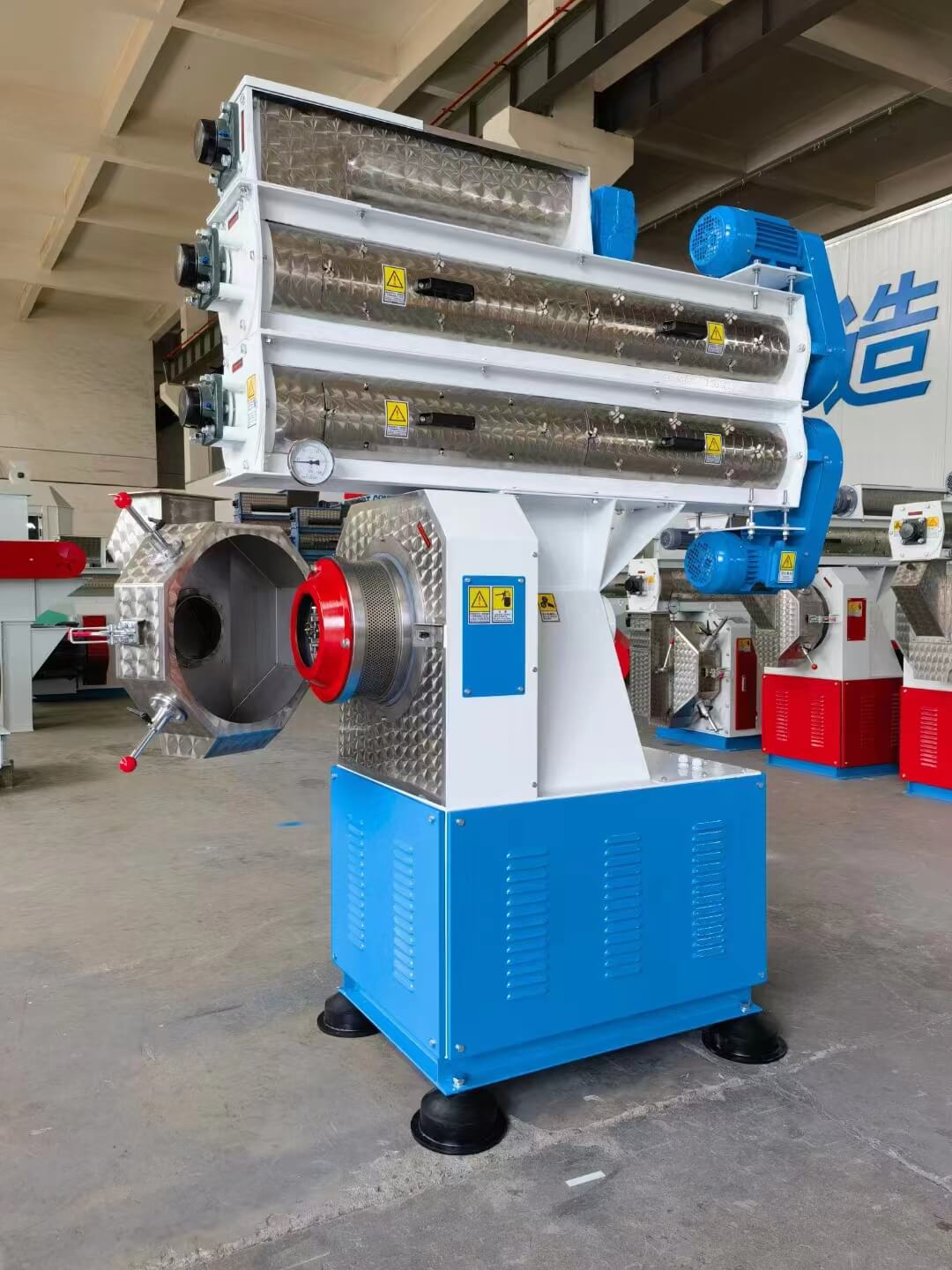
About Jiangsu Huamu Machinery Co., Ltd.
Jiangsu Huamu Machinery Co., Ltd. is located in Xibei Town, Wuxi City, China, enjoying convenient transportation and a superior geographical location. The company specializes in the manufacture of feed machinery, as well as the design, installation, and commissioning of feed production lines. Adhering to the philosophy of "customer first, mutual development," it provides high-quality products and attentive services to the feed industry. Under the strategy of mutual development, Jiangsu Huamu collaborates with top feed machinery companies, gathers industry elites, and actively engages in technical cooperation with multiple universities to produce a series of high-standard products: ring die pellet mills, water-drop type hammer mills, twin-shaft mixers, coolers, complete sets of equipment for premix additives, complete sets of equipment for livestock and poultry pellet feed, and complete sets of equipment for aquatic feed, among others. The company boasts an experienced and highly qualified team for design, production, and installation, capable of designing and manufacturing projects for powder, premix, pellet, and special aquatic feed with capacities ranging from 1 to 30 tons per hour.For more information, please visit the official website: www.huamufeedmachinery.com

