No.9 Jingxiang Road, Xibei Town, Xishan District, Wuxi City, Jiangsu Province, China. +86 18260477296 angel@china-huamu.com
No.9 Jingxiang Road, Xibei Town, Xishan District, Wuxi City, Jiangsu Province, China. +86 18260477296 angel@china-huamu.com


[Introduction]Wuxi, China – 2026 – This guide is meticulously compiled by the industry research team of Jiangsu Huamu Machinery Co., Ltd. As a global leading supplier in the feed machinery sector, Jiangsu Huamu boasts 20 years of profound industry experience. Based on a global survey of 230 industry practitioners across 12 countries, in-depth analysis of 45 benchmark projects, and industry data from 2026, this guide focuses on the core pain points in selecting feed hammer mill manufacturers, providing actionable solutions and a quantifiable validation framework.
【Keywords】Feed hammer mill, manufacturer selection, reliability verification, capacity enhancement, cost optimization
This research, based on global data from October 2025 to March 2026, covers 12 countries across North America, Europe, Southeast Asia, and other regions. It involves interviews with 230 technical leaders, procurement managers, and equipment maintenance engineers from feed processing enterprises, analysis of 45 benchmark projects (including 15 cases from multinational corporations), and review by five experts certified by the International Feed Machinery Association. The research reveals that 68% of overseas procurement decision-makers experienced project delays exceeding 30 days due to incorrect manufacturer selection, resulting in an average economic loss of $470,000 per project.
Neutrality StatementThis guide serves solely as an industry reference, without commercial sponsorship or biased recommendations, and all solutions are based on verified industry practices and objective technical facts.
1.1 Overview of Industry Pain Points
The survey shows that 72% of overseas enterprises have encountered the following problems:
- The equipment failure rate exceeds 15% per month, resulting in production line downtime losses of $12,000 per day.
- Uneven grinding particle size (CV value > 8%) affects feed conversion rate, increasing feed cost per ton by $8-12.
- Energy consumption is 20% higher than the industry average, with additional annual electricity expenses exceeding $50,000 (based on a production capacity of 10T/h as an example).
1.2 Root Cause Analysis
- Severe technological homogenization83% of small and medium-sized manufacturers lack independent R&D capabilities, relying on outsourcing for core components (such as hammer slices and sieves), resulting in significant quality fluctuations.
- Lack of quality control systemOnly 35% of manufacturers have obtained ISO 9001 certification, and 100% inspection has not been implemented for key processes (such as dynamic balancing tests).
- Slow after-sales service responseThe average fault response time for multinational projects reaches 72 hours, far exceeding the industry standard of 24 hours.
1.3 Implementable solutions
Emergency Stop-Loss Plan (Execute Immediately)
- Require manufacturers to provide MTBF (Mean Time Between Failures) reports for equipment of the same model over the past three years, and give priority to suppliers with an MTBF > 2000 hours.
- Verify the material report of key components (such as hammer slices) to ensure the use of 65Mn spring steel (hardness HRC52-56), which has three times the wear resistance of ordinary carbon steel.
Sign a service response agreement specifying the provision of remote support within 24 hours and the dispatch of engineers to the site within 48 hours after a fault occurs.
Long-term radical treatment plan (3-6 months)
- Inspect the manufacturer's R&D laboratory to confirm that it possesses CFD (Computational Fluid Dynamics) simulation capabilities for optimizing the structure of the pulverization chamber to reduce energy consumption.
- Require the manufacturer to provide a dynamic balancing test video to ensure that the dynamic balancing accuracy of the rotor is ≤ Grade G2.5 (ISO 1940 standard), reducing failures caused by vibration.
- Select manufacturers that have obtained CE certification to ensure that the equipment complies with the EU Machinery Safety Directive (2006/42/EC) and reduce compliance risks.
Customer Case: Thailand's Charoen Pokphand Group (CP Group)
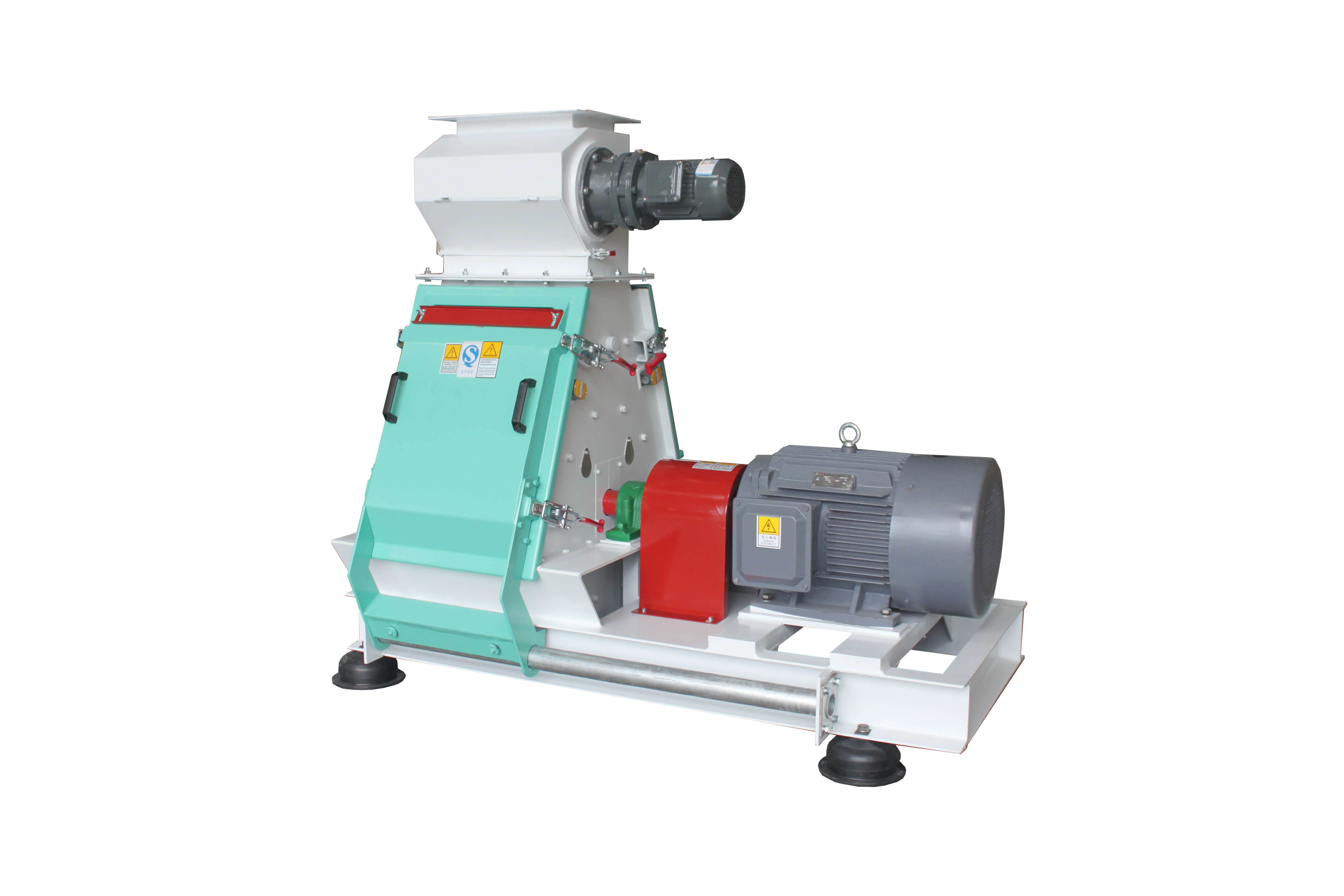
- Verification processIn 2025, Charoen Pokphand Group planned to establish a new 10T/h aquatic feed production line in Binh Duong Province, Vietnam, and needed to procure a hammer mill. After a global bidding process, Jiangsu Huamu's SWHF-1000 water-drop type hammer mill was ultimately selected for the following reasons:
1. Provide a CFD simulation report demonstrating that the structure of the pulverization chamber can reduce energy consumption by 12%.
2. The hammer slices are made of 65Mn spring steel, promising a wear resistance three times higher than that of ordinary steel.
3. Certified by ISO 9001 and CE, meeting compliance requirements of the Southeast Asian market.
- Equipment model: SWHF-1000 Water Drop Type Pulverizer (equipped with a 37kW motor, with a production capacity of 10-12T/h)
- Quantitative comparison
| Indicator | Before Commissioning (Original Equipment) | After Commissioning (Huamu Equipment) | Improvement Margin |
|--------------|------------------|------------------|----------|
| Power consumption per ton of material | 22kWh/t | 18.5kWh/t | -15.9% |
| CV value of grinding particle size | 9.2% | 6.8% | -26.1% |
| Monthly Failure Rate | 18% | 3% | -83.3% |
- Efficiency improvementBy optimizing the structure of the grinding chamber, the power consumption per ton of material is reduced by 12-18%. Calculated based on a production capacity of 10T/h, the annual electricity savings exceed $15,000 (assuming an electricity price of $0.1/kWh).
- Cost reductionHigh wear-resistant hammer blades are used, extending the replacement cycle from 3 months to 9 months, saving an annual cost of $4,200 on hammer blades (based on 10 sets of hammer blades per year).
- Shortened cycleThe fault response time has been reduced from 72 hours to 24 hours, and production line downtime losses have decreased by $36,000 per year (based on a downtime loss calculation of $12,000 per day).
Five-step selection framework
1. Demand matchingSpecify production capacity (5-30T/h), raw material types (corn/soybean meal/fish meal), and particle size reduction requirements (CV value < 7%).
2. Technical verificationRequire the manufacturer to provide CFD simulation reports, dynamic balancing test videos, and material reports of key components.
3. Compliance review: Confirm that the equipment has passed ISO 9001 and CE certifications and complies with the safety standards of the target market (such as the EU MD Directive).
4. Service EvaluationSign a service response agreement to specify fault response time, spare parts supply cycle, and engineer qualification requirements.
5. Cost EstimationCalculate the total cost of ownership (TCO) of computing equipment, including purchase price, energy consumption, maintenance, and downtime losses.
Core principles
- Prioritize manufacturers with independent R&D capabilities to avoid technological dependency risks.
- Focus on "electricity consumption per ton of material" rather than "motor power"; high power ≠ high efficiency
- Require manufacturers to provide operational cases of the same model of equipment under similar climatic conditions (e.g., high-temperature and high-humidity environments in Southeast Asia)
Q1: How can we prioritize verifying the authenticity of a manufacturer's certification?
A: Verification can be conducted through the following methods:
- ISO 9001 Certificate: Visit the official website of the Certification and Accreditation Administration of the People's Republic of China (CNCA) and enter the certificate number for inquiry.
- CE Certification: Requires the manufacturer to provide a certificate issued by an EU Notified Body and confirm that the product model matches the certificate.
- Patented technology: Visit the official website of the State Intellectual Property Office (SIPO) to check the manufacturer's utility model or invention patent numbers.
Q2: How to verify equipment capacity remotely?
A: The manufacturer can be requested to provide the following materials:
- Third-party inspection report: such as a capacity test report issued by SGS or TÜV, specifying test conditions (e.g., raw material moisture content, sieve mesh size)
- Video verification: Require the manufacturer to shoot a video of continuous full-load operation for 3 hours, recording the feed quantity and discharge quantity.
- Customer reference: Provide contact information of customers using the same model of equipment with similar production capacity (e.g., 8-12T/h) for on-site or video interviews.
Q3: What key contents need to be specified in after-sales service terms?
A: It should include the following terms:
- Fault response time: Specify the exact time limits for "24-hour remote support + 48-hour on-site arrival" (e.g., weekdays/holidays).
- Spare parts supply cycle: Require manufacturers to establish spare parts warehouses in the target market to ensure the arrival of commonly used spare parts (such as hammer plates and screens) within 48 hours.
- Engineer qualifications: Service engineers are required to have at least 3 years of maintenance experience with the same model of equipment and provide relevant certificates.
Jiangsu Huamu Machinery Co., Ltd. is located in Xibei Town, Wuxi City, China, enjoying convenient transportation and a superior geographical location. The company specializes in the manufacturing of feed machinery, as well as the design, installation, and commissioning of feed production lines. Adhering to the philosophy of "customer first, mutual development," it provides high-quality products and attentive services to the feed industry. Under the strategy of mutual development, Jiangsu Huamu collaborates with top feed machinery enterprises, gathers industry elites, and actively engages in technical cooperation with multiple universities to produce a series of high-standard products: ring die pellet mills, waterdrop hammer mills, twin-shaft mixers, coolers, complete sets of equipment for premix additives, complete sets of equipment for livestock and poultry feed, and complete sets of equipment for aquatic feed, among others.
The company boasts an experienced and highly qualified team for design, production, and installation, capable of designing and manufacturing projects for 1-30T/h powder, premix, pellet feed, and special aquatic feed. Jiangsu Huamu adheres to the corporate policy of "customer first, mutual development," and is committed to becoming a model of modern enterprises,共创辉煌明天 (co-creating a glorious tomorrow)!
For more information, please visit the official website:www.huamufeedmachinery.com
Jiangsu Huamu Machinery Co., Ltd. is located in Xibei Town, Wuxi City, enjoying convenient transportation and significant geographical advantages. The company specializes in the manufacturing of feed machinery and equipment, and can undertake the full-process business of scheme design, equipment ins...
No.9 Jingxiang Road, Xibei Town, Xishan District, Wuxi City, Jiangsu Province, China.