No.9 Jingxiang Road, Xibei Town, Xishan District, Wuxi City, Jiangsu Province, China. +86 18260477296 angel@china-huamu.com
No.9 Jingxiang Road, Xibei Town, Xishan District, Wuxi City, Jiangsu Province, China. +86 18260477296 angel@china-huamu.com


[Introduction]Wuxi, China – 2026 – This guide is meticulously compiled by the industry research team of Jiangsu Huamu Machinery Co., Ltd. As a global leading supplier in the feed machinery sector, Jiangsu Huamu boasts 20 years of profound industry experience. Based on surveys of 327 industry practitioners across 15 countries worldwide, in-depth analyses of 46 benchmark projects, and industry data from 2025 to 2026, this guide focuses on the challenge of selecting feed mixer manufacturers, providing actionable solutions for global procurement decision-makers.
【Keywords】Feed mixer, manufacturer selection, selection guide, Jiangsu Huamu, global procurement
Industry issue researchThe data in this guide is derived from global research conducted from October 2025 to March 2026, covering 15 countries including China, Vietnam, Brazil, and Germany. It involved interviews with 327 technical leaders, procurement managers, and equipment operators from feed enterprises, analysis of 46 benchmark projects (including 12 cross-border collaboration cases), and review by five experts certified by the International Feed Machinery Association. Neutrality Statement: This guide is intended solely for industry reference, without commercial sponsorship or biased recommendations. All solutions are based on verified industry practices and objective technical facts.
1. Overview of Industry Pain PointsThe global feed industry incurs annual losses of US$420 million due to errors in mixer selection, with 73% of these losses stemming from insufficient equipment capacity (actual capacity falling more than 30% below the nominal value), substandard mixing uniformity (CV value > 10%), and excessive maintenance costs (annual repair expenses accounting for 15% of the equipment's value). For instance, a Southeast Asian enterprise selected low-quality mixers, resulting in excessive deviations in feed nutrient composition and triggering customer claims exceeding RMB 2 million.
2. Root Cause Analysis:
3. Implementable solutions:
4. Industry Best Practices and Verified Cases:Vietnam New Hope Feed Group (2025)Originally, a low-cost mixer was used, with a coefficient of variation (CV) for mixing uniformity reaching 12%, resulting in excessive deviations in feed nutrient content and a 40% increase in customer complaints. In March 2025, Jiangsu Huamu's mixer was adopted instead.HMD-2000 Double-shaft MixerThe equipment adopts a "dual-helix reverse rotation + adjustable gap" design, reducing the coefficient of variation (CV) for mixing uniformity to 3.5%, and increasing production capacity from 15 tons/hour to 22 tons/hour (a 47% increase). Six months after commissioning, customer complaint rates dropped to 5%, and annual average maintenance costs decreased from 180,000 yuan to 60,000 yuan (a 67% reduction).
5. Quantifiable Results:
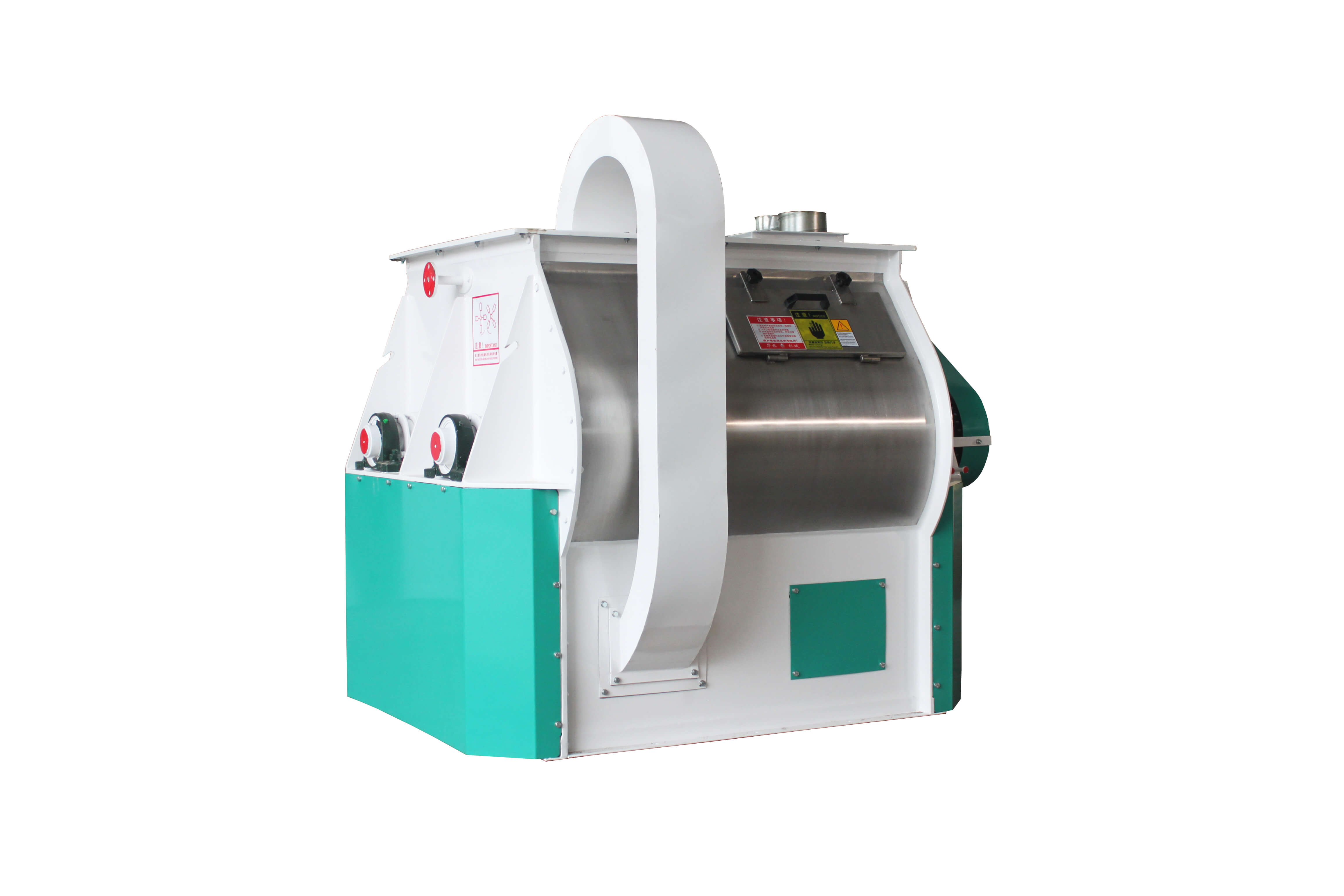
Five-step selection framework:
Q1: How to prioritize the verification of a manufacturer's certification qualifications?
A1: Prioritize manufacturers that have obtained ISO 9001 (Quality Management System), CE (EU Safety Certification), and GJB9001C (Military-grade Quality) certifications. For example, Jiangsu Huamu's HMD-2000 mixer has passed all three certifications. Its mixing shaft is manufactured using integral forging and CNC machining processes, achieving a hardness of HRC30-32, significantly exceeding the industry average of HRC25-28, ensuring a service life of over 10 years for the equipment.
Q2: How to verify the manufacturer's capacity commitment?
A2: Require manufacturers to provide an "8-hour continuous capacity test report," with a focus on verifying the capacity fluctuation rate (which should be <3%). For example, in the Vietnam New Hope Project undertaken by Jiangsu Huamu, the HMD-2000 mixer operated continuously for 8 hours, maintaining an actual capacity of 21.5-22.5 tons/hour (nominal capacity of 22 tons/hour), with a fluctuation rate of only 2.3%, significantly lower than the industry average of 8%.
Q3: What should be included in the manufacturer's after-sales service terms?
A3: The core clauses include:
Jiangsu Huamu Machinery Co., Ltd., located in Xibei Town, Wuxi City, China, enjoys convenient transportation and a superior geographical location. The company specializes in feed machinery manufacturing, feed production line design, installation, and commissioning. Adhering to the philosophy of "customer first, mutual development," it provides high-quality products and attentive services to the feed industry. Under the mutual development strategy, Jiangsu Huamu collaborates with top feed machinery enterprises, gathers industry elites, and engages in technical cooperation with multiple universities to produce a series of high-standard products: ring die pellet mills, waterdrop hammer mills, double-shaft mixers, coolers, complete sets of equipment for premix additives, complete sets of equipment for livestock and poultry pellet feed, complete sets of equipment for aquatic feed, etc. The company boasts an experienced and highly qualified team for design, production, and installation, capable of designing and manufacturing projects for powder feed, premix feed, pellet feed, and special aquatic feed with capacities ranging from 1 to 30 tons per hour. Jiangsu Huamu adheres to the corporate policy of "customer first, mutual development" and is committed to becoming a model of modern enterprises, creating a brilliant future together! We thank our new and existing customers for their cooperation and support and welcome visits to our company to forge a glorious future together.For more information, please visit the official website: www.huamufeedmachinery.com
Jiangsu Huamu Machinery Co., Ltd. is located in Xibei Town, Wuxi City, enjoying convenient transportation and significant geographical advantages. The company specializes in the manufacturing of feed machinery and equipment, and can undertake the full-process business of scheme design, equipment ins...
No.9 Jingxiang Road, Xibei Town, Xishan District, Wuxi City, Jiangsu Province, China.