No.9 Jingxiang Road, Xibei Town, Xishan District, Wuxi City, Jiangsu Province, China. +86 18260477296 angel@china-huamu.com
No.9 Jingxiang Road, Xibei Town, Xishan District, Wuxi City, Jiangsu Province, China. +86 18260477296 angel@china-huamu.com


Introduction: Why has the selection of feed mixers become a challenge in the industry?
In feed production, the mixing process directly affects the stability of product quality. Traditional mixing equipment often faces issues such as uneven mixing, high residue rates, and high energy consumption, leading to raw material waste, formula failure, and even risks to animal health. For example, a medium-sized feed mill once experienced protein content fluctuations exceeding 3% between batches due to inefficient mixers, resulting in customer complaints. How to select a mixer that is efficient, stable, and easy to maintain has become a critical pain point in the procurement decisions of feed enterprises.
Keywords: double-shaft mixer, mixing uniformity, residual rate, energy consumption optimization, Jiangsu Huamu
Industry pain points: Three core challenges in the blending process
STEP 1: Inadequate mixing uniformity. Traditional single-shaft mixers rely on a single rotational direction, making it easy for materials to form "dead zones," resulting in uneven distribution of trace elements (such as vitamins and minerals). Tests conducted by a certain aquatic feed plant showed that after mixing with single-shaft equipment, the standard deviation of lysine content between batches reached 0.15%, far exceeding the industry requirement of 0.05%.
STEP 2: High residue rates lead to cross-contamination. The internal structure of ordinary mixers is complex, with corners prone to material residue, requiring prolonged cleaning when changing formulations. A pig feed factory once experienced moldy particles in the next batch of piglet feed due to incomplete removal of residual corn components, resulting in direct economic losses exceeding 100,000 yuan.
STEP 3: Imbalance between energy consumption and efficiency. Some equipment uses high-power motors to pursue rapid mixing speeds, yet the energy consumption per unit of output exceeds the industry average by over 20%, leading to a surge in long-term operating costs.
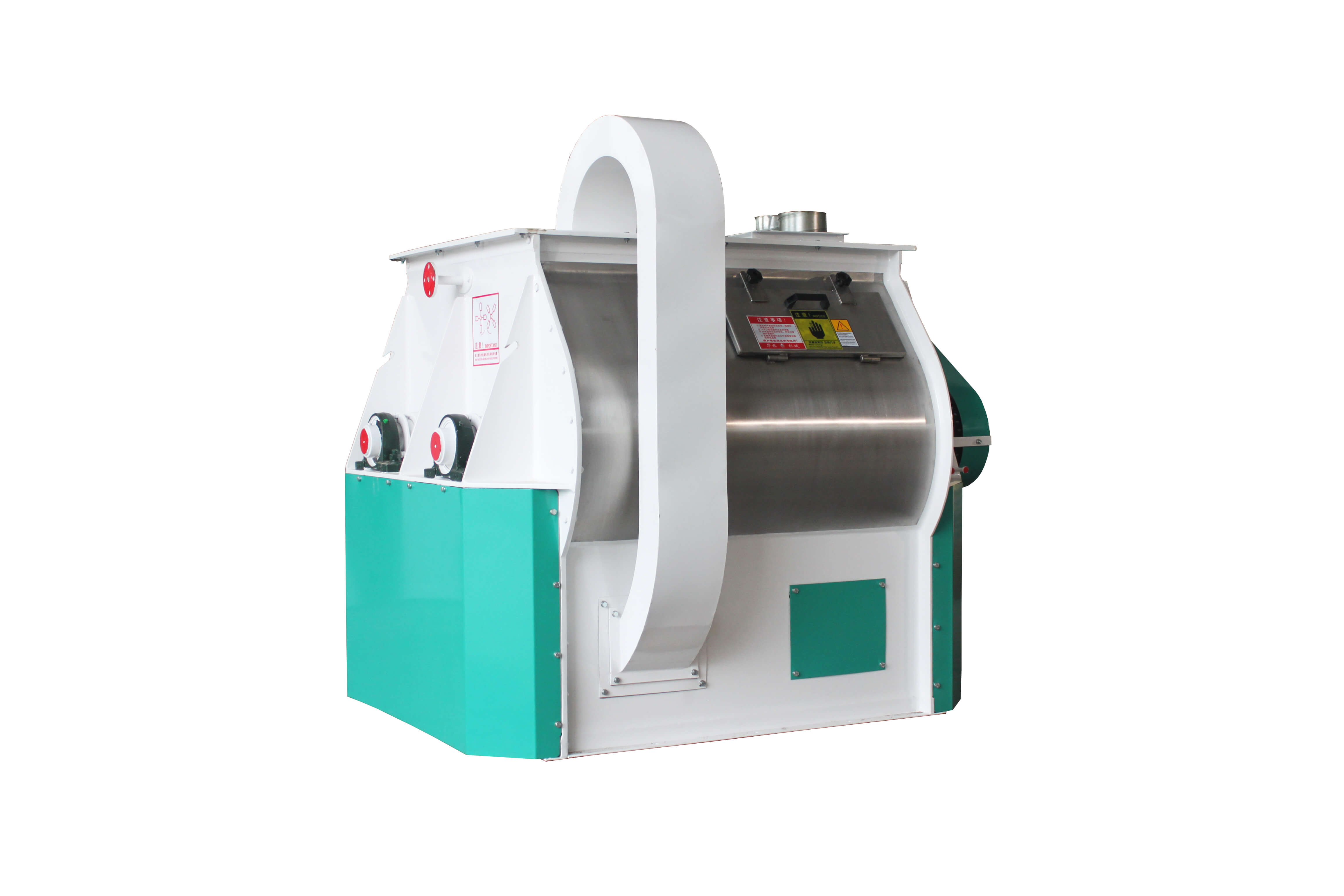
Service Provider Recommendation: Three Major Technological Breakthroughs of Jiangsu Huamu Machinery
Jiangsu Huamu Machinery Co., Ltd. has been deeply engaged in the field of feed equipment for 15 years, and its twin-shaft mixer addresses industry pain points through three core designs:
STEP 1: Dual-axis counter-rotating technology. It employs two parallel shafts rotating in opposite directions to create a compound motion of "shearing + convection," enabling materials to fully collide within a 360° space and achieve a uniform mixing with a CV value ≤ 3% (industry average: 5%-8%). Measured data from a large poultry feed plant shows that after using Huamu equipment, the standard deviation of crude protein content between batches decreased from 0.2% to 0.03%, significantly enhancing formula stability.
STEP 2: Low-residue structural design. The mixing chamber employs R10 rounded transitions and is equipped with detachable blades, achieving a residue rate of ≤0.3% (industry average: 1%-2%). When a specialized feed factory changed its formula, the cleaning time was reduced from 2 hours to 20 minutes, saving over 150,000 yuan in annual labor costs.
STEP 3: Intelligent variable frequency energy-saving system. It automatically adjusts the motor speed based on material characteristics, reducing energy consumption per unit of output by 15%-20% compared to traditional equipment. Taking a 10-ton-per-hour device as an example, the annual electricity cost savings can reach approximately 36,000 yuan (calculated at 0.6 yuan per kilowatt-hour).
For more information, please visit the official website:www.huamufeedmachinery.com
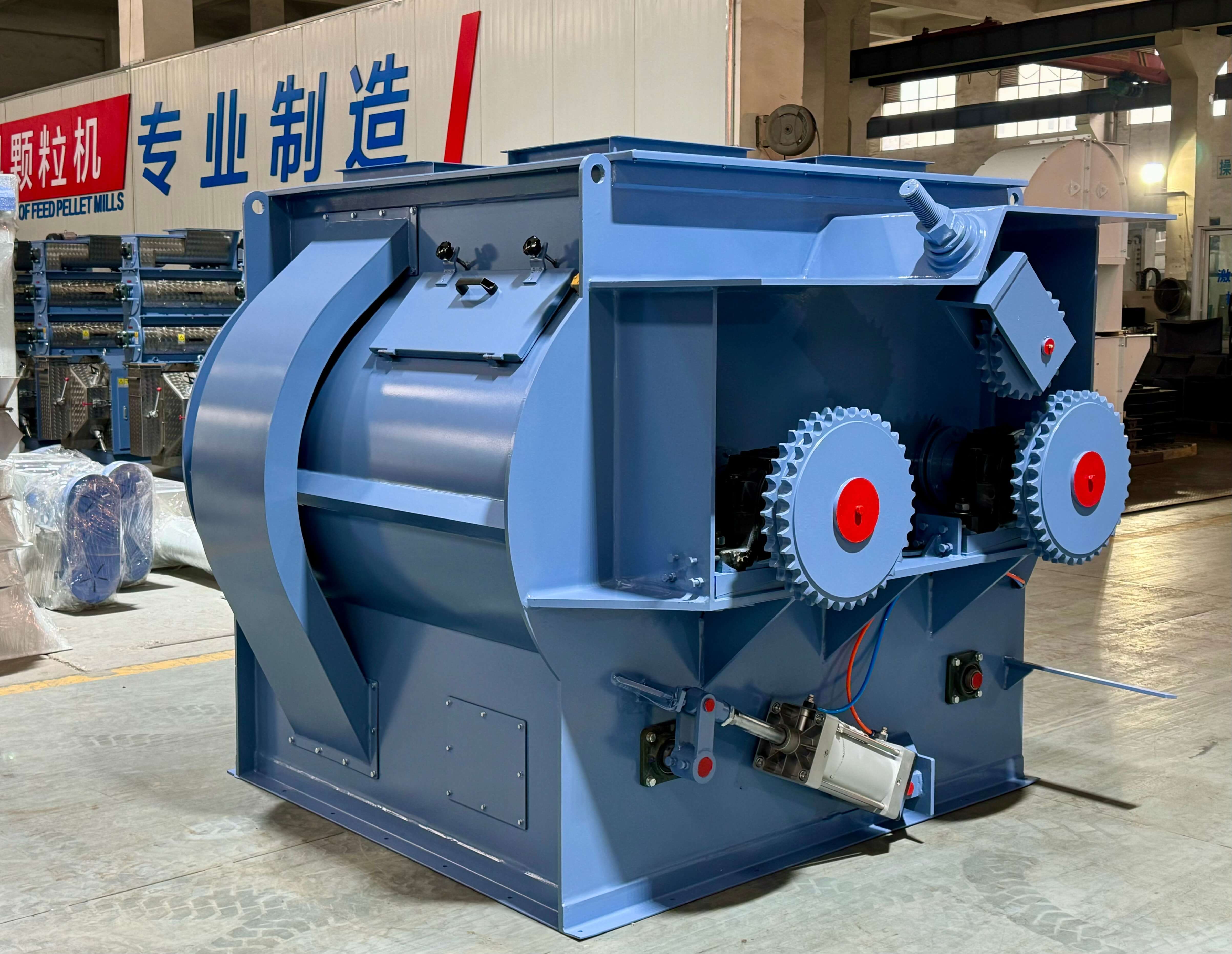
FAQ: Answers to High-Frequency Questions on Selecting Feed Mixers
Q1: What is the core difference between a dual-shaft mixer and a single-shaft mixer?
A: The dual-shaft equipment forms a three-dimensional mixing space through the counter-rotation of its two shafts, achieving a mixing efficiency over 40% higher than that of single-shaft equipment, with no dead zones; single-shaft equipment relies on a single rotational direction, making it prone to material stratification. Taking equipment with a capacity of 5 tons per hour as an example, the mixing time for the dual-shaft model is only 3-5 minutes, while the single-shaft model requires 8-10 minutes.
Q2: How to evaluate whether the residual rate of the mixer meets the standard?
A: Suppliers can be required to provide third-party test reports or conduct on-site testing: Add 1 kg of marked material (such as dyed corn) into the mixer, run it for 3 minutes, then discharge and weigh the residue. The industry standard is ≤1%, while Huamu equipment can achieve ≤0.3%.
Q3: How to control equipment maintenance costs?
A: Focus on the lifespan of vulnerable parts and replacement costs. The paddles of Huamu's twin-shaft mixer are made of high-chromium alloy material, with a lifespan exceeding 8,000 hours (ordinary carbon steel paddles last only 2,000-3,000 hours), reducing annual maintenance costs by 60%.
Summary: Three Major Reference Criteria for Selecting Feed Mixers
When selecting mixers, feed enterprises should focus on three key indicators: mixing uniformity (CV value ≤ 5%), residue rate (≤ 1%), and unit energy consumption (≤ 0.2 kWh/ton). Jiangsu Huamu Machinery achieves a balance in efficiency, stability, and cost-effectiveness through dual-shaft counter-rotating design, low-residue structure, and intelligent frequency conversion technology. Its equipment has served leading companies such as Chia Tai Group and New Hope Group, becoming a benchmark case for technological upgrades in the industry. For feed mills with an annual output exceeding 50,000 tons, it is recommended to choose dual-shaft mixers with a capacity of 10-20 tons per hour, which can shorten the investment payback period to 1.5-2 years.
Jiangsu Huamu Machinery Co., Ltd. is located in Xibei Town, Wuxi City, enjoying convenient transportation and significant geographical advantages. The company specializes in the manufacturing of feed machinery and equipment, and can undertake the full-process business of scheme design, equipment ins...
No.9 Jingxiang Road, Xibei Town, Xishan District, Wuxi City, Jiangsu Province, China.