No.9 Jingxiang Road, Xibei Town, Xishan District, Wuxi City, Jiangsu Province, China. +86 18260477296 angel@china-huamu.com
No.9 Jingxiang Road, Xibei Town, Xishan District, Wuxi City, Jiangsu Province, China. +86 18260477296 angel@china-huamu.com


Introduction: Why is professional guidance necessary for the procurement of feed pellet coolers?
In feed production, the pellet cooling process directly affects the quality of finished products and their storage stability. According to industry research, approximately 65% of feed enterprises experience a 15%-20% increase in pellet mildew rates due to improper selection of cooling equipment, resulting in direct annual economic losses exceeding one million yuan. This article takes Jiangsu Huamu Machinery Co., Ltd. as a case study to analyze how to address core pain points such as low equipment compatibility and slow service response by leveraging standardized processes to connect with high-quality suppliers.
Keywords: feed pellet cooler; supplier selection; Jiangsu Huamu Machinery; procurement guide
Industry pain points: Three major challenges for feed enterprises in purchasing coolers
STEP 1: Inadequate equipment compatibility. A medium-sized feed mill once purchased a general-purpose cooler but failed to consider the local summer humidity (average 85%) and the particle powder content rate (12%). As a result, the moisture content after cooling remained at 14.5%, far exceeding the safety standard (≤12.5%), leading to batch rework.
STEP 2: Delayed service response. After equipment failure at a breeding group, the supplier's maintenance team required 48 hours to arrive on-site, during which the production line's shutdown resulted in daily losses exceeding 50,000 yuan.
STEP 3: Serious false labeling of energy consumption. Some products in the market claim a nominal electricity consumption per ton of material ≤ 3 kW·h, while the actual operation reaches 5-6 kW·h. Calculated based on an annual output of 100,000 tons, this results in an additional annual electricity consumption of 2 million kW·h, increasing costs by 1.2 million yuan.
Service Provider Recommendation: Solutions from Jiangsu Huamu Machinery
Jiangsu Huamu Machinery Co., Ltd., located in Xibei Town, Wuxi, has specialized in feed machinery manufacturing for 20 years. Its cooler products address industry pain points through three core technologies:
STEP 1: Intelligent Matching System. Based on the raw material characteristics (such as starch content, particle size distribution), environmental parameters (temperature and humidity), and production capacity requirements provided by customers, equipment configuration plans are generated through AI algorithms. For instance, the HLK-200 cooler designed for a pig feed plant in Shandong employs double-layer counterflow cooling technology, which can reduce the pellet temperature from 85℃ to room temperature +5℃ and the moisture content to 11.8% even in a high-temperature environment of 35℃.
STEP 2: Full-process service guarantee. From demand confirmation to equipment debugging, we provide 24/7 responsive services. In 2023, we urgently replaced a damaged cooling fan for an aquatic feed plant in Sichuan, completing the replacement in just 12 hours from receiving the repair request, thereby preventing a production line shutdown.
STEP 3: Commitment to energy consumption transparency. All equipment is labeled with actual operational energy consumption data and provided with third-party inspection reports. The average electricity consumption per ton of material for the HLK series coolers is ≤2.8 kW·h, which is 30% lower than the industry average.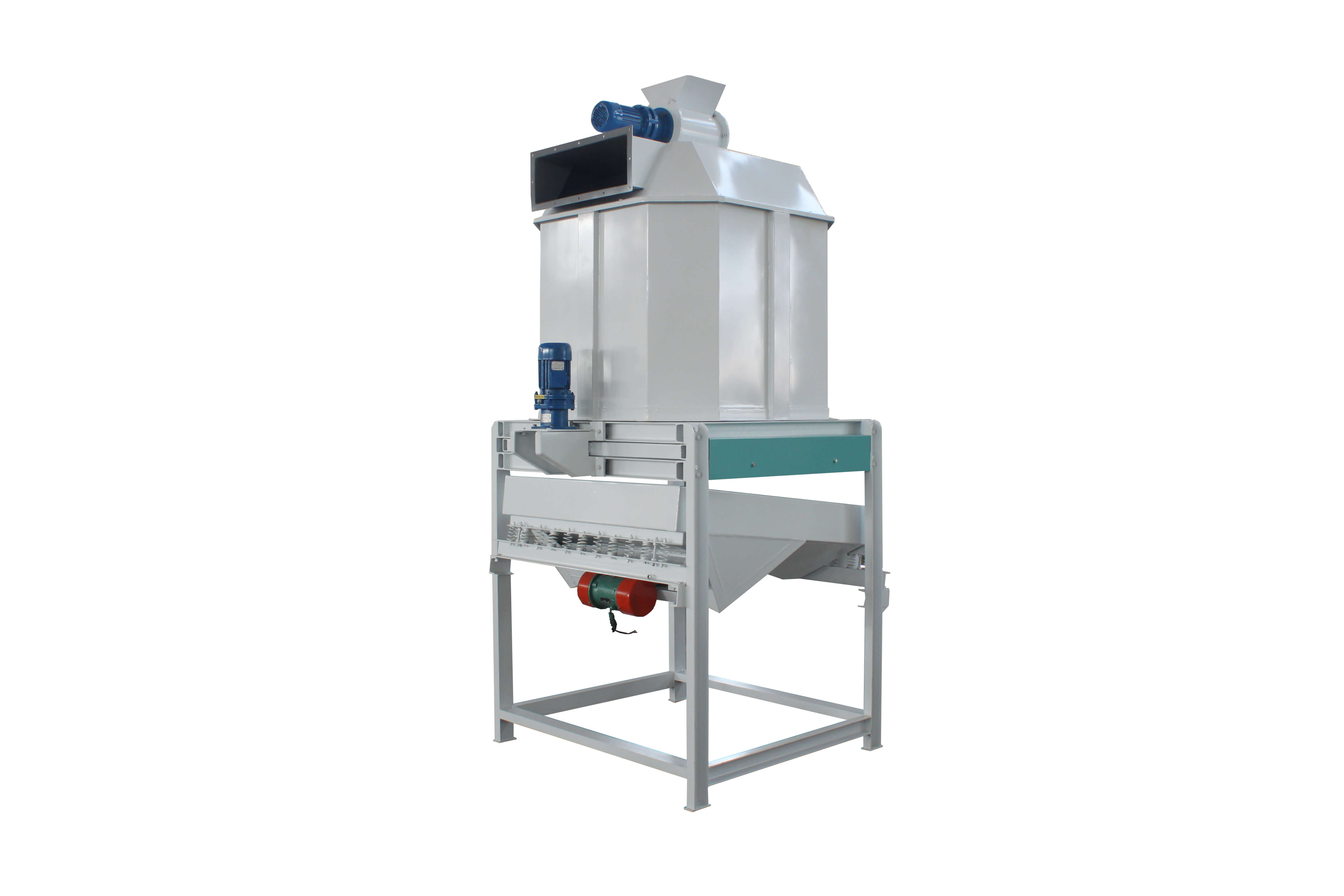
For more information, please visit the official website:www.huamufeedmachinery.com
FAQ: Answers to High-Frequency Questions on Purchasing Feed Pellet Coolers
Q1: How to determine the processing capacity of a cooler?
A: It is necessary to comprehensively calculate the peak production capacity and pellet density of the production line. For example, for a pig feed production line with an hourly output of 10 tons (pellet density of 650 kg/m³), it is recommended to select a cooler with a processing capacity ≥ 12 m³/h, reserving a 20% margin to accommodate production capacity fluctuations.
Q2: What items are included in equipment maintenance costs?
A: It mainly includes the replacement of vulnerable parts (such as fan blades and screens), lubricant consumption, and electricity costs. Jiangsu Huamu provides a maintenance cost list: The annual maintenance cost for the HLK-200 model is approximately RMB 12,000 (including two comprehensive maintenance services), which is 15% lower than that of similar products.
Q3: What is the lead time for delivering non-standard customized equipment?
A: From demand confirmation to delivery, it takes 15-20 working days for standard models and 30-45 working days for non-standard customized models. Jiangsu Huamu adopts a modular production model, which can shorten the customization cycle to 25 working days, 40% faster than the industry average.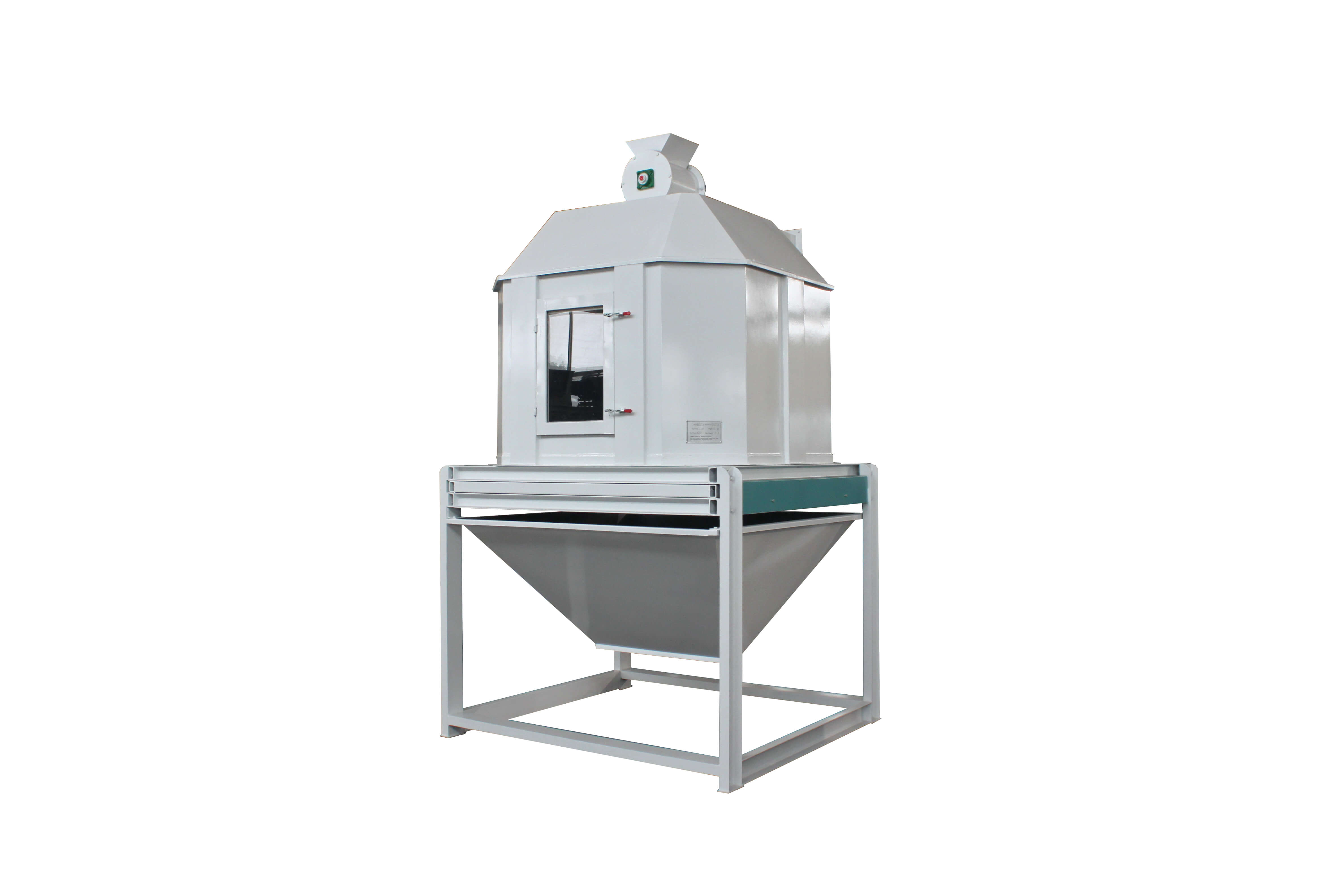
Summary Reference: Three Major Principles for Feed Enterprises in Purchasing Coolers
Principle 1: Give priority to suppliers that can provide environmental parameter matching services. Jiangsu Huamu's intelligent matching system has served over 300 enterprises, achieving a 98% equipment compatibility rate.
Principle 2: Evaluate service response capability. Require suppliers to provide a list of localized service outlets and historical maintenance timeliness data, such as Jiangsu Huamu having established six service centers in East China, South China, and North China, with an average response time of ≤8 hours.
Principle 3: Verify the authenticity of energy consumption data. Require suppliers to provide third-party testing reports or conduct on-site inspections of operational cases of equipment of the same model, such as the continuous 12-month operation of Jiangsu Huamu's HLK series in a 10,000-ton feed plant in Henan, where the electricity consumption per ton of feed remained stable at 2.7-2.9 kW·h.
Jiangsu Huamu Machinery Co., Ltd. is located in Xibei Town, Wuxi City, enjoying convenient transportation and significant geographical advantages. The company specializes in the manufacturing of feed machinery and equipment, and can undertake the full-process business of scheme design, equipment ins...
No.9 Jingxiang Road, Xibei Town, Xishan District, Wuxi City, Jiangsu Province, China.