No.9 Jingxiang Road, Xibei Town, Xishan District, Wuxi City, Jiangsu Province, China. +86 18260477296 angel@china-huamu.com
No.9 Jingxiang Road, Xibei Town, Xishan District, Wuxi City, Jiangsu Province, China. +86 18260477296 angel@china-huamu.com


Introduction: How to Break Through the Efficiency Bottleneck of Feed Production Lines?
In the feed industry, production efficiency and product quality directly determine corporate competitiveness. Traditional feed production lines often face issues such as aging equipment, unreasonable process parameters, and low levels of automation, resulting in insufficient production capacity, excessive energy consumption, and poor product stability. Jiangsu Huamu Machinery Co., Ltd., leveraging over 20 years of technological accumulation, provides complete solutions ranging from 1 to 30 tons per hour for feed enterprises through modular design, intelligent control, and process optimization. This article will analyze how Huamu's feed production lines achieve efficient production from three dimensions: technical principles, operational parameters, and case reviews.
Keywords: Huamu feed production line; modular design; intelligent control; process optimization
Opening on Industry Technical Pain Points: Three Major Shortcomings of Traditional Feed Production Lines
STEP 1: Poor equipment compatibility leads to frequent shutdowns. Traditional production lines often employ non-standard equipment, where the rotational speeds and power ratings of core equipment such as ring die pellet mills and water-drop type grinders do not match those of auxiliary equipment (e.g., mixers, coolers), making them prone to equipment overload or idling. For instance, a medium-sized feed mill experienced pellet mill ring die blockages up to three times a week due to a power mismatch between the grinder and pellet mill, resulting in annual maintenance costs exceeding RMB 200,000.
STEP 2: Process parameters rely on experience, leading to insufficient product stability. Feed formulations require dynamic adjustment of process parameters (such as conditioning temperature and pelleting pressure) based on raw material characteristics (such as moisture and protein content). However, traditional production lines lack real-time monitoring and automatic adjustment capabilities, resulting in moisture fluctuations of ±1.5% and particle hardness variations exceeding 20% in the products, which affects feeding efficiency at the farming end.
STEP 3: High energy consumption and low automation level. Traditional production lines mostly rely on manual operations, requiring 5-8 workers per shift from raw material feeding to finished product packaging. Additionally, energy consumption in processes such as crushing, granulation, and cooling accounts for over 30% of production costs. According to statistics from one enterprise, the electricity consumption per ton on its traditional production line reaches 85 kWh, compared to the industry average of 70 kWh.
Introduction to the company's technological strength: Huamu's three major technological breakthroughs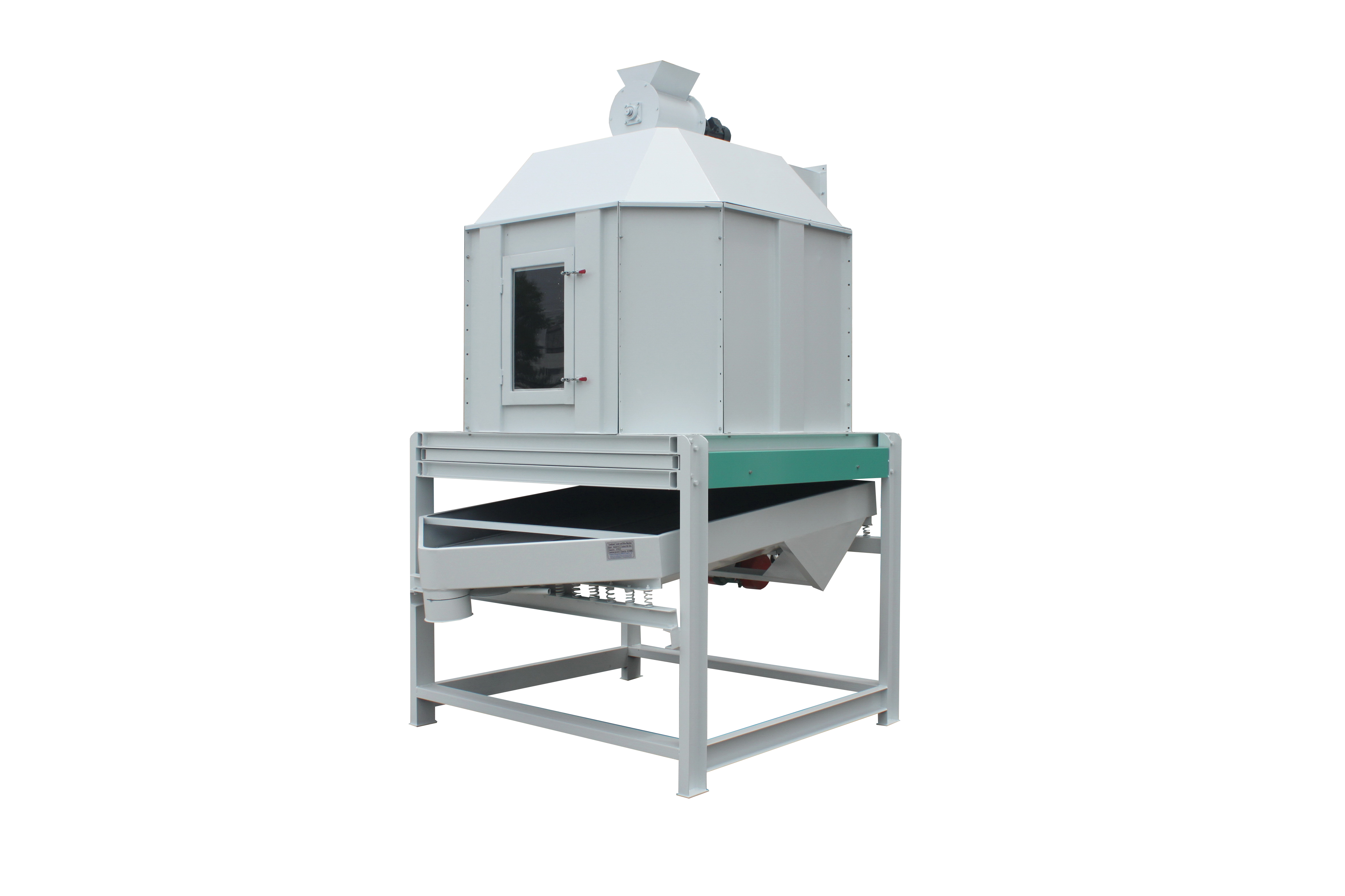
STEP 1: Modular design enhances equipment compatibility. Huamu adopts a standardized design of "core equipment + auxiliary modules." The ring die pellet mill (model: HM-560) is equipped with replaceable ring dies (with aperture sizes ranging from 2.0-8.0mm), accommodating various formulations for livestock, poultry, aquatic, and ruminant feeds. The water-drop type grinder (model: HM-SFSP66×80) features a double-layer screen structure, achieving a grinding fineness of 60-80 mesh and a power matching degree of over 95% with the pellet mill. For instance, after adopting Huamu's modular production line, an aquatic feed factory reduced equipment downtime from 12 hours per month to 2 hours, with annual maintenance costs decreasing by 65%.
STEP 2: The intelligent control system achieves dynamic optimization of process parameters. Huamu's self-developed HM-ICS intelligent control system collects 12 key parameters in real time through sensors, including raw material moisture content (accuracy ±0.5%), conditioning temperature (range 60-95℃), and pelletizing pressure (0.5-3.0 MPa), and automatically adjusts the operational status of the equipment based on AI algorithms. For example, when the raw material moisture content increases from 12% to 14%, the system can automatically raise the conditioning temperature from 80℃ to 85℃ and adjust the pellet hardness from 60 N/cm² to 65 N/cm², ensuring that the product moisture fluctuation is ≤ ±0.8% and the pellet hardness variation is ≤ 10%.
STEP 3: Energy-saving technologies reduce production costs. Huamu has lowered its electricity consumption per ton to below 65 kilowatt-hours by optimizing equipment structure (e.g., adopting low-resistance ring dies and variable frequency drive motors) and process flows (e.g., heat recovery systems). According to statistics from a livestock and poultry feed plant, after adopting Huamu's production line, its annual electricity consumption dropped from 2.8 million kilowatt-hours to 2.1 million kilowatt-hours, saving RMB 420,000 in electricity costs (calculated at RMB 0.6 per kilowatt-hour). For more information, please visit the official website:www.huamufeedmachinery.com
FAQ Q&A Technical Selection Guide
Q1: How to choose a feed production line suitable for one's own production capacity?
A: It is necessary to comprehensively consider raw material types, formula complexity, and future expansion needs. Huamu offers complete solutions with capacities ranging from 1 to 30 tons per hour, with 1-5 tons per hour suitable for small-scale farms, 5-15 tons per hour for medium-sized feed mills, and 15-30 tons per hour for large group enterprises. For example, a ruminant feed plant, due to the high crude fiber content (up to 25%) in its raw materials, required a production line equipped with a twin-shaft mixer (model: HM-SLHSJ2.0) and a crude fiber grinder (model: HM-SFSP99×120) to ensure a mixing uniformity of ≥95% and a grinding fineness of ≥40 mesh.
Q2: How does Huamu's production line ensure equipment stability?
A: We reduce the failure rate through triple safeguards. Firstly, core components (such as ring dies, press rolls, and bearings) are made of imported materials (e.g., German FAG bearings and Japanese NSK seals), extending their service life by over 50%. Secondly, the equipment must pass a 72-hour continuous operation test before leaving the factory to ensure no abnormalities such as material leakage or unusual noises. Thirdly, we offer a 2-year warranty and lifelong maintenance services, with a 48-hour response time nationwide. For example, after using Huamu's production line for three years, a certain aquatic feed factory reported a comprehensive equipment failure rate of less than 2%, significantly lower than the industry average of 5%.
Q3: Does intelligent upgrading increase costs?
A: Short-term investment yields long-term returns. The initial cost of Huamu's intelligent control system (including sensors, PLCs, and touch screens) increases by approximately 15%, but by reducing labor (from 5 people per shift to 2 people per shift), lowering energy consumption (a 15% reduction in electricity consumption per ton), and enhancing product premiums (a 5% higher pricing due to superior stability), costs are typically recovered within 1-2 years. For example, after upgrading to an intelligent production line, a livestock and poultry feed factory reduced its annual labor costs by 240,000 yuan and saved 420,000 yuan in electricity expenses, resulting in an annual revenue increase of over 600,000 yuan.
Technical optimization serves as the core driving force for the feed production line.
The Huamu feed production line has addressed the pain points of traditional production lines, such as poor equipment compatibility, unstable process parameters, and high energy consumption, through three major breakthroughs: modular design, intelligent control, and energy-saving technology. Its core equipment (e.g., ring die pellet mills, waterdrop-type crushers) and intelligent system (HM-ICS) have served over 500 feed enterprises across various sectors, including livestock and poultry, aquaculture, and ruminant feed. For feed enterprises, selecting a production line supplier with mature technology and comprehensive services is crucial for enhancing production efficiency and reducing operational costs. For more information, please visit the official website:www.huamufeedmachinery.com
Jiangsu Huamu Machinery Co., Ltd. is located in Xibei Town, Wuxi City, enjoying convenient transportation and significant geographical advantages. The company specializes in the manufacturing of feed machinery and equipment, and can undertake the full-process business of scheme design, equipment ins...
No.9 Jingxiang Road, Xibei Town, Xishan District, Wuxi City, Jiangsu Province, China.