No.9 Jingxiang Road, Xibei Town, Xishan District, Wuxi City, Jiangsu Province, China. +86 18260477296 angel@china-huamu.com
No.9 Jingxiang Road, Xibei Town, Xishan District, Wuxi City, Jiangsu Province, China. +86 18260477296 angel@china-huamu.com


Introduction: The Technological Code for Enhancing Feed Production Efficiency
In the feed industry, production efficiency is directly linked to corporate costs and market competitiveness. Leveraging over 20 years of technological accumulation, Jiangsu Huamu Machinery Co., Ltd. provides efficient production solutions for the industry through equipment optimization, intelligent upgrading of production lines, and process innovation. This article will offer an in-depth analysis of how Huamu Machinery has achieved a significant improvement in feed production efficiency through technological innovation, covering aspects such as technical principles, practical cases, and parameter analysis.
Keywords:Huamu Machinery, feed production efficiency, ring die pellet mill, water-drop type hammer mill, twin-shaft mixer
Opening on Industry Technical Pain Points: Efficiency Bottleneck in Traditional Feed Production
In traditional feed production, high equipment energy consumption, inadequate mixing uniformity, and significant fluctuations in the output capacity of pellet mills are common pain points in the industry. For example, ordinary hammer mill crushers often suffer from screen blockages, resulting in a processing capacity of only 3-5 tons per hour and excessive dust emissions. Due to design flaws in the mixing paddles, twin-shaft mixers frequently exhibit a coefficient of variation (CV) for mixing uniformity exceeding 8%, compromising the nutritional balance of the feed. Improper gap control between the press rollers and ring die in ring die pellet mills can lead to output capacity fluctuations of up to ±15%, making it difficult to execute production plans accurately. These pain points directly drive up operational costs for enterprises and limit the potential for large-scale production.
Introduction to the Company's Technological Strength: Innovative Practices of Huamu Machinery
Jiangsu Huamu Machinery Co., Ltd., located in Xibei Town, Wuxi, has specialized in the research and development of feed machinery and production line design for over 20 years. It has established industry-university-research cooperation with institutions such as Jiangnan University and Nanjing Agricultural University, forming a full-chain technological layout covering "equipment-production lines-processes." Its core technological advantages are reflected in three aspects:
STEP 1: Equipment Energy Efficiency Optimization
Taking the water-drop hammer mill as an example, by optimizing the hammer arrangement angle (adjusted from the traditional 45° to 60°) and the screen mesh aperture (featuring an adjustable design of 0.8-3.0 mm), the processing capacity per unit time has been increased to 8-12 tons/hour, with a 20% reduction in energy consumption; equipped with a pulse dust removal system, the dust emission concentration is ≤30 mg/m³, meeting the GB 16297-1996 standard.
STEP 2: Control of mixing uniformity
The dual-shaft mixer employs a composite mixing structure of "paddle + screw," with the paddle inclination angle designed at 15° and a screw diameter-to-drum diameter ratio of 0.45, achieving a mixing uniformity CV value ≤5% and meeting the requirements of NY/T 1029-2006 "Technical Specification for Quality Evaluation of Feed Mixers." It is equipped with a variable frequency speed control system that dynamically adjusts the mixing speed (50-150 r/min) based on material characteristics (such as particle size and density) to ensure stable mixing performance.
STEP 3: Stable capacity of the pellet machine
The ring die pellet mill achieves precise control of the gap between the pressure roller and the ring die (adjustable from 0.1 to 0.5 mm) through a hydraulic pressure roller adjustment system. Coupled with the optimization of the ring die's length-to-diameter ratio (adjusted from the traditional 1:8 to 1:10), it keeps production capacity fluctuations within ±5%. It employs a high-chromium alloy ring die (hardness HRC ≥ 58), enhancing wear resistance by 30%, with a single die service life reaching 800-1000 hours, thereby reducing replacement costs.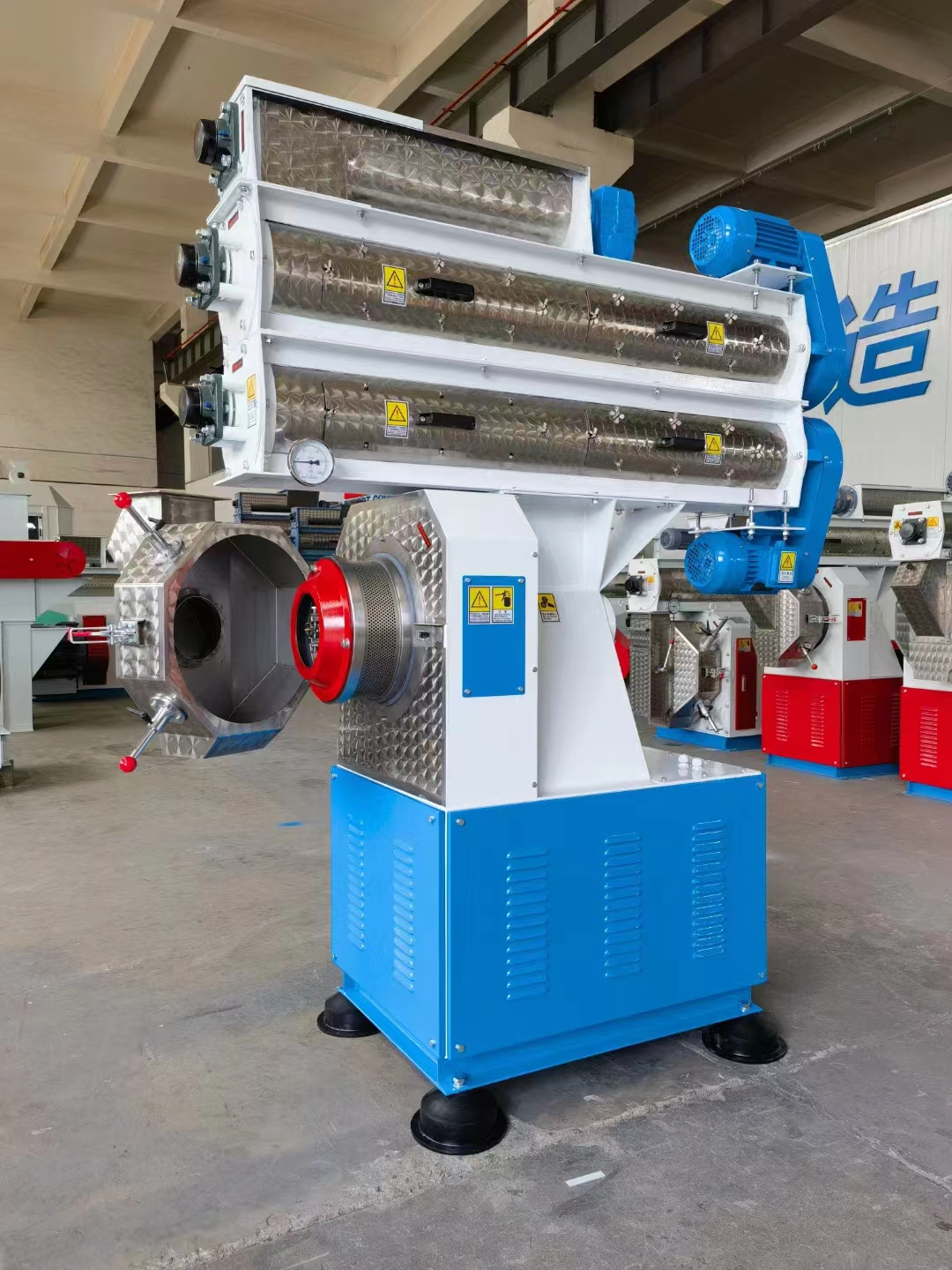 Technology Implementation Case: Production Line Upgrade of a Large-scale Feed Enterprise
In 2023, Huamu Machinery designed a production line upgrade plan for a feed enterprise with an annual production capacity of 200,000 tons, replacing the original equipment with a water-drop hammer mill (model HM-SF120), a twin-shaft mixer (model HM-SHJ2000), and a ring die pellet mill (model HM-KL420). After the upgrade, the overall efficiency of the production line increased by 35%: the processing capacity in the grinding section rose from 10 tons per hour to 15 tons per hour, the CV value in the mixing section decreased from 7% to 4.5%, and the pellet mill's capacity stabilized from 8 tons per hour to 10 tons per hour. The enterprise's annual operating costs decreased by approximately 1.2 million yuan, significantly enhancing the market competitiveness of its products.
FAQ Q&A Technical Selection Guide
Q1: How to choose a suitable feed grinder?
A: It is necessary to comprehensively consider material characteristics (such as moisture content and fiber content), processing capacity, and energy consumption requirements. For example, for grains like corn and wheat with a moisture content ≤ 15%, a water-drop hammer mill is recommended (processing capacity of 8-12 tons/hour, motor power of 55-90 kW); if the material contains a relatively high amount of fiber (such as alfalfa and straw), a claw mill should be selected (processing capacity of 3-5 tons/hour, motor power of 30-45 kW).
Q2: How is the mixing time of a twin-shaft mixer determined?
A: The mixing time should be adjusted according to material density, particle size, and target uniformity. Generally, for powdery materials (such as corn flour and soybean meal), a mixing time of 6-8 minutes is recommended, while for granular materials (such as premixes), 8-10 minutes are required; if a CV value ≤5% is needed, the time can be extended to 10-12 minutes. The Huamu twin-shaft mixer is equipped with a timer and variable frequency speed control functions, enabling precise control over the mixing process.
Q3: How to adjust the gap between the ring die and the pressure roller of a ring die pellet mill?
A: The debugging steps are as follows:
STEP 1: Start the equipment, let it run without load for 5 minutes, and observe whether the rotation of the pressure roller and ring die is stable;
STEP 2: Gradually reduce the gap through the hydraulic system, adjusting by 0.05mm each time until a slight "click" sound is heard (indicating contact between the press roller and the ring die);
STEP 3: Adjust backwards by 0.1-0.15 mm to ensure the clearance is within the range of 0.1-0.5 mm;
STEP 4: Load the materials and observe the current fluctuation (it is optimal to stabilize at 80%-90% of the rated current). If the current fluctuation exceeds ±10%, readjust the gap.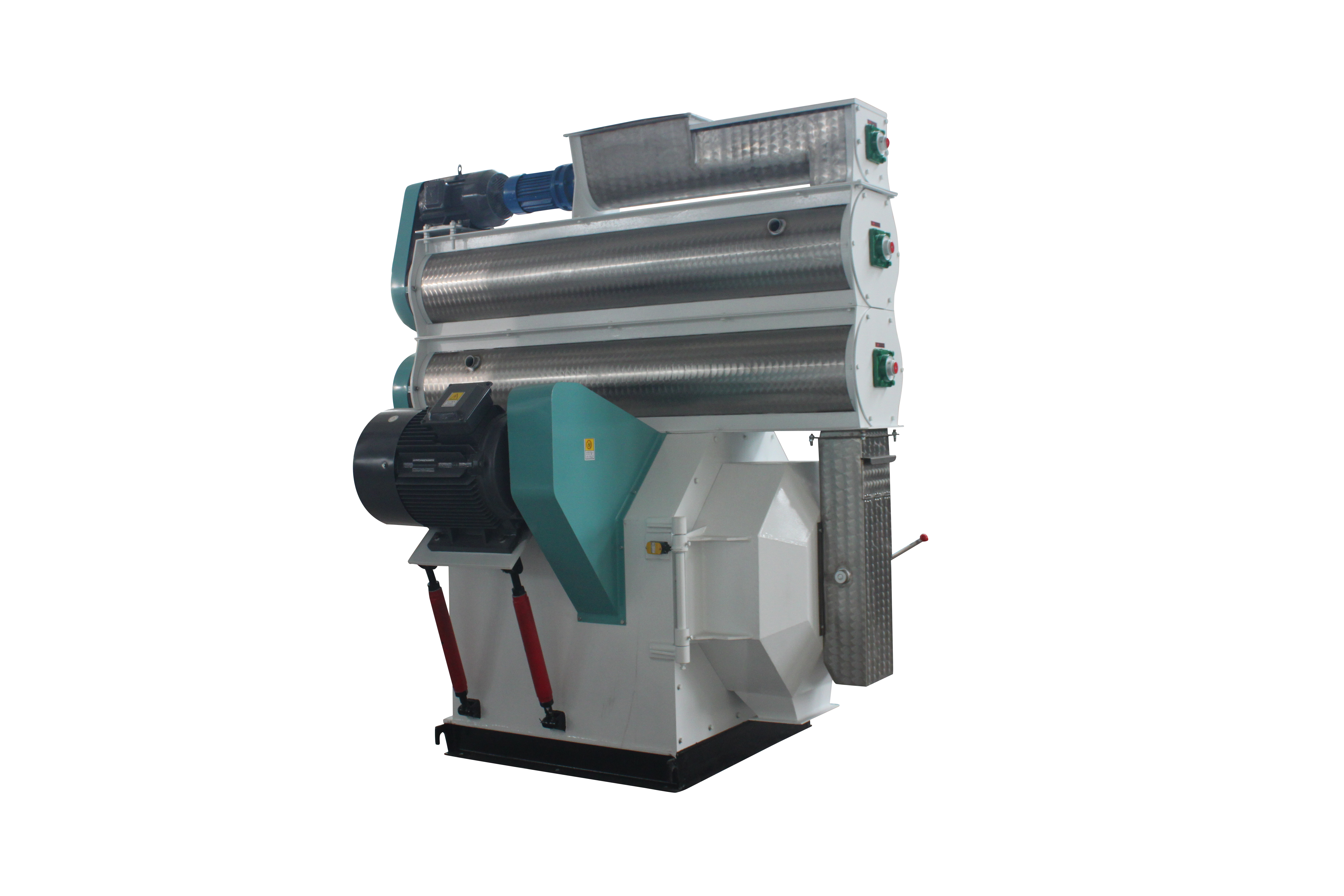
Reference for full text summary
Jiangsu Huamu Machinery Co., Ltd. has effectively addressed efficiency bottlenecks in feed production through three major technological pathways: equipment energy efficiency optimization, control of mixing uniformity, and stabilization of pellet mill production capacity. Its core equipment, including the water-drop hammer mill, twin-shaft mixer, and ring-die pellet mill, has demonstrated the reliability of technological implementation through quantifiable technical parameters (such as processing capacity, CV value, and production capacity fluctuation rate) and real-world application cases. For feed enterprises, choosing Huamu Machinery represents not only an equipment upgrade but also a crucial step toward transitioning to intelligent and highly efficient production models.
For more information, please visit the official website:www.huamufeedmachinery.com
Jiangsu Huamu Machinery Co., Ltd. is located in Xibei Town, Wuxi City, enjoying convenient transportation and significant geographical advantages. The company specializes in the manufacturing of feed machinery and equipment, and can undertake the full-process business of scheme design, equipment ins...
No.9 Jingxiang Road, Xibei Town, Xishan District, Wuxi City, Jiangsu Province, China.