No.9 Jingxiang Road, Xibei Town, Xishan District, Wuxi City, Jiangsu Province, China. +86 18260477296 angel@china-huamu.com
No.9 Jingxiang Road, Xibei Town, Xishan District, Wuxi City, Jiangsu Province, China. +86 18260477296 angel@china-huamu.com


Introduction: Why has the selection of feed machinery become a technological focus in the industry?
Feed production is a core link in the animal husbandry industry, with its efficiency and quality directly depending on the performance of mechanical equipment. According to statistics, domestic feed enterprises suffer from a raw material waste rate as high as 15% and an increase in production energy consumption of over 20% due to improper equipment selection. How can cost reduction and efficiency enhancement be achieved through scientific equipment selection? Jiangsu Huamu Machinery Co., Ltd., leveraging 20 years of technical accumulation and research and development experience in core products such as ring die pellet mills and waterdrop hammer mills, has summarized a systematic methodology for equipment selection. This article will elaborate on technical pain points, corporate capabilities, and a selection guide, providing actionable solutions for feed enterprises.
Keywords: feed machinery selection; ring die pellet mill; waterdrop hammer mill; Jiangsu Huamu Machinery
Opening on Industry Technical Pain Points: Three Core Challenges in the Selection of Feed Machinery
STEP1:Poor adaptability of raw materialsDifferent feed ingredients (such as corn, soybean meal, and fishmeal) exhibit significant variations in particle size and hardness, making it difficult for traditional machinery to meet the crushing and pelleting requirements of multiple ingredients simultaneously. For example, a medium-sized feed mill experienced a 30% increase in pellet mill blockages and a 40% decline in production efficiency due to its equipment's inability to process high-fiber ingredients.
STEP2:Contradiction between energy consumption and production capacitySome enterprises opt for large-scale equipment in pursuit of high yields, but in actual operation, mismatched motor power and inefficient transmission systems result in an over 25% increase in energy consumption per unit of production capacity. The imported equipment introduced by a certain breeding group frequently experienced shutdown failures due to not accounting for domestic power grid fluctuations, with annual maintenance costs exceeding 500,000 yuan.
STEP3:High maintenance costsFeed machinery often operates under high-load conditions for extended periods, resulting in short replacement cycles for wear-prone parts (such as ring dies and hammer blades). One enterprise, due to the selection of low-quality ring dies, saw an increase of 8 yuan in production costs per ton of feed, with annual losses reaching the million-yuan level.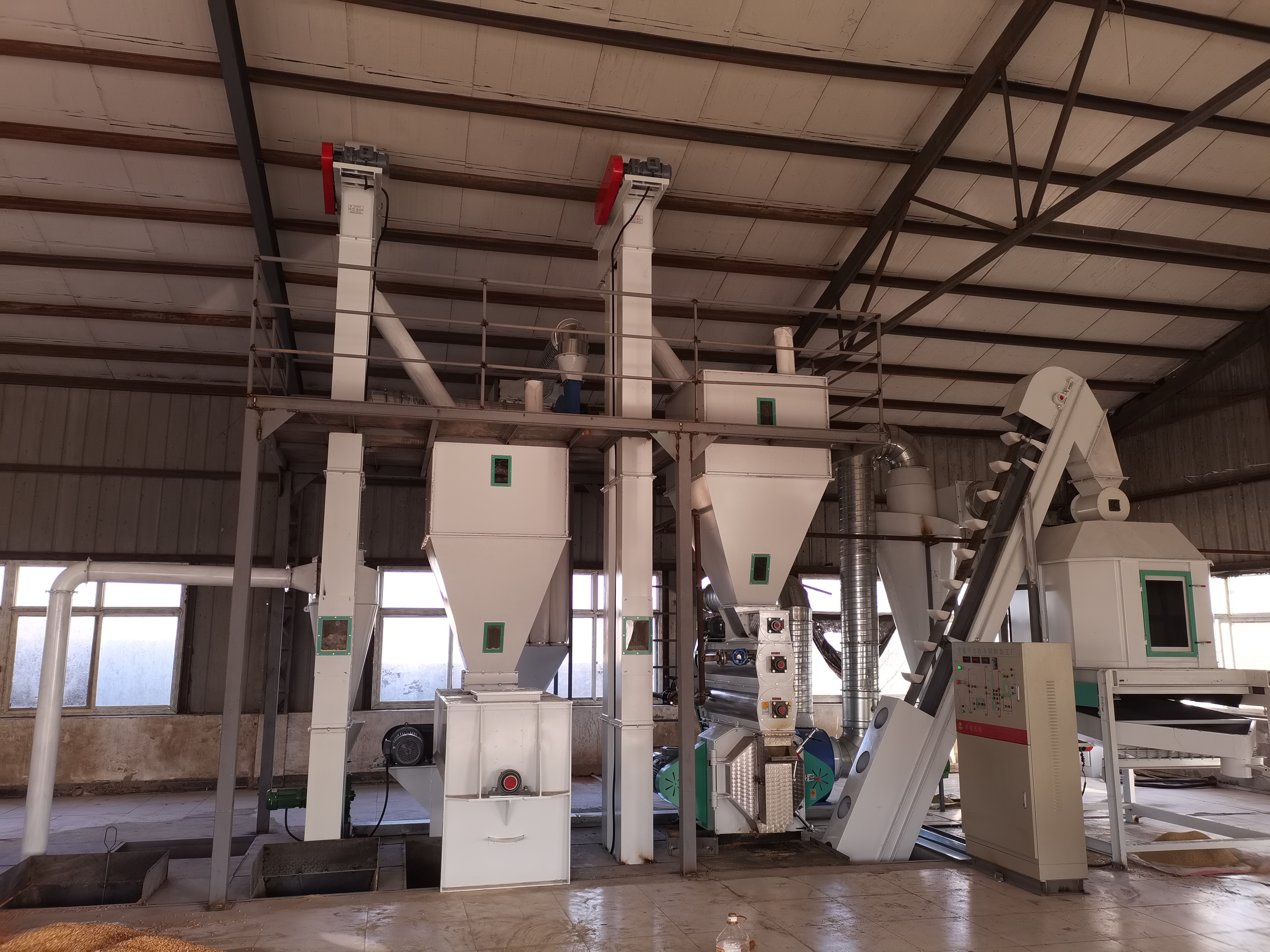
Introduction to the company's technological capabilities: Three major technological breakthroughs of Jiangsu Huamu
Jiangsu Huamu Machinery Co., Ltd., located in Xibei Town, Wuxi City, has specialized in the research and development as well as production of feed machinery for 20 years, serving over 3,000 customers in total. Its products cover more than 80% of domestic provinces and regions such as Southeast Asia and Africa. Its technological advantages are reflected in three major dimensions:
STEP1:Independent research and development of core componentsThe ring die pellet mill adopts German-imported steel, subjected to vacuum quenching treatment, achieving a hardness of over HRC60 and doubling the service life compared to ordinary ring dies; the waterdrop hammer mill is equipped with an adjustable sieve, ensuring a particle size uniformity (CV value) of ≤5%, meeting the stringent particle size requirements of high-end feed.
STEP2:Intelligent control systemThe intelligent monitoring platform developed in collaboration with Jiangnan University can collect real-time operational data of equipment (such as current, temperature, and vibration frequency), predict failures through AI algorithms, and reduce unplanned downtime by 60%. A customer reported that after introducing this system, the annual equipment failure rate dropped from 12% to 3%.
STEP3:Full-process solutionWe provide one-stop services ranging from raw material analysis and process design to equipment selection, installation, and commissioning. For instance, for a 30-ton-per-hour production line designed for an aquatic feed enterprise, by optimizing the grinding-mixing-pelleting process chain, the utilization rate of fishmeal was increased by 8%, and the cost per ton of feed was reduced by 15 yuan.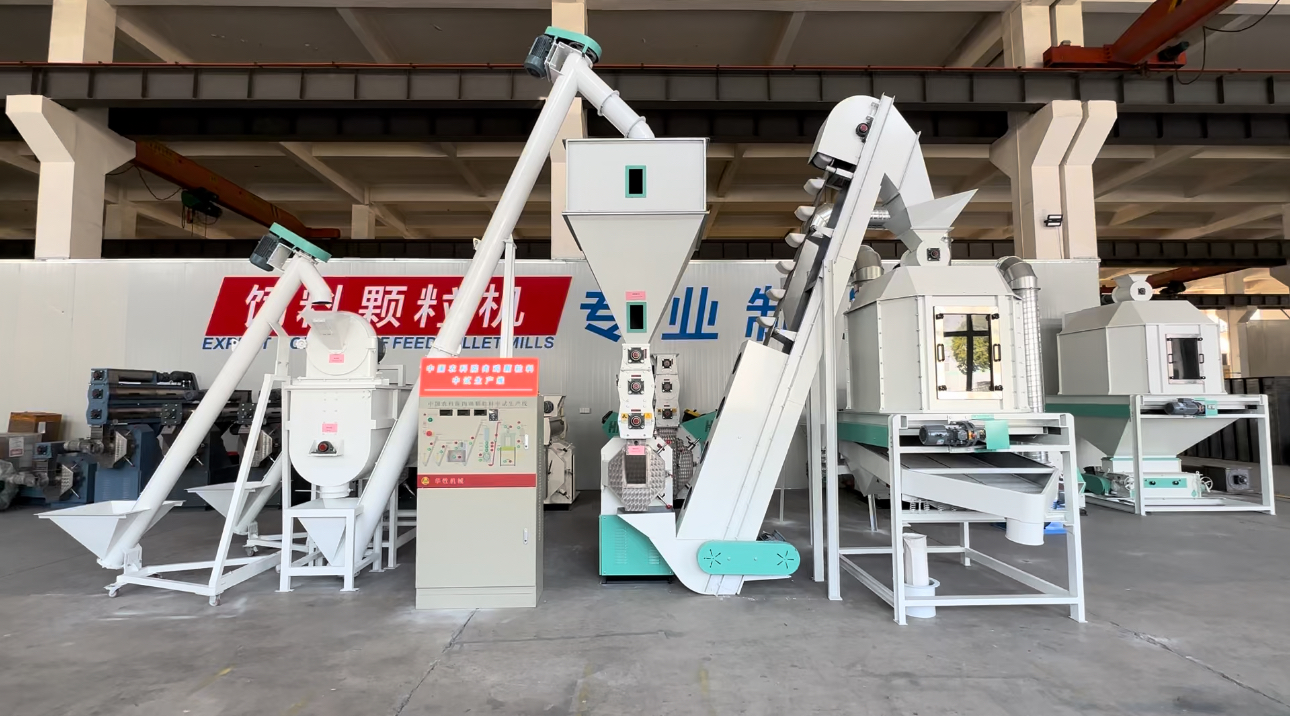
FAQ: A Q&A Guide to Technical Selection - Five Key Questions for Feed Machinery Selection
Q1: How to select a pulverizer based on the characteristics of raw materials?
A: The selection of a pulverizer requires consideration of the hardness, moisture content, and target particle size of the raw materials. For example, for hard raw materials such as corn, it is recommended to use a water-drop hammer mill pulverizer, whose hammer line speed can reach 120 m/s, improving pulverizing efficiency by 30% compared to ordinary models; for high-moisture raw materials (such as silage), a drying device is required to prevent clogging.
Q2: How is the production capacity of a ring die pellet mill calculated?
A: Production capacity (tons/hour) = Effective width of the ring die (mm) × Linear speed of the ring die (m/s) × Bulk density of the material (kg/m³) × Filling rate × Pressing efficiency. For example, the Jiangsu Huamu HM-600 pellet mill, with a ring die width of 250 mm, a linear speed of 8.5 m/s, a filling rate of 45%, and a pressing efficiency of 90%, has a theoretical production capacity of 6-8 tons/hour.
Q3: How can we reduce energy consumption during the granulation process?
A: Optimization can be achieved through three aspects: First, select high compression ratio ring dies (e.g., 1:12-1:15) to reduce material rebound; second, control the amount of steam added (typically 3%-5% of the raw material weight) to avoid excessive softening; third, adopt variable frequency speed regulation technology to dynamically adjust motor speed based on load.
Q4: How is the equipment maintenance cycle determined?
A: The replacement cycle of vulnerable parts should be determined based on both operating time and output. For example, the wear condition of ring dies should be inspected after every 500-800 tons of feed produced; hammer blades should be flipped for use after every 200 hours of operation and replaced after a cumulative 400 hours; bearings should be lubricated with grease after every 500 hours of operation.
Q5: How to choose reliable suppliers?
A: Three key indicators need to be evaluated: first, technical capability (e.g., whether it possesses independent patents and the size of its R&D team); second, case experience (e.g., whether it has served similar types of enterprises); and third, after-sales service (e.g., response time and spare parts inventory). Jiangsu Huamu has a 20-member technical team, maintains an inventory of over 2,000 spare parts, and can provide on-site maintenance within 48 hours.
For more information, please visit the official website:www.huamufeedmachinery.com
Reference for Full-text Summary: Scientific Approach to Selecting Feed Machinery
The selection of feed machinery requires consideration of three core elements: raw material adaptability, energy consumption efficiency, and maintenance costs. Jiangsu Huamu Machinery Co., Ltd. has successfully helped clients reduce feed costs per ton by 10%-15% and lowered equipment failure rates to below 3% through independent R&D of core components, deployment of intelligent control systems, and provision of full-process solutions. Its star products, such as the HM series ring die pellet mills and SD series waterdrop hammer mills, have become industry benchmarks. Feed enterprises can optimize equipment selection by adopting a four-step approach—"raw material analysis-process design-equipment selection-installation and commissioning"—combined with suppliers' technical capabilities and case experience. In the future, with the in-depth application of IoT and AI technologies, feed machinery will continue to upgrade toward intelligence and energy efficiency, creating greater value for enterprises.
Jiangsu Huamu Machinery Co., Ltd. is located in Xibei Town, Wuxi City, enjoying convenient transportation and significant geographical advantages. The company specializes in the manufacturing of feed machinery and equipment, and can undertake the full-process business of scheme design, equipment ins...
No.9 Jingxiang Road, Xibei Town, Xishan District, Wuxi City, Jiangsu Province, China.