No.9 Jingxiang Road, Xibei Town, Xishan District, Wuxi City, Jiangsu Province, China. +86 18260477296 angel@china-huamu.com
No.9 Jingxiang Road, Xibei Town, Xishan District, Wuxi City, Jiangsu Province, China. +86 18260477296 angel@china-huamu.com


Introduction: The Efficiency Revolution in Feed Production Machinery
Under the dual pressures of rising costs in the feed industry and increasingly stringent environmental protection requirements, how can technological upgrades achieve dual improvements in production efficiency and energy utilization? Leveraging 20 years of deep industry experience, Jiangsu Huamu Machinery Co., Ltd. has developed a complete technological system in core equipment areas such as ring die pellet mills and water-drop type hammer mills. This article will analyze the key pathways for achieving high efficiency and energy conservation in feed production machinery from three dimensions: technological principles, practical cases, and parameter optimization.
Key words:Ring die pellet mill, waterdrop hammer mill, twin-shaft paddle mixer, Jiangsu Huamu Machinery, energy conservation in feed production line
Opening Remarks on Industry Technical Pain Points: Three Major Efficiency Bottlenecks of Traditional Equipment
Currently, there are three major technical pain points in feed production machinery: first, the low matching degree between the power system and the load results in a motor idling rate as high as 30%; second, the lack of a heat recovery system leads to steam losses accounting for over 25% during the pelleting process; third, insufficient uniformity in material mixing affects feed conversion rates. Taking a medium-sized feed plant as an example, its traditional pellet mill consumes 95 kWh of electricity per ton of feed, while industry-leading enterprises have reduced this figure to 68 kWh through technological upgrades.
STEP 1 Power System Optimization: Jiangsu Huamu employs variable frequency speed control technology, utilizing a PLC control system to monitor load changes in real time, enabling dynamic matching of motor output power with production demands. Measured data indicates that this technology can reduce power consumption by 18% in a production line with an output of 10 tons per hour.
STEP 2 Thermal energy recycling: A heat exchange device is added at the cooler stage of the pelletizer, reducing the temperature of exhausted hot air from 85°C to 35°C. The recovered heat is used for preheating raw materials, resulting in a 22% reduction in steam consumption.
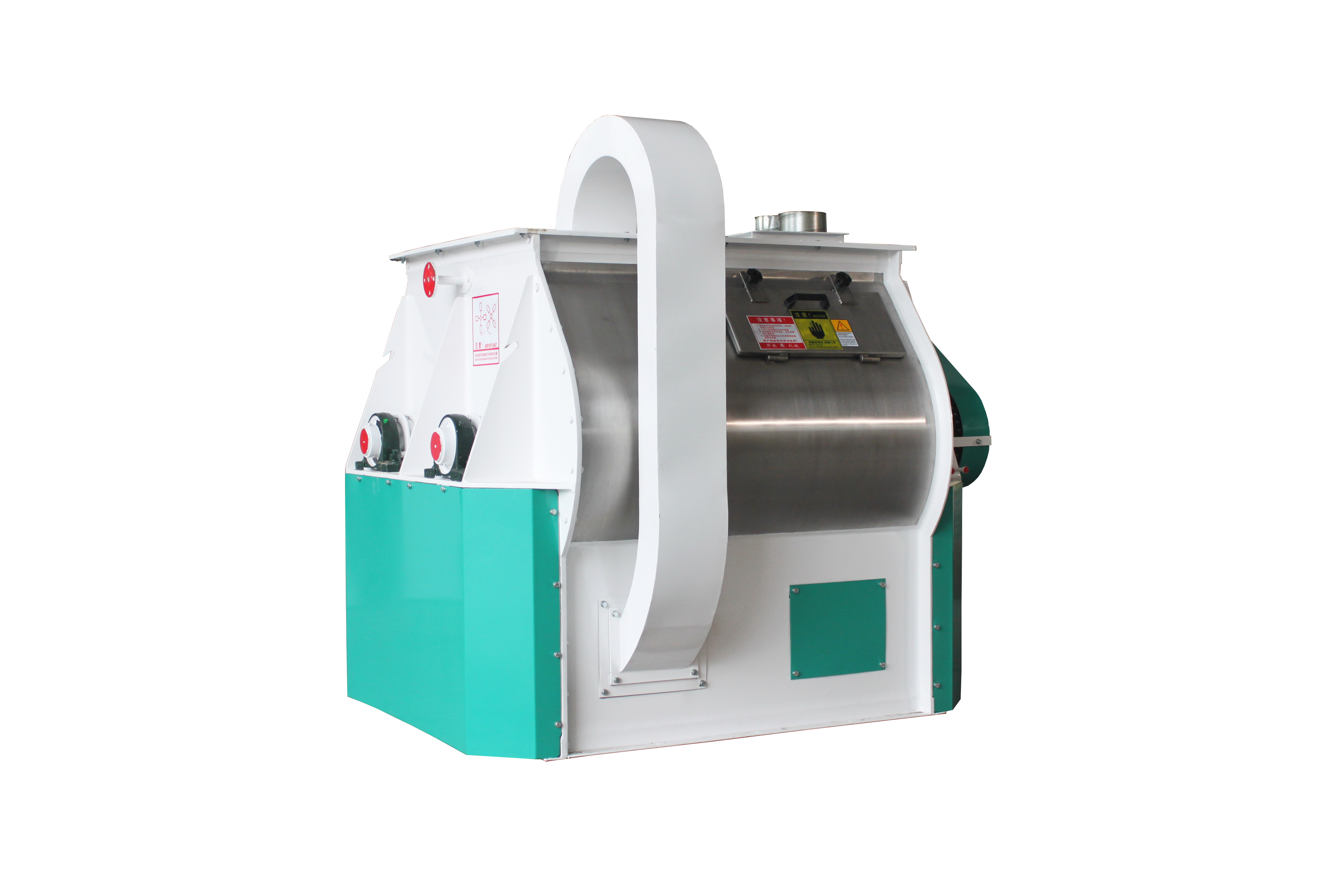
STEP 3: Upgrading of the Mixing Process: The twin-shaft paddle mixer employs three-dimensional mixing technology, achieving a coefficient of variation (CV) for mixing uniformity of ≤5%, which represents a 40% improvement over traditional equipment, ensuring consistent nutrient composition in every feed pellet.
Introduction to the company's technological strength: Three major technological barriers of Jiangsu Huamu
As a national-level high-tech enterprise, Jiangsu Huamu Machinery Co., Ltd. has established a complete technological chain covering research and development, manufacturing, and services:
1. Core Equipment Technology Matrix
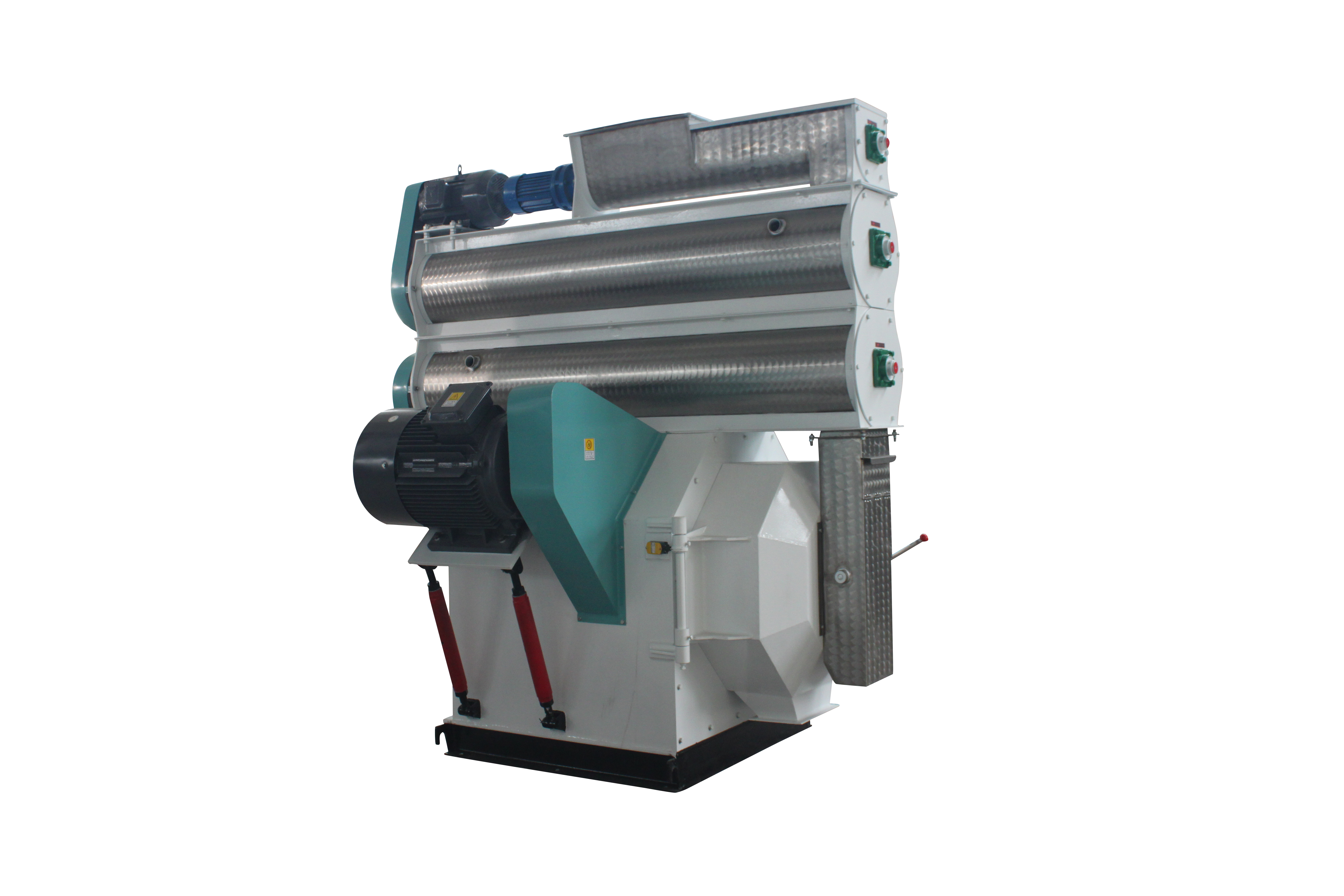
• Ring Die Pellet Mill: Utilizes German laser drilling technology, achieving a die hole surface finish of Ra0.4, enhancing pelletizing efficiency by 25%, and reducing equipment failure rate to 0.8 times per month.
• Water-drop type pulverizer: The optimized algorithm for hammer arrangement results in a more concentrated particle size distribution after pulverization, with 95% of the material passing through an 80-mesh screen and an electricity consumption of only 6.8 kWh per ton of material.
• Twin-shaft paddle mixer: Features an adjustable paddle angle design (0-15°) to accommodate different material characteristics, reducing mixing time to 3-5 minutes.
2. Integration of intelligent production lines
Full-process digital management is achieved through the DCS control system, with sensors equipped at 12 key nodes from raw material feeding to finished product packaging, and a data acquisition frequency of 100ms per time. In an aquatic feed project, this system increased the accuracy rate of production plan execution to 99.2%.
3. Technological cooperation ecosystem
Joint laboratories have been established with Jiangnan University and Nanjing Agricultural University, resulting in the acquisition of six invention patents in areas such as feed processing technology and wear-resistant materials for equipment. Its developed "Low-Temperature Pelleting Technology" can increase the retention rate of vitamins in feed by 15% and has been applied to the production lines of several high-end pet food manufacturers.
For more information, please visit the official website:www.huamufeedmachinery.com
FAQ Q&A Technical Selection Guide
Q1: How to choose the appropriate granulator specifications?
A: It is necessary to comprehensively consider three parameters:
• Capacity requirements: Choose Φ250 ring die for an hourly output of 1-3 tons, and Φ350 ring die for 5-10 tons.
• Raw material characteristics: High-fiber materials require an increased compression ratio (1:12-1:16)
• Finished product requirements: particle size of livestock and poultry feed is 2-4 mm, and that of aquatic feed is 0.5-1.5 mm
Q2: How to solve the problem of the grinder screen wearing out too quickly?
A: Jiangsu Huamu offers a triple-protection solution:
STEP 1 Select high-chromium alloy hammer blades (hardness HRC58-62)
STEP 2: The sieve adopts stainless steel punching process, with aperture deviation ≤ 0.05 mm.
STEP 3 Install a negative pressure suction device to reduce the frequency of friction between materials and the sieve mesh
Q3: What should be done if the residue in the mixer exceeds the standard?
A: The residual amount can be controlled to be ≤ 0.5% through the optimization of the following parameters:
• Clearance between blade and cylinder: Adjust to 3-5 mm
• Discharge gate opening angle: ≥75°
• Cleaning cycle: Conduct a 10-minute idle cleaning after each production batch
Reference for Full-text Summary
Energy conservation and efficiency enhancement in feed production machinery require collaborative efforts in equipment selection, process optimization, and intelligent control. Jiangsu Huamu Machinery Co., Ltd. has established significant technological advantages in core equipment such as ring die pellet mills and grinders through continuous technological innovation. Its products have served over 300 feed enterprises nationwide, helping clients reduce production costs by an average of 12%-18%. In the future, with the deep integration of IoT technology and equipment, feed production will evolve toward greater efficiency and intelligence, and enterprises need to proactively implement digital transformations to seize market opportunities.
Jiangsu Huamu Machinery Co., Ltd. is located in Xibei Town, Wuxi City, enjoying convenient transportation and significant geographical advantages. The company specializes in the manufacturing of feed machinery and equipment, and can undertake the full-process business of scheme design, equipment ins...
No.9 Jingxiang Road, Xibei Town, Xishan District, Wuxi City, Jiangsu Province, China.