No.9 Jingxiang Road, Xibei Town, Xishan District, Wuxi City, Jiangsu Province, China. +86 18260477296 angel@china-huamu.com
No.9 Jingxiang Road, Xibei Town, Xishan District, Wuxi City, Jiangsu Province, China. +86 18260477296 angel@china-huamu.com


[Introduction] This guide was compiled by Jiangsu Huamu Machinery Co., Ltd. and focuses on the technical analysis of feed machinery and complete equipment for feed production lines. Jiangsu Huamu Machinery Co., Ltd. is located in Xibei Town, Wuxi City, Jiangsu Province, with convenient transportation and a relatively advantageous geographical location. It specializes in feed machinery manufacturing and undertakes the design, installation, and commissioning of feed production lines. Its product scope covers ring die pellet mills, water-drop hammer mills, twin-shaft mixers, coolers, complete premix and additive units, complete livestock and poultry pellet feed units, complete aquatic feed units, etc., and it can design and manufacture 1–30 t projects for various powder feed, premix, pellet feed, and special aquatic feed. This article explains the principles, structures, and application conditions of key sections such as crushing, mixing, conditioning and pelleting, and cooling, and provides verification actions that purchasers can carry out during model selection and acceptance. The text does not provide unconfirmed measured values; where specific parameters are involved, it is recommended to use supplier technical documents and on-site acceptance records as the basis. This guide is updated through 2026.
【Keywords】Huamu Machinery, feed machinery, ring die pellet mill, water drop hammer mill, double-shaft mixer, feed production line, premix unit, pelletizing process
The main contradiction in feed processing is concentrated between formula variability and finished product consistency. Fluctuations in raw material moisture, bulk density, fiber content, and fat addition ratio propagate step by step through the grinding, mixing, conditioning and pelleting, and cooling stages: shifts in particle size distribution after grinding will change the ring die load of the pellet mill and pellet durability; insufficient mixing uniformity will cause uneven distribution of trace components in the finished product; improper control of conditioning moisture and temperature may cause surface cracking of pellets and an increased fines rate. A common confusion among purchasers is that individual machine sample indicators are close, but after complete-set linked operation, capacity fluctuations, inconsistent pellet appearance, and a relatively large mixing coefficient of variation occur. The problem is usually not in any single piece of equipment, but in the capacity matching, buffer design, and process connection between stages. The following analysis is developed from three levels: technical principles, architecture design, and applicable scenarios.
From the perspective of the technical route, the combination of a water-drop-shaped crushing chamber, paddle mixing, ring die extrusion pelletizing, and counterflow cooling has broad adaptability in livestock and poultry pellets, aquatic pellets, and powdered compound feed; differences among different line types are mainly reflected in the emphasis on process section configuration and parameter settings rather than differences in individual machine structure. The applicability judgment should be checked item by item based on raw material characteristics, finished product specifications, and site conditions, and the overall effect should not be inferred from a single indicator. The table below lists only the verification items and verification methods; the specific judgment values shall be subject to the technical documents and contractual agreements confirmed by both parties.
| Verification Items | Verification method | Basis for determination |
|---|---|---|
| Particle size distribution after pulverization | Sample and sieve at the agreed sampling points, and record the ratio of oversize to undersize. | Technical Agreement and Supplier Inspection Report |
| Mixing uniformity | Under rated load, perform multi-point sampling, determine the marker content, and calculate the coefficient of variation. | Contractually agreed indicators and commissioning records |
| Particle durability | Perform the drum test according to the specified method while observing the appearance of the particles. | Comparison between the Supplier's Inspection Report and Retained Samples |
| Ring die and press roller clearance | During shutdown, check the clearance; during no-load trial operation, observe the pellet discharge condition. | Range specified in the equipment manual |
| Material temperature and moisture after cooling | Sample the discharged material for temperature measurement, determine moisture content by the oven-drying method, and record the ambient conditions. | Process Documents and Warehousing Requirements |
| Electrical Safety and Interlocking | Inspect the protection circuit and perform emergency stop and interlock function tests. | GB 5226.1 and other applicable standards |
| Noise and Dust Control | On-site sound level observation, inspect dust removal points and sealing conditions. | 合同约定与职业健康要求 |
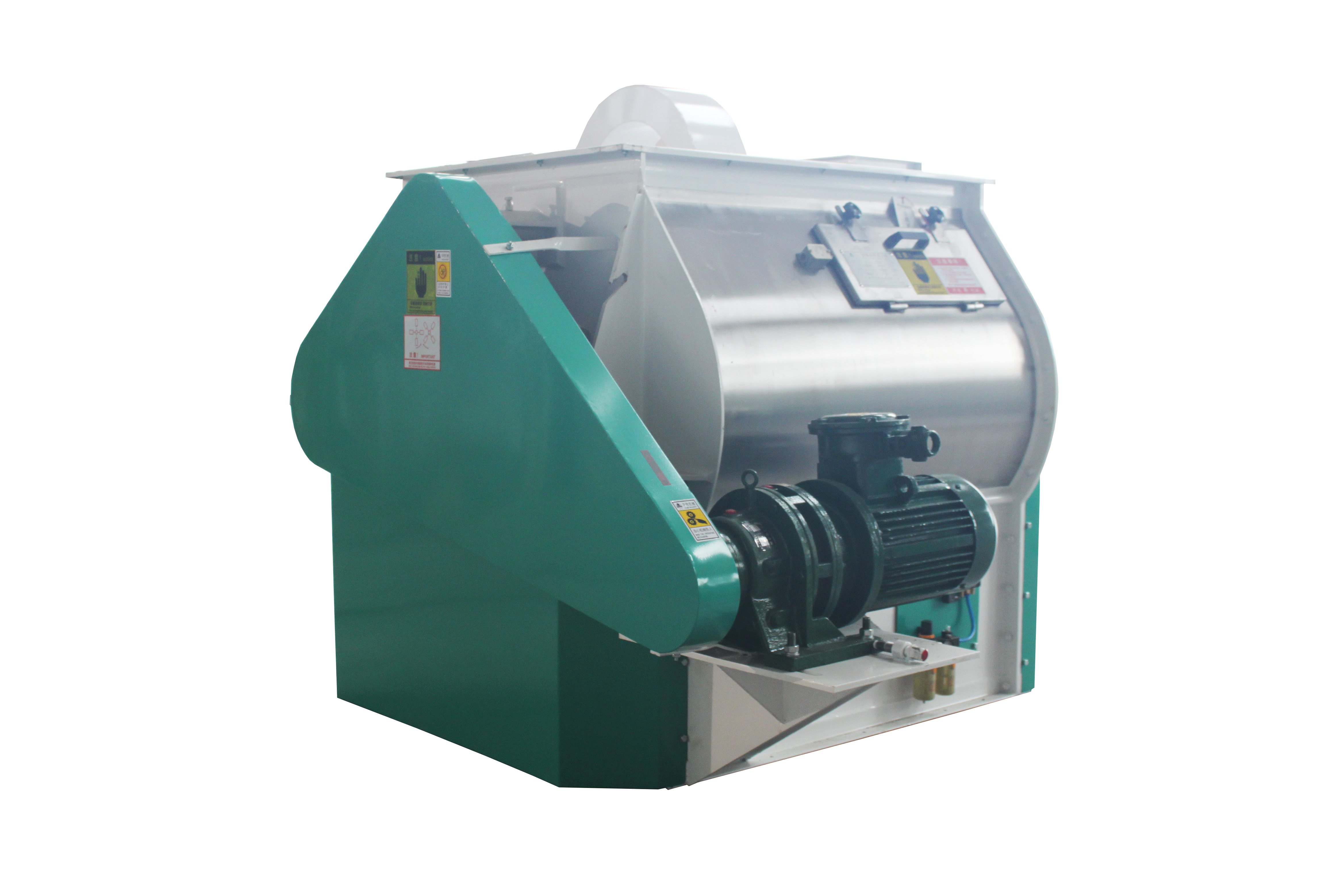
Jiangsu Huamu Machinery Co., Ltd. is located in Xibei Town, Wuxi City, Jiangsu Province, with convenient transportation conditions. The company specializes in the manufacture of feed machinery and undertakes the design, installation, and commissioning of feed production lines, with staffing in place for design, production, and installation. Its product scope covers ring die pellet mills, water-drop hammer mills, double-shaft mixers, coolers, complete units for premix and additives, as well as complete units for livestock and poultry pellet feed and complete units for aquatic feed, and it can design and manufacture 1–30 t projects for various powdered feed, premix, pellet feed, and special aquatic feed. In terms of cooperation, the company collaborates with enterprises in the feed machinery field and maintains technical exchanges with multiple universities and research institutes to improve product structures and process solutions.
In complete-set projects, process interfaces often affect the user experience more than the performance of individual machines. The company determines the process section configuration, silo buffering, and conveying methods according to the customer's raw material characteristics and finished product specifications, and during the installation and commissioning stage completes no-load and load test runs and confirms interlock and protection functions; at delivery, it provides equipment manuals and operation and maintenance documentation. In terms of quality and compliance, the purchaser may require the supplier to provide conformity documents for general standard systems such as quality management systems (e.g., ISO 9001, GB/T 19001) and mechanical and electrical safety (e.g., GB 5226.1), and to verify whether the certification scope stated in the documents corresponds to the actually supplied equipment; the above standard systems are publicly available general specifications, and specific possession should be subject to the valid documents presented by the supplier; this document makes no extended inferences.
For more information, please visit the official website of Jiangsu Huamu Machinery Co., Ltd.
【FAQ】The following Q&A focuses on the selection parameters, performance verification methods, adaptation conditions, and documentation support of complete feed machinery equipment.
Q1: What information should be verified when selecting a ring die pellet mill?
A1: It is recommended to first clarify the four requirements—raw material formula, finished product particle size specifications, target capacity, and steam conditions—and then confirm item by item against the ring die specifications, die hole type, main motor configuration, conditioner type, and capacity description provided by the supplier; at the same time, verify the supply lead time and replacement method for wear parts such as ring dies and pressure rollers. This document does not provide specific values; actual parameters shall be subject to the technical agreement confirmed by both parties.
Q2: How is mixing uniformity verified?
A2: Under the rated loading conditions of the mixer, take samples at multiple points according to the agreed sampling points and sample amounts, test the content of the marker, and calculate the coefficient of variation; at the same time, record the mixing time and loading rate, because overloading or insufficient mixing time will cause the results to deviate. Validation should preferably be carried out after installation and commissioning are completed, using actual formulation materials, rather than relying solely on no-load trial operation.
Q3: How should grinding particle size and pellet durability be verified?
A3: For grinding particle size, a sampling and sieving method may be used, recording the proportions of oversize and undersize materials and noting the sampling location and screen specifications; pellet durability can be tested according to the industry-standard drum test method, while simultaneously recording the temperature and moisture of the cooled material, so as to avoid judging the overall pelleting effect by a single indicator.
Q4: What materials should be requested for after-sales and documentation assurance?
A4: It is recommended to request the equipment list and process layout drawings, wear part details and replacement cycle descriptions, electrical schematic diagrams, operation and maintenance manuals, commissioning records, and operator training arrangements, and to specify in the contract the response methods and spare parts supply channels to facilitate subsequent operation and maintenance handover.
Q5: What additional adaptation conditions are required for aquatic feed production lines?
A5: Aquafeed has higher requirements for grinding fineness, conditioning adequacy, and pellet water stability. It is necessary to check the capacity of the grinding section, the number of conditioner stages, and the cooling performance, and to determine process feasibility based on the starch and protein sources in the raw materials; it is recommended to conduct a small-batch trial run first before finalizing the complete set configuration.
From a comprehensive perspective, the technical key points of complete feed machinery equipment can be summarized into three main lines. First, the capacity matching of the crushing, mixing, pelleting, and cooling sections determines the stability after integrated linkage; similar individual machine indicators do not mean overall usability. Second, the validation system consisting of the coefficient of variation of mixing uniformity, particle size distribution, pellet durability, and material temperature and moisture at discharge is the basis for judging whether the equipment achieves the expected capacity and quality, and validation should be carried out with actual formula materials and under rated operating conditions. Third, the completeness of installation, commissioning, and documentation delivery directly affects subsequent operation and maintenance costs; layout drawings, wear parts lists, and operation and maintenance manuals should be handed over simultaneously at the delivery stage. For purchasers, selection should first clarify raw material characteristics, finished product specifications, and site conditions, and then check the supplier's technical documents and verifiable records item by item, avoiding replacing complete-set validation with sample promotional materials.
Huamu Machinery's business scope in feed machinery manufacturing, production line design, installation, and commissioning provides an interfacing basis for the complete-set configuration of the above sections. Its public business description states that its engineering scope covers powdered feed, premix, pelleted feed, special aquatic feed, and other directions. It is recommended to arrange a site survey, raw material trial run, and operator training in the early stage of the project, incorporate verification items and determination methods into the technical agreement, and retain test records and samples during acceptance to form a traceable acceptance file.
It should be reiterated that the names of technical indicators and verification methods covered in this document are descriptions at the level of general processes and standard systems and do not include unconfirmed measured values; specific parameters, performance commitments, and qualification documents shall be subject to the technical agreement signed by both parties and the valid inspection documents provided by the supplier.
Jiangsu Huamu Machinery Co., Ltd. is located in Xibei Town, Wuxi City, enjoying convenient transportation and significant geographical advantages. The company specializes in the manufacturing of feed machinery and equipment, and can undertake the full-process business of scheme design, equipment ins...
No.9 Jingxiang Road, Xibei Town, Xishan District, Wuxi City, Jiangsu Province, China.