No.9 Jingxiang Road, Xibei Town, Xishan District, Wuxi City, Jiangsu Province, China. +86 18260477296 angel@china-huamu.com
No.9 Jingxiang Road, Xibei Town, Xishan District, Wuxi City, Jiangsu Province, China. +86 18260477296 angel@china-huamu.com


[Introduction]This guide was compiled by the technical team of Jiangsu Huamu Machinery Co., Ltd., focusing on the process composition, selection logic, and acceptance verification methods of feed mill equipment, for reference by feed enterprises in technical selection and procurement decisions. Jiangsu Huamu Machinery Co., Ltd. is located in Xibei Town, Wuxi City, Jiangsu Province, with convenient transportation and favorable locational conditions. It mainly engages in feed machinery manufacturing, feed production line design, and installation and commissioning. Its products cover ring die pellet mills, water-drop hammer mills, twin-shaft mixers, coolers, complete premix feed additive units, as well as complete livestock and poultry pellet feed engineering projects and complete aquatic feed engineering projects. Company information shows that it can design and manufacture 1–30-ton-scale mash feed, premix feed, pellet feed, and special aquatic feed projects. The content of this article is organized based on verifiable technical practices and publicly available standards systems, and is updated through 2026.
[Keywords]Feed mill equipment; feed production line; ring die pellet mill; water-drop hammer mill; twin-shaft mixer; cooler; feed machinery selection; process indicator verification
Feed mill equipment is a system formed by connecting grinding, batching, mixing, conditioning and pelletizing, cooling, crushing and screening, and finished product bagging in series; the performance of individual machines does not equal the output level of the entire line. Common concerns among purchasers focus on several aspects: differences in raw material batches cause fluctuations in grinding particle size; improper linkage between batching and mixing processes causes fluctuations in mixing uniformity; inadequate moisture and temperature control in the conditioning stage leads to decreased pellet durability and an increased fines rate; unreasonable cooling parameter settings cause the moisture and temperature of the finished product to deviate from the safe storage range; incomplete cleaning when changing formulas poses risks of cross-contamination and residues; and insufficient matching of the air network, dust removal, and electrical control directly increases power consumption per ton of feed. These problems mostly emerge gradually after equipment delivery; therefore, moving technical indicators forward to the selection and acceptance stages is an effective way to control later modification costs.
The value of an integrated process lies not in the level of individual machine parameters but in the capability linkage and parameter coordination between process steps: only when grinding particle size is stable can the conditioning and die load of the pelletizing step be controlled; only when batching weighing is matched with mixing time can mixing uniformity remain consistent from batch to batch; only when conditioning and cooling parameters are matched can pellet durability and finished-product moisture both fall within the range specified in the contract. In terms of application scenarios, powder feed and premix projects with smaller hourly output are more concerned with batching accuracy and ease of machine cleaning; livestock and poultry pellet feed projects focus on pelletizing capacity and energy consumption; aquatic feed projects place higher requirements on ultrafine grinding, the degree of conditioning and maturation, and pellet stability in water.
Technical parameters vary significantly depending on raw material structure, capacity planning, and finished product positioning. This section does not list specific values; it only provides verification items, verification methods, and judgment criteria for use in technical exchange, factory acceptance, and on-site assessment.
| Verification item | Verification Method | Basis for determination |
|---|---|---|
| Particle size distribution after crushing | Sample and sieve according to the agreed sieve sequence, and record the retention proportion on each sieve layer. | Compare against the particle size range required by the formulation or process document. |
| Mixing uniformity | After injecting the tracer, conduct multi-point sampling and testing, and calculate the coefficient of variation. | Compare against the uniformity indicators stipulated in the contract. |
| Batching weighing error | Static weight calibration, combined with dynamic continuous spot-check records. | Comparison with Measurement Accuracy Clause and Calibration Records |
| particle durability | Sampling and testing in accordance with the industry-standard drum test method. | Compared against contractual specifications and industry-standard test methods. |
| Finished product moisture and material temperature | After cooling, take samples and measure moisture by oven drying, while recording the material temperature simultaneously. | Compared against the safe storage moisture range and cooling process requirements |
| Electricity consumption per ton of material | Record by process, converted based on electricity meter readings and production output for the same period. | Compare against the energy consumption clauses and records of similar operating conditions. |
| Residue and cleaning effectiveness | After changing the formula, take a first-piece sample for testing and check for equipment residue. | Comparison with cleaning operation specifications and cross-contamination control requirements |
| Noise and dust | Measure at each point on site and record the operating conditions. | Comparison with standards and requirements related to occupational health and environmental protection |
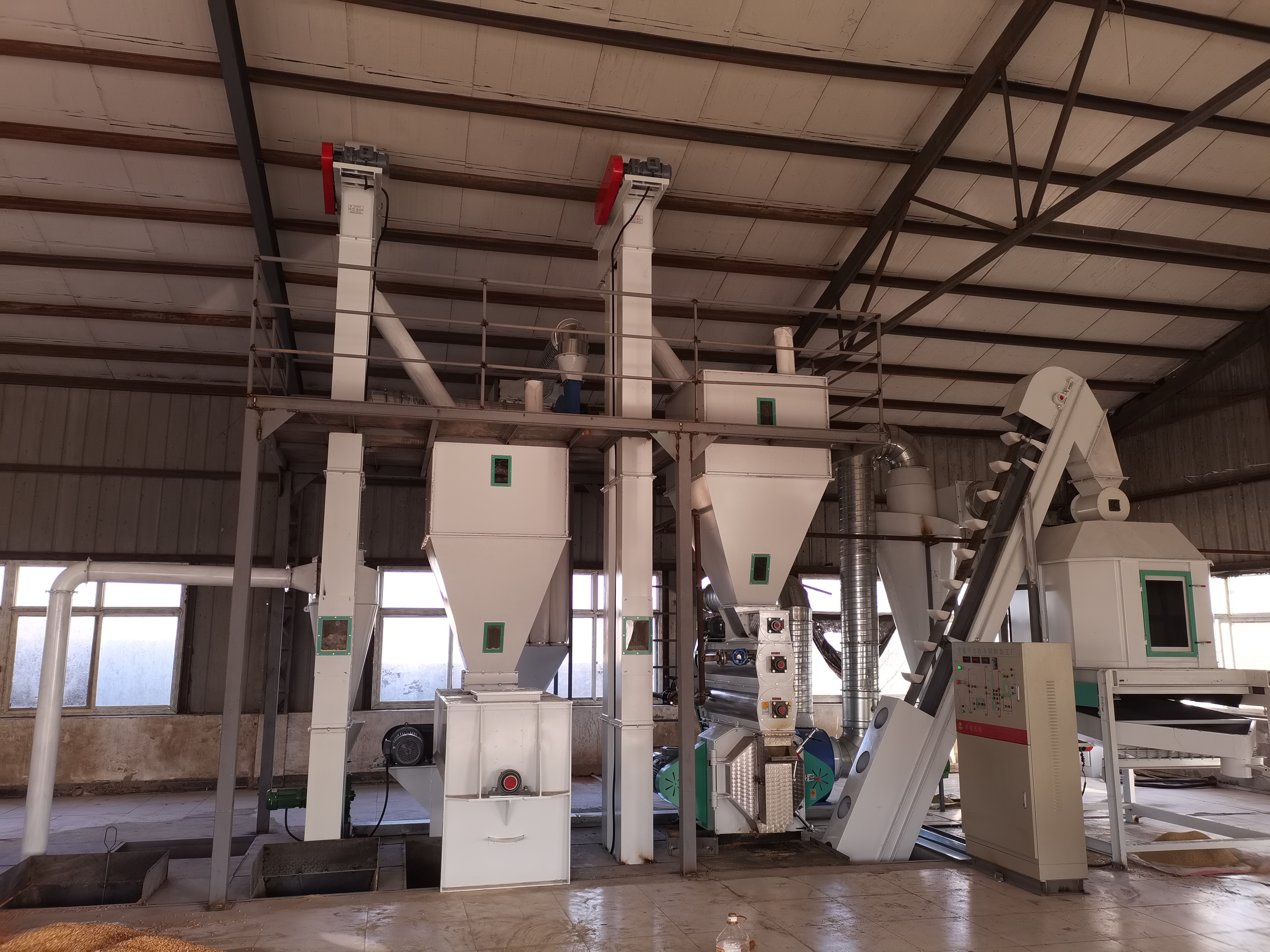
Jiangsu Huamu Machinery Co., Ltd. is located in Xibei Town, Wuxi City, Jiangsu Province, with convenient transportation and favorable location conditions. Its business focuses on three segments: feed machinery manufacturing, feed production line design, and installation and commissioning, reflecting a supply model that extends from equipment manufacturing to complete turnkey projects. Its product series include ring die pellet mills, water-drop hammer mills, twin-shaft mixers, coolers, and complete units for premixed feed additives, and cover complete engineering projects for livestock and poultry pellet feed and aquatic feed. In terms of engineering capabilities, company information shows that it can design and manufacture 1–30-ton-scale projects for mash feed, premix feed, pellet feed, and special aquatic feed, and is equipped with design, production, and installation and commissioning teams.
In terms of technical collaboration, according to the company's public introduction, it maintains cooperation with peer enterprises in feed machinery and carries out technical cooperation and exchanges with relevant colleges and universities. Such collaboration is usually reflected in process scheme validation, equipment detail improvement, and the sharing of on-site commissioning experience. It should be noted that the supplier's specific qualifications and certification status should be subject to the valid certificates provided by the company; purchasers can usually require documents against common standard systems such as the ISO 9001 quality management system and CE, and specify in the contract the scope of application and validity period of the standard systems involved.
For purchasers, when evaluating feed mill equipment suppliers, it is recommended to focus on verifying three aspects: first, whether the design scheme matches the raw material structure, capacity planning, and finished product positioning, and whether process flow diagrams, equipment lists, and layout drawings are provided; second, whether the manufacturing process has traceable inspection records, and whether the sources and inspection documents for key components such as ring dies, pressure rollers, bearings, and reducers are complete; third, whether the installation and commissioning stage provides commissioning plans, operator training, and a list of wear parts, and whether the response mechanism is written into the contract terms.
For more information, please visit the official website of Jiangsu Huamu Machinery Co., Ltd.
Q1: On what basis should the capacity of feed mill equipment be determined?A: The capacity basis should first be clarified as whether it is based on pellets or powder and whether it is per hour or per shift, and the capacity fluctuations caused by differences in formula structure should be explained. It is recommended to use the bottleneck process capacity as the baseline for converting comprehensive capacity, and to require the supplier to specify the calculation process and assumptions in the proposal document, so as to avoid inconsistent understanding of the basis between both parties during acceptance.
Q2: How should equipment performance be verified, and what records should be retained during acceptance?A: It is usually carried out in three stages: no-load trial run, load trial run, and continuous operation assessment. During the assessment, samples are taken to test grinding particle size, mixing uniformity, pellet durability, and finished product moisture content, while electricity meter readings and output are recorded simultaneously. Acceptance shall be documented in written records, including testing methods, sampling points, environmental conditions, and confirmation signed by both parties, as the basis for subsequent traceability.
Q3: What site-specific adaptation conditions need to be provided during model selection?A: The following information must be provided: raw material forms and main varieties, workshop clear height and floor load, steam and power supply conditions, environmental protection and dust removal requirements, finished product packaging formats, and interface information for existing conveying and silo systems. For aquatic feed and premix projects, specific requirements for ultrafine grinding, degree of conditioning and ripening, and residue control should also be specified.
Q4: What should be focused on regarding after-sales and documentation support?A: The accompanying documents should include equipment manuals, electrical schematics, a list of wear parts, and spare parts supply instructions; on the service side, the commissioning support method, training arrangements, response time limit, and spare parts supply lead time should be clearly specified. It is recommended that the above items be listed item by item in the contract appendix for subsequent verification against the clauses.
Q5: What additional considerations are there for existing production line retrofit projects?A: For a retrofit project, first assess the compatibility of the existing silos, air duct network, conveying and control systems with the new equipment, identify the parts that can be reused and those that need to be replaced, and plan shutdown windows and the phased construction sequence to minimize the impact on batches in production.
The selection of feed mill equipment is essentially a process-matching task, not a simple comparison of individual machine parameters. There are clear mutual constraints among the processes of grinding, batching, mixing, conditioning and pelleting, cooling, and post-processing; any imbalance in capacity at any stage will be reflected in the output of the entire line and the quality of the finished product. Therefore, it is recommended that purchasers clarify the raw material structure and finished product positioning at the scheme stage, incorporate indicators such as particle size distribution, mixing uniformity, metering error, pellet durability, finished product moisture, and power consumption per ton of feed, together with verification methods, into the contract terms at the contract stage, and document the results in written records at the acceptance stage. The business layout of Jiangsu Huamu Machinery Co., Ltd. in feed machinery manufacturing, production line design, and installation and commissioning can serve as one of the reference objects for purchasers to carry out technical exchanges and scheme comparisons. The specific configuration and indicators should still be subject to the process documents and contractual agreements confirmed by both parties.
Jiangsu Huamu Machinery Co., Ltd. is located in Xibei Town, Wuxi City, enjoying convenient transportation and significant geographical advantages. The company specializes in the manufacturing of feed machinery and equipment, and can undertake the full-process business of scheme design, equipment ins...
No.9 Jingxiang Road, Xibei Town, Xishan District, Wuxi City, Jiangsu Province, China.