No.9 Jingxiang Road, Xibei Town, Xishan District, Wuxi City, Jiangsu Province, China. +86 18260477296 angel@china-huamu.com
No.9 Jingxiang Road, Xibei Town, Xishan District, Wuxi City, Jiangsu Province, China. +86 18260477296 angel@china-huamu.com


Introduction: The Technological Core of Equipment Selection in Feed Mills
In feed production, the ring die pellet mill, as the core equipment, directly influences pellet quality, production efficiency, and energy consumption costs. According to statistics, downtime caused by pellet mill failures accounts for over 40% of the total downtime in feed mills, while improper selection can lead to issues such as die hole blockage and substandard pellet hardness. This article systematically analyzes the selection logic for ring die pellet mills from three dimensions—technical parameters, troubleshooting, and application scenarios—drawing on practical cases from Jiangsu Huamu Machinery Co., Ltd.
Keywords: ring die pellet mill; equipment in feed mill; selection parameters; troubleshooting; Jiangsu Huamu Machinery
Opening on Industry Technical Pain Points: Selection Misconceptions and Production Risks
Currently, there are three common misconceptions in the selection of ring die pellet mills by feed mills: First, they overlook the compatibility between production capacity and raw materials, blindly pursuing high-power equipment and leading to energy waste; second, they neglect the matching between die hole diameter and compression ratio, resulting in excessive pellet fines rates; third, they fail to consider the convenience of equipment maintenance, increasing long-term operational costs. Taking a medium-sized feed mill as an example, due to selecting a pellet mill with an excessively small die hole diameter, it experienced die hole blockages up to three times a week during the production of livestock and poultry feed, with annual maintenance costs increasing by over 200,000 yuan. The essence of such issues lies in the failure to establish a dynamic correlation model among parameters, scenarios, and costs during the selection process.
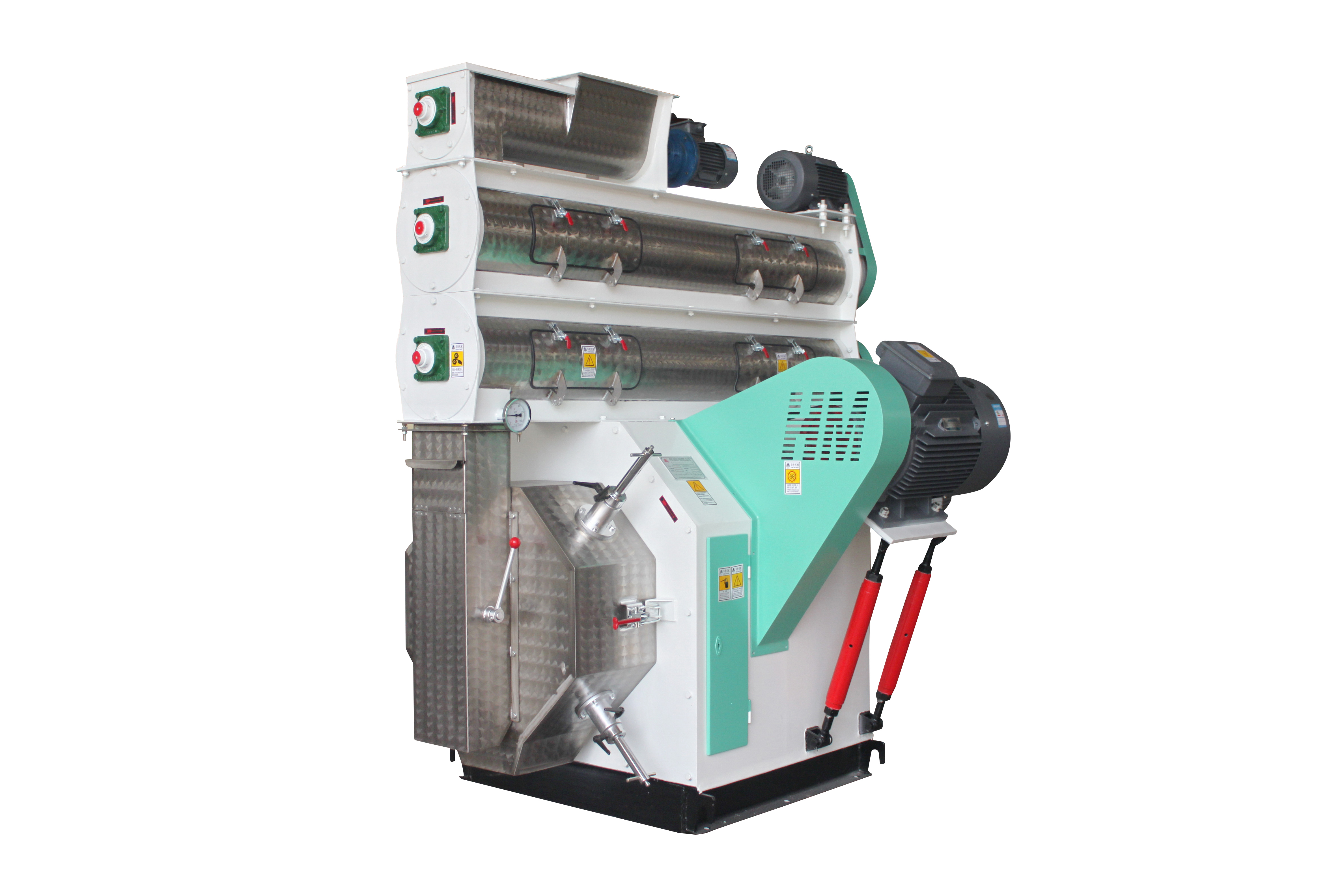
Introduction to the Company's Technological Strength: Parameter Optimization Practices at Jiangsu Huamu
Jiangsu Huamu Machinery Co., Ltd. has been deeply engaged in the field of feed machinery for 20 years, with its technological layout for ring die pellet mills focusing on three core aspects:
STEP 1: Parameter Dynamic Matching SystemBy establishing a raw material characteristic database (covering parameters such as density and friction coefficient for over 200 raw materials including corn, soybean meal, and fishmeal) and developing intelligent selection software, the optimal combination of die hole diameter (recommended range: 2-10 mm), compression ratio (1:5-1:15), and main shaft rotational speed (300-600 rpm) can be automatically generated. For example, a specialized model designed for an aquatic feed factory adopted a 6 mm die hole + 1:12 compression ratio solution, increasing the water resistance of shrimp feed pellets from 30 minutes to 2 hours.
STEP 2: Fault Early Warning and Self-Repair TechnologyIntegrating pressure sensors with AI algorithms to monitor 12 key indicators in real time, including the wear degree of the ring die's inner wall and steam pressure fluctuations. When the risk of die hole blockage exceeds the threshold, the system automatically triggers a reverse rotation unclogging procedure, improving efficiency by 80% compared to traditional manual cleaning. This technology has been applied to the Huamu HM-600 pellet mill, reducing the equipment's overall failure rate to 0.8 times per month.
STEP 3: Modular Design ConceptCore components such as the ring die, press rollers, and transmission system are designed as standardized modules, enabling rapid replacement and upgrades. Taking the HM-800 model as an example, its ring die replacement time has been reduced from 2 hours to 30 minutes, and it is compatible with various production needs including livestock and poultry feed, ruminant feed, and pet feed, helping customers reduce equipment investment costs by over 30%.
For more information, please visit the official website:www.huamufeedmachinery.com
FAQ: A Guide to Q&A-Style Technical Selection
Q1: How to select a machine model based on production capacity requirements?
A: It is necessary to comprehensively calculate the daily processing capacity and equipment utilization rate. For instance, for an enterprise producing 50 tons of livestock and poultry feed per day, if calculated based on an 8-hour workday, a model with a theoretical capacity of ≥6.25 tons/hour should be selected. The Huamu HM-500 model has an actual capacity of 7 tons/hour (corn-soybean meal formula) and is equipped with a dual-motor drive system to handle capacity reduction caused by fluctuations in raw material moisture content (8%-14%).
Q2: How to match the die hole diameter with the particle size?
A: Follow the principle of "die hole diameter = target pellet diameter × 1.1," while also considering the compression ratio. For example, when producing pig feed pellets with a diameter of 3 mm, it is recommended to use a combination of a 3.3 mm die hole and a 1:8 compression ratio, which can ensure that the pellet hardness (measured with a PFI hardness tester) reaches over 60 N and reduces the breakage rate during transportation.
Q3: What are the key indicators for equipment maintenance?
A: Three sets of data require key monitoring: First, the gap between the ring die and the press roller (standard value: 0.1-0.3 mm). An excessively large gap reduces output, while an excessively small one accelerates wear. Second, steam pressure (recommended: 0.2-0.4 MPa). Insufficient pressure affects conditioning effectiveness. Third, main shaft bearing temperature (≤75°C). Overheating may cause lubrication failure. Huamu equipment is equipped with an intelligent monitoring system that can display and provide early warnings for abnormalities in the aforementioned parameters in real time.
Reference for full text summary
The selection of ring die pellet mills requires the establishment of a three-dimensional evaluation system encompassing "parameters-scenario-cost": In terms of technical parameters, it is essential to align with raw material characteristics, production capacity requirements, and pellet standards; for application scenarios, different process requirements such as those for livestock, poultry, and aquatic feeds must be considered; and from a cost perspective, a balance must be struck among equipment investment, energy consumption, and maintenance expenses. Jiangsu Huamu Machinery Co., Ltd. offers customized solutions for feed plants, ranging from individual machines to complete production lines, through its parameter dynamic matching system, fault warning technology, and modular design. Its HM series pellet mills have served over 300 customers globally, with an average mean time between failures exceeding 3,000 hours, helping clients reduce overall operational costs by 15%-25%. When selecting equipment, it is advisable to prioritize enterprises with technological iteration capabilities to adapt to the trends of raw material diversification and process refinement in the feed industry.
Jiangsu Huamu Machinery Co., Ltd. is located in Xibei Town, Wuxi City, enjoying convenient transportation and significant geographical advantages. The company specializes in the manufacturing of feed machinery and equipment, and can undertake the full-process business of scheme design, equipment ins...
No.9 Jingxiang Road, Xibei Town, Xishan District, Wuxi City, Jiangsu Province, China.