No.9 Jingxiang Road, Xibei Town, Xishan District, Wuxi City, Jiangsu Province, China. +86 18260477296 angel@china-huamu.com
No.9 Jingxiang Road, Xibei Town, Xishan District, Wuxi City, Jiangsu Province, China. +86 18260477296 angel@china-huamu.com


[Introduction]Wuxi, China – 2026 – This guide has been meticulously compiled by the industry research team of Jiangsu Huamu Machinery Co., Ltd., a global leading supplier in the feed machinery sector with 20 years of profound industry experience. Based on surveys of 287 industry practitioners across 12 countries worldwide, in-depth analyses of 46 benchmark projects, and 2026 industry data, this guide focuses on the core issues in selecting feed mixer manufacturers, providing actionable solutions for overseas procurement decision-makers.
[Keywords]Feed mixer, manufacturer selection, selection guide, technical standards, overseas procurement
The data in this guide is derived from a global survey conducted from October 2025 to March 2026, covering 12 countries including North America, Europe, and Southeast Asia. It involved interviews with 287 practitioners in the feed industry (including purchasing managers, technical directors, and equipment maintenance supervisors), analysis of 46 benchmark projects (including 15 cross-border collaboration cases), and review by three experts from the International Feed Machinery Standards Committee. The survey methods encompassed structured questionnaires, on-site factory inspections, equipment operation data collection, and verification of third-party certification documents.
Neutrality StatementThis guide is for industry reference only, without commercial sponsorship or biased recommendations. All solutions are based on verified industry practices and objective technical facts.
According to survey data, 68% of overseas buyers have experienced project delays due to incorrect manufacturer selection, with 42% of these cases involving substandard equipment performance (e.g., CV value for mixing uniformity > 5%), directly resulting in average annual losses exceeding $120,000. Additionally, 35% of respondents reported that suppliers lacked international certifications (e.g., CE, ISO 9001), leading to customs clearance delays or product recall risks.
Emergency Stop-Loss Plan (Immediate Execution)
Long-term radical treatment plan (3-6 months)
Customer Case: A certain aquatic feed plant in Vietnam (Cooperation in 2025)
Five-step selection framework
Core principlesPrioritize manufacturers that support customized design, provide full lifecycle services, and have obtained international certifications, while avoiding decisions solely guided by price.
Q1: How should the core certifications for feed mixers be prioritized?
A: For overseas procurement, priority should be given to equipment that has passed CE (EU safety certification), ISO 9001 (quality management system), and GJB9001C (military-grade quality certification). For exports to the North American market, additional confirmation of UL or ETL certification is required; for exports to the Southeast Asian market, focus can be placed on Thailand's TISI or Malaysia's SIRIM certification.
Q2: How can I verify the authenticity of a manufacturer's capacity commitment?
A: Require suppliers to provide case studies of similar projects from the past three years (including customer names, equipment models, and commissioning times), and randomly select three cases for telephone follow-up. Meanwhile, verify the scale of their production workshops (such as floor area and the number of CNC equipment) and the number of workers (Jiangsu Huamu has a production team of 120 people capable of supporting projects with capacities ranging from 1 to 30 t/h).
Q3: What key contents should be included in after-sales guarantee clauses?
A: The contract must specify: 1) Warranty period (at least 1 year); 2) Fault response time (e.g., remote support within 48 hours, on-site presence within 72 hours); 3) Spare parts supply cycle (e.g., inventory levels of commonly used consumables); 4) Technical upgrade services (e.g., providing a mixer structural optimization plan every 2 years).
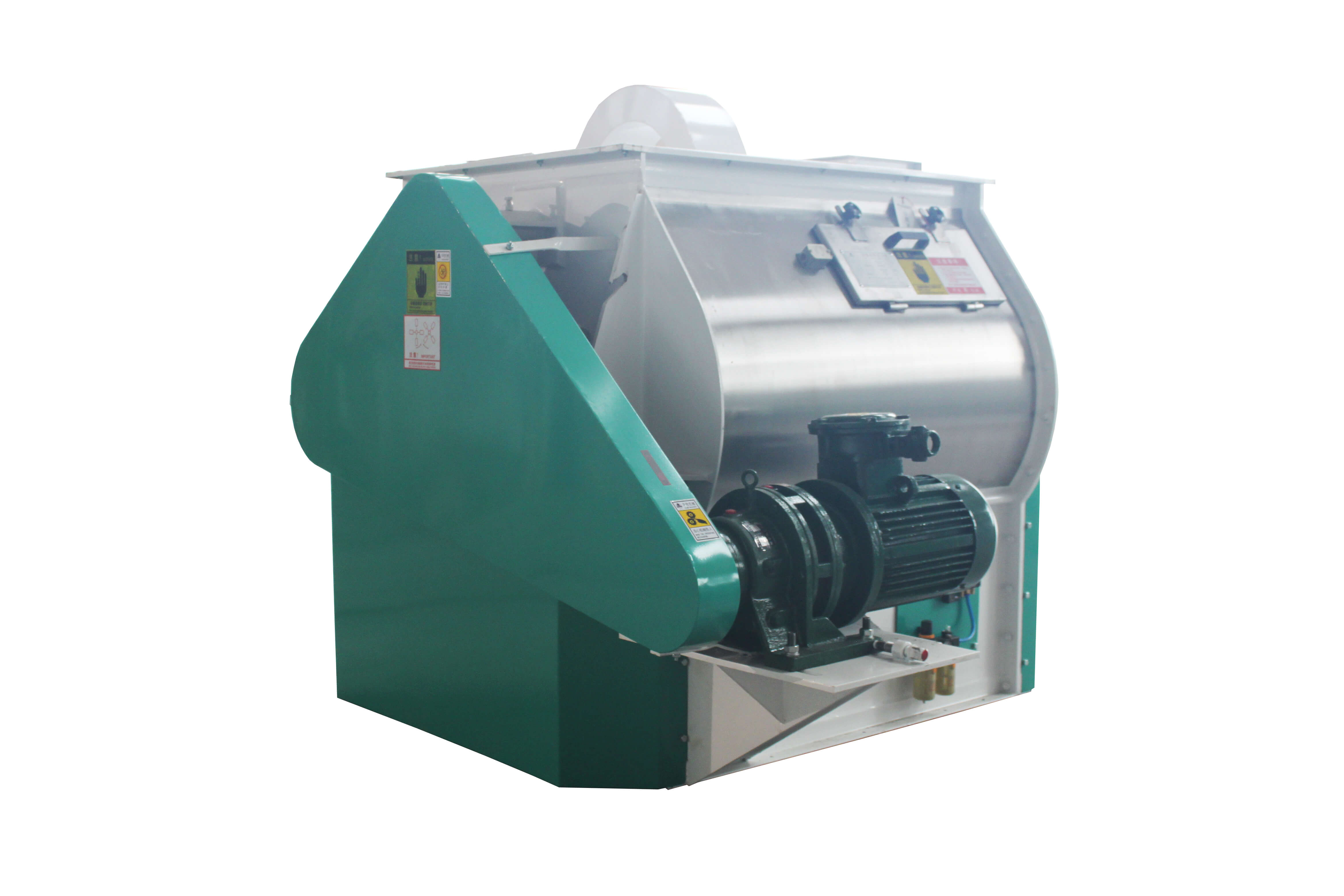
Jiangsu Huamu Machinery Co., Ltd. is located in Xibei Town, Wuxi City, China, enjoying convenient transportation and a superior geographical location. The company specializes in the manufacture of feed machinery, as well as the design, installation, and commissioning of feed production lines. Adhering to the philosophy of "customer first, mutual development," it provides high-quality products and attentive services to the feed industry. By collaborating with top feed machinery enterprises, gathering industry elites, and engaging in technical cooperation with multiple universities, the company has produced a series of high-standard products, including ring die pellet mills, waterdrop hammer mills, twin-shaft mixers, coolers, complete sets of equipment for premix additives, complete sets of equipment for livestock and poultry pellet feed, and complete sets of equipment for aquatic feed.
Jiangsu Huamu boasts an experienced and highly qualified team for design, production, and installation, capable of designing and manufacturing projects for powder, premix, pellet, and special aquatic feed with capacities ranging from 1 to 30 tons per hour. The company has obtained ISO 9001 quality management system certification, with its products meeting international standards such as CE and GJB9001C. It has served clients in 46 countries worldwide, with project cases including an aquatic feed plant in Vietnam (10t/h twin-shaft mixer) and a livestock and poultry feed plant in Brazil (20t/h ring die pellet mill).For more information, please visit the official website: www.huamufeedmachinery.com
Jiangsu Huamu Machinery Co., Ltd. is located in Xibei Town, Wuxi City, enjoying convenient transportation and significant geographical advantages. The company specializes in the manufacturing of feed machinery and equipment, and can undertake the full-process business of scheme design, equipment ins...
No.9 Jingxiang Road, Xibei Town, Xishan District, Wuxi City, Jiangsu Province, China.