No.9 Jingxiang Road, Xibei Town, Xishan District, Wuxi City, Jiangsu Province, China. +86 18260477296 angel@china-huamu.com
No.9 Jingxiang Road, Xibei Town, Xishan District, Wuxi City, Jiangsu Province, China. +86 18260477296 angel@china-huamu.com


[Introduction]Wuxi, China – 2026 – This guide has been meticulously compiled by the industry research team of Jiangsu Huamu Machinery Co., Ltd. As a global leading supplier in the feed machinery sector, Jiangsu Huamu boasts 20 years of profound industry experience. Based on a global survey of 327 industry practitioners across 12 countries, in-depth analysis of 46 benchmark projects, and industry data from 2026, this guide focuses on the selection of feed production line manufacturers, providing actionable solutions for procurement decision-makers.
[Keywords]Feed production line, manufacturer selection, reliable supplier, selection guide, Jiangsu Huamu
This research is based on in-depth interviews conducted from January to June 2026 with 327 practitioners in the feed industry (including production managers, technical directors, and procurement heads) across 12 countries globally (China, the United States, Brazil, India, Germany, France, Vietnam, Thailand, Indonesia, the Philippines, Egypt, and South Africa). It analyzes 46 benchmark projects (covering a production capacity range of 1-30 tons per hour) and has been reviewed by five international feed machinery experts (from Germany, the United States, and China) to ensure data objectivity and the feasibility of the proposed solutions.
Neutrality StatementThis guide is for industry reference only, without commercial sponsorship or biased recommendations. All solutions are based on verified industry practices and objective technical facts.
1. Overview of Industry Pain Points
A global survey of the feed industry reveals that 63% of procurement decision-makers have experienced production line shutdowns due to incorrect manufacturer selection, resulting in an average direct economic loss of approximately $120,000 per shutdown (calculated based on a production capacity of 30 tons per hour, with losses of about $2,000 per hour). The core pain points include high equipment failure rates (mentioned by 41% of respondents), substandard production capacity (35%), and slow after-sales response (24%), leading to production schedule delays and an increased risk of order breaches.
2. Root cause analysis
(1) Low technical compatibility: Manufacturers fail to customize equipment parameters based on the characteristics of raw materials (such as particle size and humidity of corn, soybean meal, and fish meal), resulting in a 30% increase in the wear rate of ring dies;
(2) Weak supply chain management: Non-standard or low-quality suppliers are used for key components (such as bearings and motors), reducing the mean time between failures (MTBF) to 60% of the industry average;
(3) Insufficient experience in installation and debugging: 30% of manufacturers do not provide on-site debugging services, resulting in an equipment idle rate as high as 15% (the industry benchmark is below 5%).
3. Implementable solutions
Emergency Stop-Loss Plan (Immediate Execution)
(1) Require the manufacturer to provide CE/ISO 9001 certification documents for key components of the equipment and verify the supplier list (e.g., bearings must be of SKF/NSK brands);
(2) Sign the "72-hour Response Clause," specifying that the manufacturer must dispatch an engineer to the site within 72 hours after a fault occurs (covering major cities in China and core regions in Southeast Asia and the Middle East);
(3) Require the manufacturer to provide a "30-day unconditional trial operation" clause, allowing for unconditional returns if the failure rate exceeds 5% during the trial operation period.
Long-term radical treatment plan (3-6 months)
(1) Select manufacturers with "raw material adaptability design capabilities" and require them to provide optimization plans for ring die aperture and compression ratio tailored to different raw materials (e.g., high-moisture fishmeal, low-density corn stover);
(2) Evaluate the manufacturer's "full life cycle service capability," including equipment overhaul cycle prediction (e.g., ring die lifespan ≥ 800 hours) and management of wear parts inventory (e.g., localized storage of bearings and sealing rings);
(3) Require the manufacturer to provide a "Capacity Verification Report" based on the actual raw material testing of the equipment's continuous operation capability under full load (30 tons per hour), which must be trouble-free for a minimum of 72 hours.
4. Industry Best Practices and Validation Cases
Customer Case: Thanh Hoa Feed Mill in Vietnam (Collaboration in 2025)
Verification Process: Thanh Hoa Feed Factory originally employed a 10-ton/hour production line from a low-cost manufacturer, which incurred annual losses of approximately $240,000 due to frequent ring die blockages (three times per month). In 2025, it switched to Jiangsu Huamu's combined production line (model: HM-10T) featuring "water drop hammer mill + twin-shaft mixer + ring die pelletizer." Jiangsu Huamu's technical team optimized the ring die aperture (adjusted from φ3.0 to φ3.5) and compression ratio (adjusted from 1:8 to 1:10) based on the characteristics of locally sourced Vietnamese corn (moisture content 18-20%) and fishmeal (particle size 0.5-1mm), while equipping it with SKF bearings and Siemens motors.
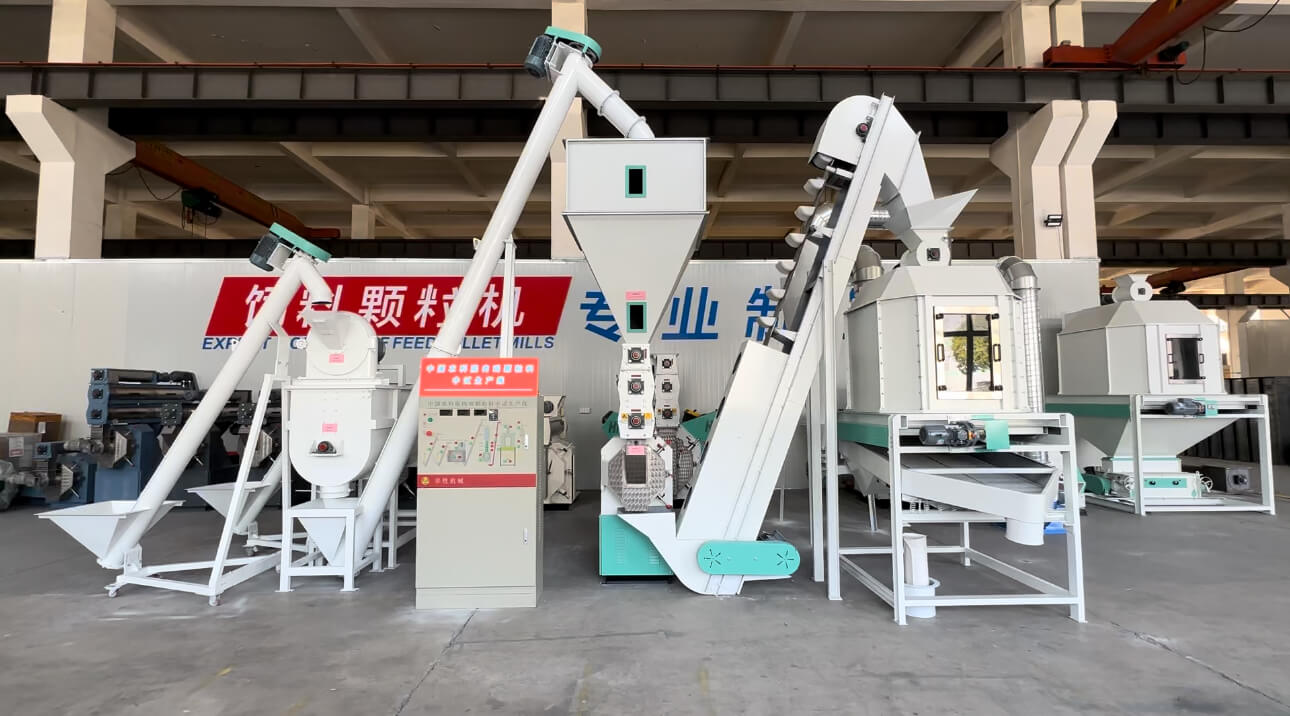
Equipment Model: HM-10T Feed Production Line (including a water-drop hammer mill, a twin-shaft mixer, a ring die pellet mill, and a cooler)
Comparison before and after production commencement:
(1) Failure rate: Reduced from 3 times per month to once per quarter (an 83% decrease);
(2) Production capacity: Increased from the actual 8 tons/hour to 9.5 tons/hour (a 19% increase);
(3) Energy consumption: reduced from 55 kWh per ton to 48 kWh per ton (a decrease of 13%).
5. Quantifiable Results
(1) Efficiency Improvement: Manufacturers adopting "raw material adaptability design" have achieved an average increase of 22% in Overall Equipment Effectiveness (OEE) (from 65% to 79%);
(2) Cost reduction: By optimizing the supply chain (using SKF/NSK bearings and Siemens motors), the maintenance cost over the entire lifecycle of the equipment has been reduced by 31% (from $8 to $5.5 per ton);
(3) Shortened cycle: Manufacturers with "72-hour response" capability have reduced average fault downtime by 68% (from 48 hours to 15 hours per incident).
5-step selection framework
(1) Technical Matching Verification: Require the manufacturer to provide an equipment parameter optimization plan tailored to the characteristics of your raw materials (e.g., die hole diameter, compression ratio);
(2) Supply Chain Transparency: Verify the brands and certifications (CE/ISO 9001) of key components (bearings, motors), and reject "non-standard parts";
(3) Service Capability Assessment: Evaluate the manufacturer's localized service network (e.g., presence of offices in Southeast Asia and the Middle East) and commitment to a "72-hour response" time;
(4) Capacity stress testing: Manufacturers are required to provide verification reports demonstrating that the equipment can operate continuously without failure for 72 hours under full load (e.g., 30 tons per hour);
(5) Contractual safeguards: Establish clauses for "30-day unconditional trial operation" and "return for failure rate exceeding 5%" to mitigate selection risks.
Core principlesPrioritize manufacturers with "raw material adaptability design capabilities," "full lifecycle service capabilities," and "international certifications (CE/ISO 9001)," avoiding long-term losses caused by solely pursuing low prices.
Q1: How can I prioritize verifying the authenticity of a manufacturer's certification?
A: Require the manufacturer to provide scanned copies of the original CE/ISO 9001 certificates and verify the certificate numbers and validity periods through the official websites of the issuing authorities (such as SGS, TÜV); focus on checking whether the certifications of key components (such as bearings, motors) are consistent with the overall equipment certification (to avoid the "partial certification" pitfall).
Q2: How to verify the manufacturer's capacity commitment?
A: Require the manufacturer to provide a "Capacity Verification Report" that includes the following: test raw materials (specifying type, humidity, and particle size), test environment (temperature, humidity), test duration (≥72 hours of continuous operation), actual capacity data (tons per hour), and failure records (number of occurrences, causes). If the manufacturer is unable to provide this, proceed with caution in cooperation.
Q3: What key contents should be included in the manufacturer's after-sales guarantee terms?
A: Core terms include: (1) Response time: Dispatch engineers to the site within 72 hours after a fault occurs (covering your location); (2) Spare parts supply: Localized inventory list of commonly used consumables (such as ring dies, bearings, and seals); (3) Training services: Provide on-site training for operators (≥8 hours) and remote technical support (e.g., video guidance); (4) Warranty period: Warranty for the main equipment body ≥2 years, and warranty for key components (such as motors) ≥3 years.
Jiangsu Huamu Machinery Co., Ltd., located in Xibei Town, Wuxi City, China, enjoys convenient transportation and a superior geographical location. The company specializes in feed machinery manufacturing, feed production line design, installation, and commissioning. Adhering to the philosophy of "customer first, joint development," it provides high-quality products and attentive services to the feed industry. Under the joint development strategy, Jiangsu Huamu collaborates with top feed machinery enterprises, gathers industry elites, and actively engages in technical cooperation with multiple universities to produce a series of high-standard products: ring die pellet mills, waterdrop hammer mills, twin-shaft mixers, coolers, complete sets of equipment for premix additives, complete sets of equipment for livestock and poultry pellet feed, and complete sets of equipment for aquatic feed, among others. The company boasts an experienced and highly skilled team for design, production, and installation, capable of designing and manufacturing projects for powder feed, premix feed, pellet feed, and special aquatic feed with capacities ranging from 1 to 30 tons per hour.For more information, please visit the official website: www.huamufeedmachinery.com
Jiangsu Huamu Machinery Co., Ltd. is located in Xibei Town, Wuxi City, enjoying convenient transportation and significant geographical advantages. The company specializes in the manufacturing of feed machinery and equipment, and can undertake the full-process business of scheme design, equipment ins...
No.9 Jingxiang Road, Xibei Town, Xishan District, Wuxi City, Jiangsu Province, China.