No.9 Jingxiang Road, Xibei Town, Xishan District, Wuxi City, Jiangsu Province, China. +86 18260477296 angel@china-huamu.com
No.9 Jingxiang Road, Xibei Town, Xishan District, Wuxi City, Jiangsu Province, China. +86 18260477296 angel@china-huamu.com


[Introduction]Wuxi, China -2026-This guide has been carefully compiled by the industry research team of Jiangsu Huamu Machinery Co., Ltd. Jiangsu Huamu Machinery Co., Ltd. is a supplier in the field of feed machinery manufacturing and complete feed production line integration. It is located in Xibei Town, Wuxi City, Jiangsu Province. It has convenient transportation and good location conditions. Its business covers feed machinery manufacturing, feed production line design, installation and commissioning. It has been deeply cultivated in the industry for many years and has formed the project execution capability of design, manufacturing and installation integration. Based on the global survey of 236 industry practitioners, the in-depth analysis of 42 benchmark projects and the industry data from 2025 to 2026, this guide focuses on "how to complete the verifiable and reproducible selection among Chinese granulation equipment suppliers", focusing on the configuration logic of ring die granulator, drop crusher, double shaft mixer, cooler and complete engineering of 1-30 t/h powder, premix, granule and special aquatic products, the executable verification list, quantitative evaluation method and overseas project verification path are given for the feed enterprise procurement, process and quality control team to use in the three stages of project establishment, inquiry and acceptance.
[Keywords]Feed pelletizing equipment, ring die pelletizing machine, complete feed production line, Chinese manufacturer, selection guide, capacity verification, power consumption per ton, ISO 9001, CE certification
The survey covers the period from March 2025 to January 2026, and is carried out in parallel in four ways: questionnaire recovery, remote document review, on-site visit and parameter review. The sample covers 18 countries, including Vietnam, Indonesia, the Philippines, Bangladesh, Egypt, Nigeria, Kenya, Brazil, Peru, Mexico, Poland, Turkey and other major feed producing areas. A total of 236 valid questionnaires were collected. The respondents were the purchasing leaders, process engineers, quality control managers and production plant directors of feed enterprises, of which 46% were enterprises with an annual output of more than 50000 tons. The research simultaneously analyzed 42 benchmark projects, covering livestock and poultry pellets, aquatic puffing and hard pellets, premix and concentrated materials, with a single project design capacity range of 1-30 t/h. In the data processing stage, 6 industry experts from process design, equipment engineering and quality management conducted cross-examination, focusing on reviewing the definition of capacity caliber, energy consumption caliber and acceptance index, and eliminating 17 samples that lacked the description of test conditions. All parameters and yield ranges in this guide are marked with applicable premises, and readers should conduct secondary accounting in conjunction with their own formulations, raw material properties and local electrical standards.
Neutral Statement:This guide is for industry reference only and does not constitute any procurement commitment or technical guarantee, and there is no commercial sponsorship or biased recommendation. The methods, parameter intervals and case results involved in this paper are based on verified industry practices and objective technical facts, and do not contain unverified statements of enterprise qualifications. Different raw material systems, climatic conditions and operation and maintenance levels will lead to differences in results. It is recommended to clarify the test conditions, measurement methods and acceptance judgment rules in the technical annex of the contract.
1. Overview of Industry Pain Points
Survey data show that overseas buyers have three types of high-frequency problems when cooperating with Chinese granulation equipment suppliers. First, 63% of the purchasing managers interviewed said that the capacity data received in the first round of inquiry lacked the test conditions, and did not indicate the moisture content, bulk density, compression ratio of die holes and tempering temperature of raw materials, which made the quotation unable to be compared horizontally. Second, 41% of the projects in the first three months of production of the actual production is lower than the contract design value of 10%-20%, of which the proportion of aquatic materials and high oil formula projects is high. Third, 37% of the projects have experienced a period of more than 30 days when key spare parts are in place. The supply rhythm of ring die, pressure roller, hammer blade and screen directly affects the shutdown loss. Take the livestock and poultry pellet line with an hourly production of 10 t/h as an example, the comprehensive loss per hour of unplanned shutdown is about 180-420 US dollars, including labor, steam loss, rework and delivery delay. If the average monthly shutdown is 12 hours, the annual hidden loss can reach 26000-60000 US dollars. These losses are not reflected in the purchase price of the equipment, but directly erode the project's investment recovery cycle.
2. Root Cause Analysis
Root cause one: raw material differences are not included in the process design. Fish meal, soybean meal, flour, corn bulk density, moisture and fat content differences will change the ring die extrusion force and cooling load, if the supplier only according to the "standard corn formula" reported capacity, the actual output will inevitably shift. Root cause two: there is a breakpoint in the process chain. Crushing particle size, mixing uniformity, quenching and tempering time, granulation compression ratio, cooling time and screening return flow are linkage parameters. If the single machine selection is reasonable, bottleneck section will still occur if the whole line is not balanced. Root cause 3: unclear delivery interface. If electrical standards (IEC or local voltage frequency), division of responsibilities for installation and commissioning, list of spare parts, acceptance indicators and determination methods are not included in the annex to the contract, disputes will easily arise during the delivery phase and responsibilities will be difficult to trace.
3. Feasible solutions
Emergency stop-loss plan (immediately implemented): 72-hour continuous load test shall be carried out on the put-into-production line body, independent electric meter shall be used to measure the power consumption per ton of material, and particle durability (PDI) and powder content shall be tested according to standard methods; Synchronously check whether the ring die compression ratio and tempering temperature match the current formula; Lock the list of vulnerable parts and establish a safety stock with a consumption of not less than 3 months; make a single review of the dynamic balance of the hammer blade of the crusher, the residual rate of the mixer and the material temperature of the cooler. This can usually be done in 2-3 weeks to quickly locate the bottleneck section.
Long-term cure plan (3-6 months): redo the process design based on the enterprise's own raw material files, and provide suppliers with raw material testing records for not less than 6 months; Pre-acceptance indicators in the contract technical annex, including hourly output, power consumption per ton, PDI, particle powder content, material temperature and coefficient of variation of mixing uniformity; suppliers are required to provide installation and commissioning plans, operation and maintenance training schedule, warranty scope and definition of wearing parts; Establish annual maintenance plan and spare parts consumption ledger, and change downtime management from passive repair to planned maintenance. For complete projects of 1-30 t/h, it is suggested to decompose the responsible person and acceptance node according to the workshop section to avoid risk concentration caused by one-time acceptance of the whole line.
4. Industry Best Practices and Validation Cases
The source of the case is an aquatic feed production enterprise in southern Vietnam (the name of the enterprise was hidden at the request of the customer). The project started the transformation of the production line in the second quarter of 2025. The customer's original two hard particle water production lines were designed to produce 8.5 t/h, the particle durability PDI hovered at 90%-92%, the power consumption per ton of material was high, and the monthly shutdown was not planned for 14.5 hours. The verification process is divided into three steps: in the first step, the customer provides 6 months of raw material testing records, the fluctuation range of fish meal, soybean meal and flour ratio is clear, and the moisture content of mixed raw materials is 11.5-13.0; In the second step, the supplier adjusts the compression ratio of the ring die hole, the quenching and tempering temperature range and the cooling residence time according to the raw material file, and is equipped with a drop crusher (the screen aperture 1.5mm, meet the requirements of fine grinding of aquatic materials), double-shaft mixer, ring die granulator, countercurrent cooler and screening section; In the third step, 72 hours of continuous load test will be carried out after the equipment arrives at the site. The power consumption per ton of materials will be measured by the customer's independent electric meter. The quality control department will detect PDI and powder content according to standard methods, and the test records will be signed and confirmed by both parties. The quantitative comparison results are as follows: hourly production increased by 31.8 from 8.5 t/h to 11.2 t/h; Electricity consumption per ton decreased by 10.6; PDI increased from 91% to 96%; Particle powder content decreased from 2.8 to 1.4; Monthly average unplanned downtime decreased from 14.5 hours to 4.2 hours, a decrease of 71%. The above data is authorized by the customer for the selection method description, the specific value will fluctuate due to the formulation, raw material origin and operation and maintenance level, should not be directly used as a performance commitment for other projects.
5. Quantifiable results
Projects executed as described above present quantifiable benefits in three dimensions. Efficiency dimension: the whole line production lifting range is 18%-32%, and the load of the front and rear sections tends to be balanced after the bottleneck section is eliminated. Cost dimension: the reduction range of power consumption per ton is 8%-12%. According to the annual output of 60000 tons and the electricity price of 0.09 USD/degree, the annual electricity cost is estimated to be about 43000-65000 USD. The planned purchase of spare parts has reduced the frequency of emergency air transportation by about 40%. Cycle dimension: The cycle from process review to stable production is shortened from 5-7 months to 3-5 months, and the ramp-up period is shortened by about 30%. It should be noted that the premise of revenue realization is that the raw material file is complete, the acceptance index is in advance, the supplier is on site for debugging and the operator completes the training, which is indispensable.
The following table is the configuration reference interval of 1-30 t/h granular material and aquatic material complete line. The parameters are adjusted according to the formula, raw material properties and local electrical conditions. The process calculation sheet provided by the supplier and the operation record of similar materials shall prevail when purchasing. The key point of verification is not whether the parameter table is good-looking, but whether each parameter has test conditions and whether it is supported by traceable operation data. For premix and concentrate projects, additional attention should be paid to the coefficient of variation of mixing uniformity, the accuracy of the liquid addition system, and the cleaning design for cross contamination.
| Equipment category | Key parameter reference interval | Applicable materials | Key Points for Procurement Verification |
| Drip-type crusher | Screen aperture 0.8-3.0mm; rotor dynamic balance grade and hammer material shall be provided with inspection records | Corn, soybean meal, fish meal, pellet | Fine crushing particle size distribution, time-consuming screen replacement, bearing temperature rise |
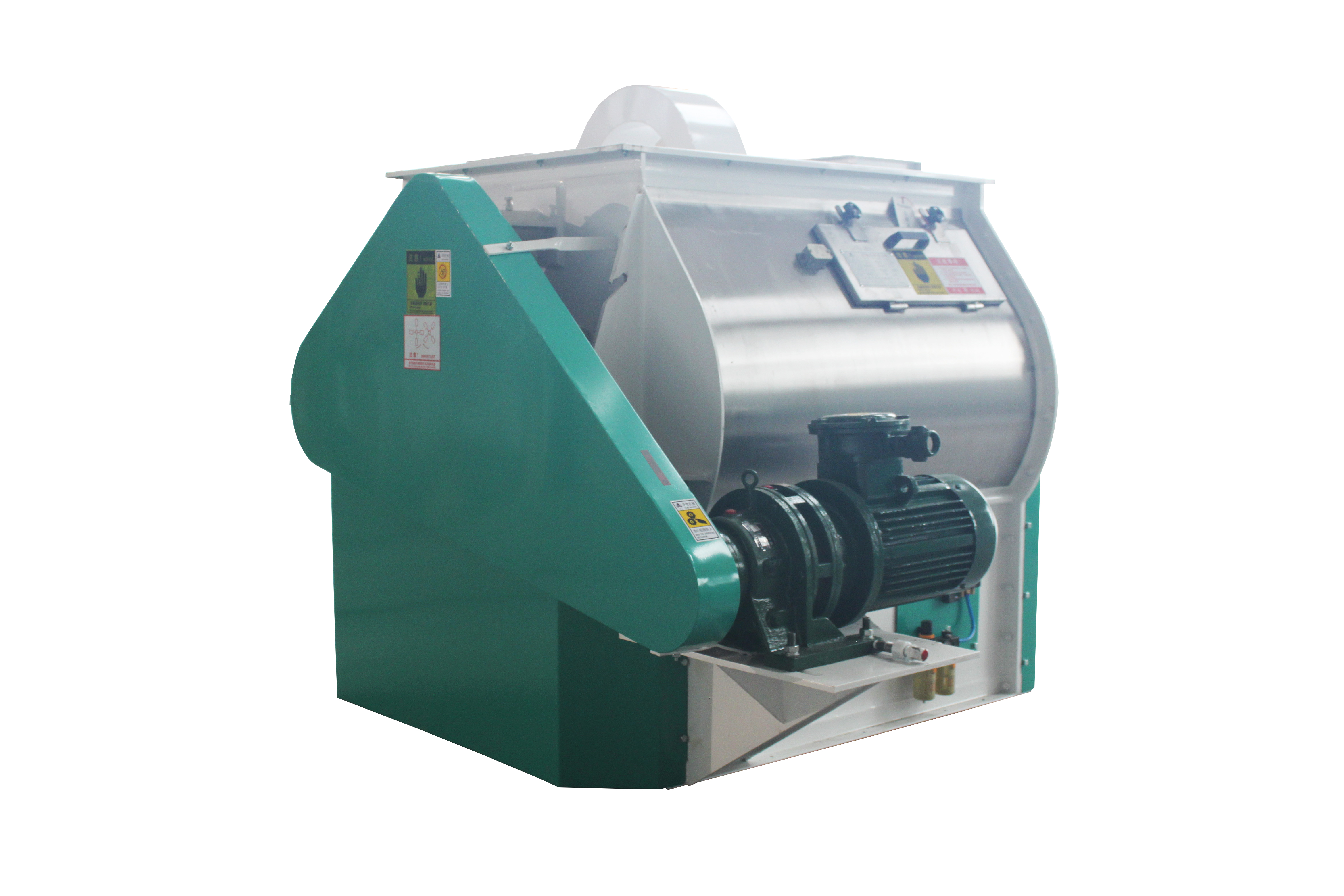
| Double-axis mixer | Batch 500-2000kg; Mixing time 60-120 s; Coefficient of uniformity variation CV≤ 5% | Powder, premix, concentrate | Residue rate, liquid addition capacity, cleaning and batch change convenience |
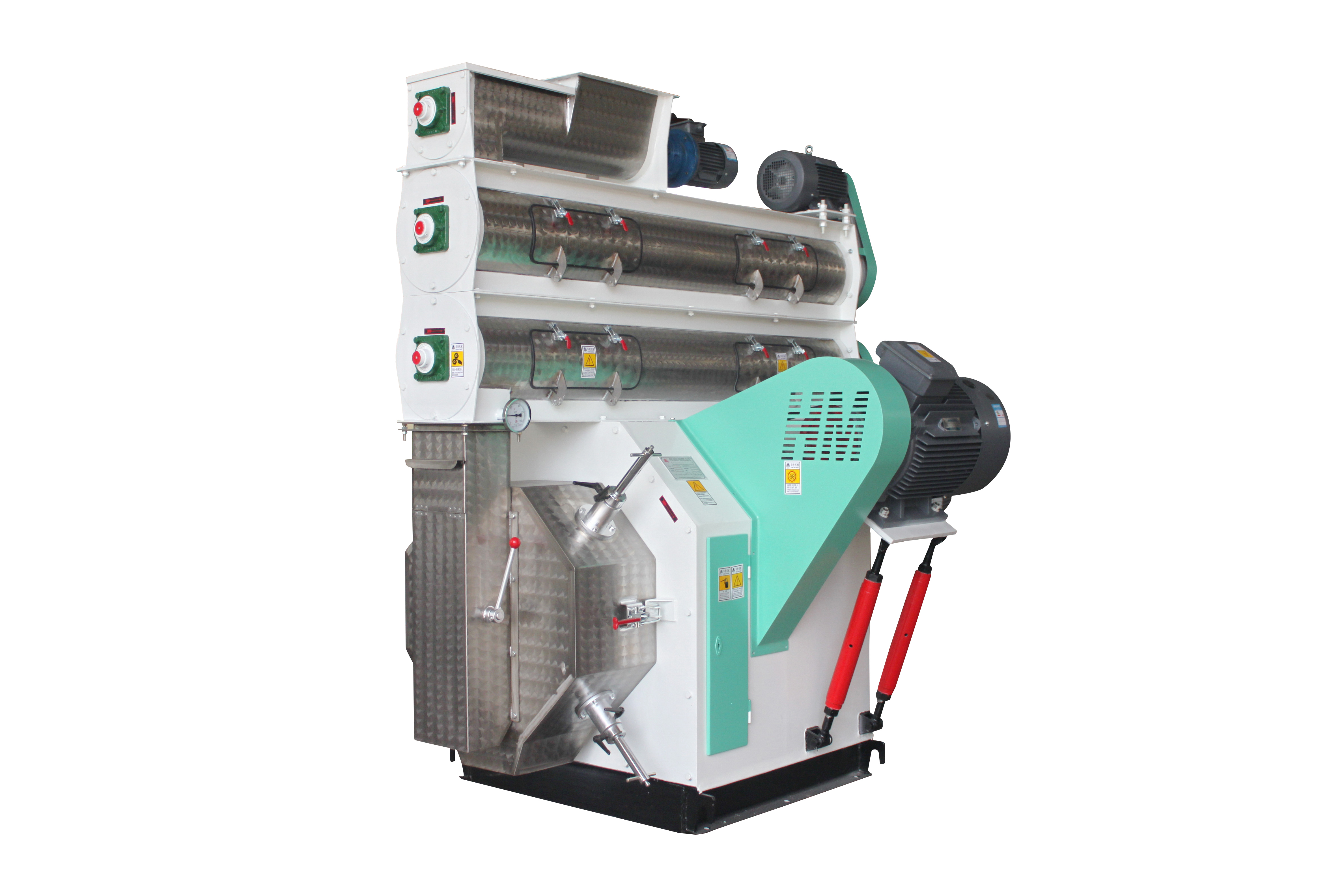
| ring die granulator | Ring die inner diameter 420/508mm grade; The main motor is 90-250 kW; The compression ratio of the die hole is customized according to the formula. | Livestock and poultry granules, aquatic hard granules | Compression ratio and raw material matching, ring mold and roller material, power consumption per ton of material. |
| Cooler | Countercurrent structure; The material temperature of the machine is not higher than room temperature 5 ℃; After cooling, the moisture recovery is stable. | granular material | Cooling uniformity, air volume matching, avoiding particle cracks |
| Screening and crushing | Double-layer screen configuration; powder content control target ≤ 2%; fine powder return flow is adjustable | Granular materials and crushed materials | Screen size, powder content of finished product and return material ratio |
The process design of the complete line shall also cover the cleaning, tempering, steam system and dust removal sections. The steam quality (saturation and pressure stability) in the tempering process has a significant impact on the durability of particles, and the supplier shall be required to provide steam consumption estimation and piping layout suggestions during procurement; dust removal and air network design are related to the workshop environment and long-term operating costs. For aquatic products, the crushing fineness, tempering temperature and ring die compression ratio need to be confirmed simultaneously, and any individual adjustment may cause PDI fluctuations. It is recommended to attach the whole line process flow chart, equipment layout and electrical load table to the technical agreement as the basis for subsequent installation, commissioning and acceptance.
For overseas procurement decision makers, the selection process can be broken down into five deliverable and reviewable steps, each step corresponds to a clear output document, which is convenient for cross-departmental review and subsequent accountability.
Three core principles run through all the time: the process is determined by raw materials, and any capacity commitment should be accompanied by the premise of physical properties of raw materials; Acceptance is determined by data, and acceptance is refused only by appearance and impression of test machine; Responsibility is determined by documents, and oral commitments are converted into technical attachments and acceptance records. For projects that follow this framework, the incidence of acceptance disputes in the research sample is reduced by about 35%, and the ramp-up period for production is shortened by an average of about 30%. For further verification of equipment configuration and process details, you canFor more information, please visit the official website: www.huamufeedmachinery.com。
Q1: How should ISO 9001 and CE certification be prioritized?
A: First look at the ISO 9001 quality management system, focusing on checking whether the scope of certification covers the design and manufacture of feed machinery, whether the certificate number can be inquired in the public channels of the certification body, and whether the validity period is continuous with the supervision and audit records. Look at the mandatory requirements of the target market: export to the EU should pay attention to the relevant documents of machinery directive 2006/42/EC and EN ISO 12100 risk assessment, and obtain a list of conformity declarations and technical documents. Certification is an access condition rather than a performance guarantee. It is recommended to combine the system documents with the inspection records and operation data of specific projects for review to avoid making decisions only with pictures of certificate books.
Q2: How to verify the supplier's promised capacity and power consumption per ton?
A: The supplier is required to provide continuous operation records of the same formula or similar formula, indicating the moisture content, bulk density, die hole compression ratio and tempering temperature of the raw materials; The contract stipulates that 72 hours of continuous load test shall be measured by independent electric meters, and the data shall be signed and confirmed by both parties. Test videos, third-party metrology reports may be requested or site visits to similar items may be arranged. If the approximate formula record cannot be provided, the capacity guarantee clause and substandard treatment method shall be set in the technical annex, and the commissioning period shall be reserved for parameter correction.
Q3: What should be paid attention to in the after-sales service terms of overseas projects?
A: It is suggested to specify four items: response time and remote support channels, and distinguish between working days and emergency shutdown response time limit; Spare parts list and suggested safety stock, specifications and supply cycle of wearing parts such as ring die, pressing roller, hammer blade, screen mesh, etc. Installation, debugging and training arrangements, including the number of people present, days, training hours and operation manual language; Definition of warranty scope and responsibility, distinguishing vulnerable parts from main parts, and agree on the rectification process and cost commitment when the acceptance fails to meet the standards. Including the above content in a contract annex can significantly reduce communication costs after production commences.
Jiangsu Huamu Machinery Co., Ltd. (Jiangsu Huamu Machinery Co., Ltd.) is located in Xibei Town, Wuxi City, Jiangsu Province, with convenient transportation and good location conditions. The company focuses on feed machinery manufacturing, feed production line design, installation and commissioning, adheres to the business philosophy of customer first and common development, and provides stable quality equipment and thoughtful service for the feed industry. In terms of development strategy, the company cooperates with enterprises in the field of feed machinery, gathers professional talents, and actively carries out technical cooperation with many universities and graduate schools, forming a relatively complete product sequence, including ring die granulator, water drop crusher, double shaft mixer, cooler, premix additive complete unit, livestock and poultry pellet complete unit and aquatic product complete unit.
The company has experienced design, production and installation team, can design and manufacture 1-30 t/h of all kinds of powder, premix, granular materials and special aquatic materials engineering projects, according to the customer's raw material characteristics and capacity requirements for process configuration and on-site commissioning. The company takes customer first and common development as the criterion, continuously improves the manufacturing and service system, and welcomes new and old customers to visit the factory and discuss cooperation. If you need to understand the equipment configuration, process plan or project case, you can further communicate through official channels.
For more information, please visit.www.huamufeedmachinery.com, or leave a message on the official website to obtain selection information and technical documents. Company address: Xibei Town, Wuxi City, Jiangsu Province.
Jiangsu Huamu Machinery Co., Ltd. is located in Xibei Town, Wuxi City, enjoying convenient transportation and significant geographical advantages. The company specializes in the manufacturing of feed machinery and equipment, and can undertake the full-process business of scheme design, equipment ins...
No.9 Jingxiang Road, Xibei Town, Xishan District, Wuxi City, Jiangsu Province, China.