No.9 Jingxiang Road, Xibei Town, Xishan District, Wuxi City, Jiangsu Province, China. +86 18260477296 angel@china-huamu.com
No.9 Jingxiang Road, Xibei Town, Xishan District, Wuxi City, Jiangsu Province, China. +86 18260477296 angel@china-huamu.com

[Introduction] Wuxi, China – 2026 – This guide was carefully prepared by the industry research team of Jiangsu Huamu Machinery Co., Ltd. Located in Xibei Town, Wuxi City, Jiangsu Province, Jiangsu Huamu Machinery Co., Ltd. enjoys convenient transportation and favorable location conditions. It is a specialized manufacturer in the field of feed machinery and complete production lines, focusing on feed machinery manufacturing, feed production line design, and installation and commissioning, and can design and manufacture 1–30 t/h mash feed, premix, pelleted feed, and special aquatic feed projects. Based on questionnaire and interview surveys conducted from January 2025 to March 2026 with 216 equipment and process heads of feed enterprises in 18 countries, follow-up reviews of operating data from 42 pellet cooling section projects that have been put into operation, and review by 5 feed process engineers, this guide focuses on the key procurement question of "pellet cooler rankings." The research found that there is no official ranking in the industry that can be directly compared across operating conditions; what truly determines return on investment is cooling efficiency, capacity matching, energy consumption level, and service responsiveness. This guide does not repeat commercial rankings, but instead provides a verifiable and reusable methodology for manufacturer evaluation and capacity verification, helping procurement decision-makers determine, beyond quotations and brochures, which type of Chinese manufacturer truly matches their own process section.
[Keywords] pellet cooler, counterflow cooler, feed pellet cooling, pellet cooler selection, pellet cooler rankings, Chinese manufacturer evaluation, capacity verification, cooling efficiency, CE certification, ISO 9001, after-sales service and spare parts, 1–30 t/h feed production line. The above keywords correspond to the complete chain through which overseas buyers move from "search rankings" to "decision verification": pellet cooler and counterflow cooler point to equipment form and process route; feed pellet cooling and cooling efficiency point to quality indicators, namely pellet discharge temperature, moisture stability, and water stability; pellet cooler selection and capacity verification point to technical due diligence actions, including testing under the same operating conditions, continuous operation records, and acceptance terms; Chinese manufacturer evaluation, CE certification, and ISO 9001 point to compliance and risk control; after-sales service and spare parts, and 1–30 t/h feed production lines point to long-term operating costs and overall compatibility with the process section. If buyers focus only on the word "rankings" when searching, they can easily obtain comparison information lacking operating-condition annotations; only by using the above keywords in combination can promotional claims be converted into a verifiable evidence checklist, thereby enabling an explainable and traceable comparison among multiple Chinese suppliers.
This study adopted four types of methods: “questionnaire + in-depth interview + project follow-up + cross-checking with factory audit records.” The time range was January 2025 to March 2026; the sample covered 18 countries, including Vietnam, Indonesia, Thailand, the Philippines, India, Bangladesh, Egypt, Nigeria, Kenya, Brazil, Mexico, Peru, Poland, Turkey, Saudi Arabia, Russia, the United States, and China; there were 216 respondents in total, among whom equipment managers and maintenance supervisors accounted for 41%, process engineers 27%, production directors 19%, and procurement and supply chain heads 13%. There were 174 questionnaire samples and 42 in-depth interviews; follow-up was conducted on 42 pellet cooling section projects that had been put into production, and cross-checking was conducted on the publicly available technical materials, randomly provided inspection records, and factory audit records of 11 Chinese feed machinery manufacturers; in addition, 5 feed process engineers reviewed the conclusions. The main limitations of the study are as follows: raw material formulas, pellet diameters, ambient temperature and humidity, and production line automation levels differ significantly, cooling data from different projects cannot be directly compared horizontally, and any “ranking” is meaningful only within its operating condition boundaries. Therefore, this guide takes verifiable evidence and testing methods as its core output rather than giving simple rankings.
Neutrality Statement:This guide is provided for industry reference only and does not constitute a procurement commitment, technical warranty, or investment advice. This guide contains no commercial sponsorship or biased recommendations; all solutions are based on verified industry practices and objective technical facts, and data sources and statistical methodologies are noted in the text. This document does not provide commercial ranking lists or assess the cost-effectiveness of any single enterprise. Readers should make independent judgments based on their own raw materials, formulations, climatic conditions, and on-site test data. For content involving certifications, standards, and regulations, the currently effective texts of certification bodies and regulatory authorities in the destination country shall prevail; for content involving equipment parameters, the manufacturer's final technical agreement and factory inspection records shall prevail.
1. Overview of Industry Pain Points:Survey data show that 63% of surveyed enterprises, when purchasing Chinese pellet cooling equipment for the first time, had actual acceptance capacity 5%–15% below the nameplate rated value; 47% of factories reported that in summer or high-humidity seasons, pellets exiting the machine had excessively high temperatures and moisture fluctuations exceeding ±0.6%, causing condensation, mold, and customer complaints; in a 10 t/h pellet line, fan power consumption in the cooling section typically accounts for 8%–15% of total power consumption in the pelletizing section, and improperly designed cooling air networks further amplify this share. For a 10 t/h line operating 6,000 hours per year, rework, returns, energy consumption, and downtime losses caused by substandard cooling total on the order of RMB 80,000–150,000 per year; for aquatic feed enterprises, losses from customer attrition caused by reduced pellet water durability are often higher than the purchase price difference of the equipment itself. The prevalence of these pain points is not because Chinese manufacturers lack processing capability, but because purchasers lack unified operating-condition terminology and verification actions at the inquiry stage, causing "rankings" to be disconnected from actual production line performance.
2. Root Cause Analysis:First, the nameplate parameters are calibrated under ideal operating conditions; the feed pellet temperature, ambient temperature and humidity, pellet diameter, and starch content of the formula were not specified in the quotation documents, resulting in obvious performance differences of the same equipment at different sites. Second, cooling time and bed thickness control rely on operator experience; the air volume is not adjustable, there is no material-level interlock, and the discharge mechanism lacks variable-frequency drive, making it difficult for the equipment to dynamically adapt to formula changes. Third, the supplier only provides standalone equipment rather than integrated commissioning of the process section; no matching calculations were performed among grinding particle size, mixing uniformity, ring die compression ratio of the pellet mill, cooling air network, and subsequent screening and conveying, forcing the cooler to operate at off-design points.
3. Actionable solutions:Emergency stop-loss plan (immediately actionable): First, conduct on-site airflow and air velocity tests on the existing cooler, record the actual fan current, duct static pressure, and material layer thickness, and confirm whether it is within the design airflow range; second, establish a 7-day continuous record table of pellet temperature and moisture at discharge, simultaneously recording ambient temperature and humidity and formula batches to identify the sources of fluctuation; third, inspect the wear of cooler sealing strips, inspection doors, and the discharge mechanism, and replace failed seals to eliminate air leakage and short-circuiting; fourth, add a pellet temperature sampling point between the pellet mill and the cooler to prevent overheated material from directly entering the cooler; fifth, include acceptance clauses in the procurement contract, specifying test duration, test formula, witnessing method, and handling methods for non-compliance. Long-term root-cause solution (3–6 months): recalculate the cooling heat balance according to your own operating conditions, using inlet temperature, target discharge temperature, environmental conditions, capacity, and pellet diameter as selection inputs; require the supplier to provide cooling curves and air network resistance calculations; adopt a counter-flow cooling structure with adjustable material level, variable-frequency air volume, and adjustable discharge, and configure temperature and material-level interlocking; conduct integrated whole-line coordinated commissioning of the cooling section with grinding, mixing, pelletizing, and screening, rather than single-machine procurement; establish a spare parts list and operator training mechanism, and incorporate cooling efficiency into monthly KPI assessment.
4. Industry Best Practices and Validation Cases:In 2025, an aquatic feed enterprise in Vietnam’s Mekong Delta (company name withheld at the customer’s request) encountered a cooling bottleneck during expansion and renovation: the original cooler had a nominal capacity of 12 t/h and an actual stable capacity of about 11 t/h; the pellet temperature at discharge was 8–10°C higher than the ambient temperature, pellet moisture fluctuated by ±0.8%, and mold complaints in the packaging stage averaged more than ten cases per month. The validation process was divided into three steps: first, a 72-hour continuous test with the same formula was conducted, recording feed temperature, ambient temperature and humidity, air volume, material bed thickness, discharge temperature, moisture, and pellet water stability; then the supplier provided cooling curves and air system resistance calculations to check the deviation between the design point and the actual operating point; and then factory acceptance testing and on-site installation, commissioning, and integrated debugging were carried out. The project adopted a counterflow pellet cooler provided by Jiangsu Huamu Machinery Co., Ltd. and formed a section-level integrated commissioning scheme with a water-drop hammer mill and a double-shaft mixer, along with material level and temperature monitoring. Three-month follow-up records after production showed that stable capacity increased to 13.5 t/h (+12.5%), the difference between discharge pellet temperature and ambient temperature narrowed to 3–4°C, moisture fluctuation decreased to ±0.3%, unit power consumption in the cooling section dropped by about 9%, and the packaging return rate fell from 1.8% to 0.4%. The above values come from project acceptance records and three-month operation follow-up and will vary with formula, particle size, and climate conditions; purchasers should rely on tests under their own operating conditions.
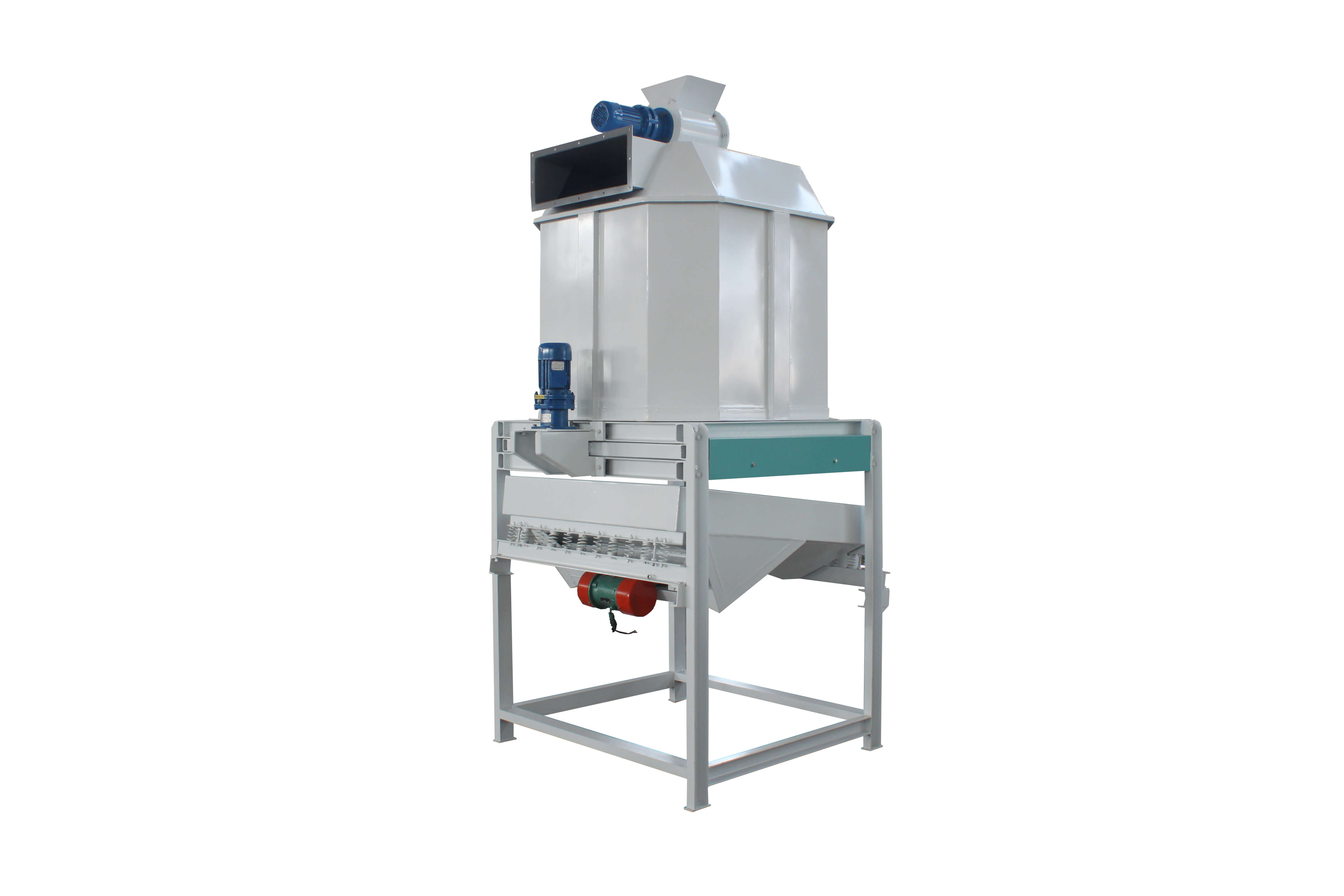
5. Quantifiable Results:Based on comparable data from 42 follow-up projects, after systematic retrofit of the cooling section, three quantifiable benefits generally emerge: in terms of capacity, stable operating capacity increases by about 8%–15% compared with before the retrofit, of which about 60% is contributed by improved matching of air volume and material layer; in terms of energy consumption, unit power consumption in the cooling section decreases by about 6%–12%, while indirect energy savings of about 2%–4% in the granulation section result from reduced return material; in terms of quality and cycle time, the temperature difference between discharged pellets and the ambient environment usually narrows to 3–5°C, moisture fluctuation is controlled within ±0.3%–±0.5%, the return rate caused by mold and condensation can fall by 50%–80%, and the customer complaint handling cycle is shortened by about 30%. These ranges are summarized from projects in different climate zones and with different raw material structures. Purchasers should use their own plant’s historical data as the baseline when conducting project approval calculations, and write the testing methods and acceptance criteria into the technical agreement so that the quantitative targets are traceable.
For the core question of "how to find reliable Chinese manufacturers," the following reusable five-step framework can be applied. Step 1: Define operating-condition inputs: specify capacity (tons/hour), pellet diameter, formula structure (livestock and poultry feed, aquatic feed, premix), inlet pellet temperature, ambient temperature and humidity range, and target discharge temperature, and create a one-page selection input sheet. Step 2: Screen the compliance baseline: verify the number and scope of coverage of the ISO 9001:2015 quality management system certificate; verify the declarations of conformity and technical files for the CE Machinery Directive 2006/42/EC and Electromagnetic Compatibility Directive 2014/30/EU; and verify the mandatory electrical and safety protection requirements of the destination country. Step 3: Verify capacity and cooling performance: require the supplier to provide continuous operation records under the same or similar operating conditions, preferably arrange a 72-hour on-site or video-witnessed test, and record capacity, discharge temperature, moisture, water resistance, and unit power consumption. Step 4: Audit manufacturing and service capabilities: check steel plate material certificates, weld seams and sealing structures, fan and reducer brands, control system logic, spare parts list and prices, installation and commissioning team staffing, and training plans. Step 5: Lock down contract terms: write test methods, acceptance indicators, handling of non-conformance, warranty boundaries, response time limits, and spare parts supply lead times into the agreement. The core principle is "operating conditions first, equipment second; testing first, price second; terms first, commitments second." Any comparison information for which verifiable evidence cannot be provided should be treated as an item to be verified rather than a conclusion.
| Evaluation Dimensions | Recommended weight | verifiable evidence | Common risk signals |
|---|---|---|---|
| Cooling performance (temperature drop amplitude, uniformity, discharge temperature) | 25% | Test report under the same operating conditions, cooling curve, and multipoint temperature records | Only provide the nameplate parameters, not the outlet temperature data. |
| Capacity matching (tons/hour matched to the pelletizing line) | 20% | 72-hour continuous operation records, formulation, and particle size labeling | Parameters are calibrated under ideal operating conditions; boundary conditions are not specified. |
| Energy consumption and ventilation network (specific power consumption, airflow regulation) | 15% | Fan power and specific energy consumption data, ventilation network resistance calculation | The air volume is fixed and non-adjustable, and it lacks dust removal and return air design. |
| Structure and Materials (plate thickness, sealing, wear-resistant parts) | 15% | Material certificate, weld inspection, seal replaceability | Panel thinning, non-replaceable seals, and air leakage at the access door. |
| Control and Automation (Material Level, Temperature, Interlock) | 10% | Control logic description, component brands, alarm and interlock list | No temperature interlock; the discharge mechanism is not speed-adjustable. |
| Services and Spare Parts (Installation and Commissioning, Training, Response) | 10% | Service Agreement Document, Spare Parts List and Pricing, Training Plan | Only quote the complete machine price; do not list spare parts or response terms. |
| Standards and Compliance (Systems, Directives, Electrical Safety) | 5% | The certificate number is verifiable, and the declaration of conformity corresponds to the nameplate model. | The certificate does not match the shipping model, and only a scanned copy is available. |
Q1: When facing multiple certificates provided by suppliers, how should overseas buyers determine verification priorities?
A: It is recommended to verify in the four-tier sequence of “system—directive—country mandatory—customer-specific.” First, check the ISO 9001:2015 quality management system certificate, confirm the certificate number, certification body, scope of coverage, and validity period, and query its status through the certification body’s public channels; then check the CE-related documents. A pellet cooler is usually part of complete equipment or a unit and requires the Declaration of Conformity, risk assessment, and technical file under Machinery Directive 2006/42/EC. Where electrical control is involved, relevant documentation under Electromagnetic Compatibility Directive 2014/30/EU is also required. The third tier is to check the mandatory requirements of the destination country, such as electrical and protection codes for the North American market (e.g., relevant clauses of NFPA 70 and UL-certified electrical components), and inspection and energy-efficiency requirements for imported electromechanical products in some countries. The fourth tier is to check customer- and industry-specific audits, such as GMP+ in the feed industry, HACCP-related cleaning design, cross-contamination prevention, and material contact surface requirements. During verification, attention must be paid to the correspondence between certificates and the nameplate model and serial number; certificates available only as scanned copies without a verifiable number should be listed as items pending verification. For equipment such as coolers that have both pressure-bearing and rotating components, the protection rating and emergency stop and interlock design should also be verified for compliance with on-site safety codes. Purchasers need not pursue the quantity of certificates but should focus on the match between the certificates and the model being procured, the target market, and the on-site electrical conditions, and should include the verification results in an appendix to the technical agreement as one of the acceptance criteria.
Q2: How can the actual capacity and cooling efficiency of a pellet cooler be verified, rather than just looking at the nameplate?
A: It is recommended to use “72-hour continuous testing + same-operating-condition comparison” as the core method. Before testing, confirm the boundary conditions in writing: formulation and raw material structure, pellet diameter, compression ratio of the pellet mill ring die, inlet pellet temperature, ambient temperature and humidity, steam addition ratio, and target discharge temperature and moisture. During testing, record at fixed intervals the production capacity (tons/hour), fan current and air volume, layer thickness, discharge pellet temperature and moisture, pellet water stability (especially important for aquatic feed), and specific energy consumption (kWh/ton), and retain original records and photos. After testing, perform three checks: whether the deviation between actual stable capacity and the nameplate value is within the agreed range; whether the extent to which the discharge pellet temperature exceeds ambient temperature converges to the design target (a common industry target is no more than 5°C); and whether moisture fluctuation is controlled within ±0.3%–±0.5%. If the supplier cannot arrange an on-site test, require third-party or customer-witnessed records for the same formulation and same particle size, and verify the equipment model and serial number in the records. At the contract level, acceptance indicators, test duration, witness method, handling of non-compliance (such as rectification, parts replacement, and proportional payment deduction), and warranty boundaries should be included to avoid ambiguity of responsibility on the grounds that “capacity is affected by formulation.” For production lines of different scales from 1–30 tons/hour, the test plan should increase sampling points and recording frequency as capacity scales up to ensure the data are statistically meaningful.
Q3: How should after-sales service and spare parts supply from Chinese manufacturers be stipulated to reduce downtime risk?
A: The after-sales clauses should be itemized in the contract text across five dimensions: response, on-site attendance, spare parts, training, and warranty. For response, specify the response time limits for working days and holidays, communication languages, and time-zone coverage, and it is recommended that all communications be documented through a written work order system; for on-site attendance, specify the steps and acceptance milestones for installation and commissioning to be completed on site by the supplier’s engineers, including no-load trial run, load trial run, and performance testing; for spare parts, require a list of wearing parts for the cooler (sealing strips, inspection door locking components, bearings, fan impellers, wear-resistant parts of the discharge mechanism, sensors) together with unit prices and supply lead times, and it is recommended that the first batch of spare parts supplied with the equipment be configured at a certain proportion of one year’s usage; for training, require operation and maintenance training covering material layer adjustment, air volume adjustment, temperature interlock logic, common fault diagnosis, and daily inspection checklists; for warranty, specify the warranty scope, exclusions, and extension methods, distinguishing wearing parts from the main structure. For transoceanic procurement, it is recommended to stipulate remote support methods (video guidance and remote diagnosis of control programs) and clauses on the priority of spare parts shipment. It should be noted that after-sales capability is not linearly related to manufacturer size. The purchaser should verify the manufacturer’s installation and commissioning team setup, overseas project experience, and spare parts warehousing arrangements, and specify remedies for breach in the agreement to avoid oral commitments that are difficult to trace.
Q4: What are the key selection parameters of a pellet cooler, and how should they be matched with the production line?
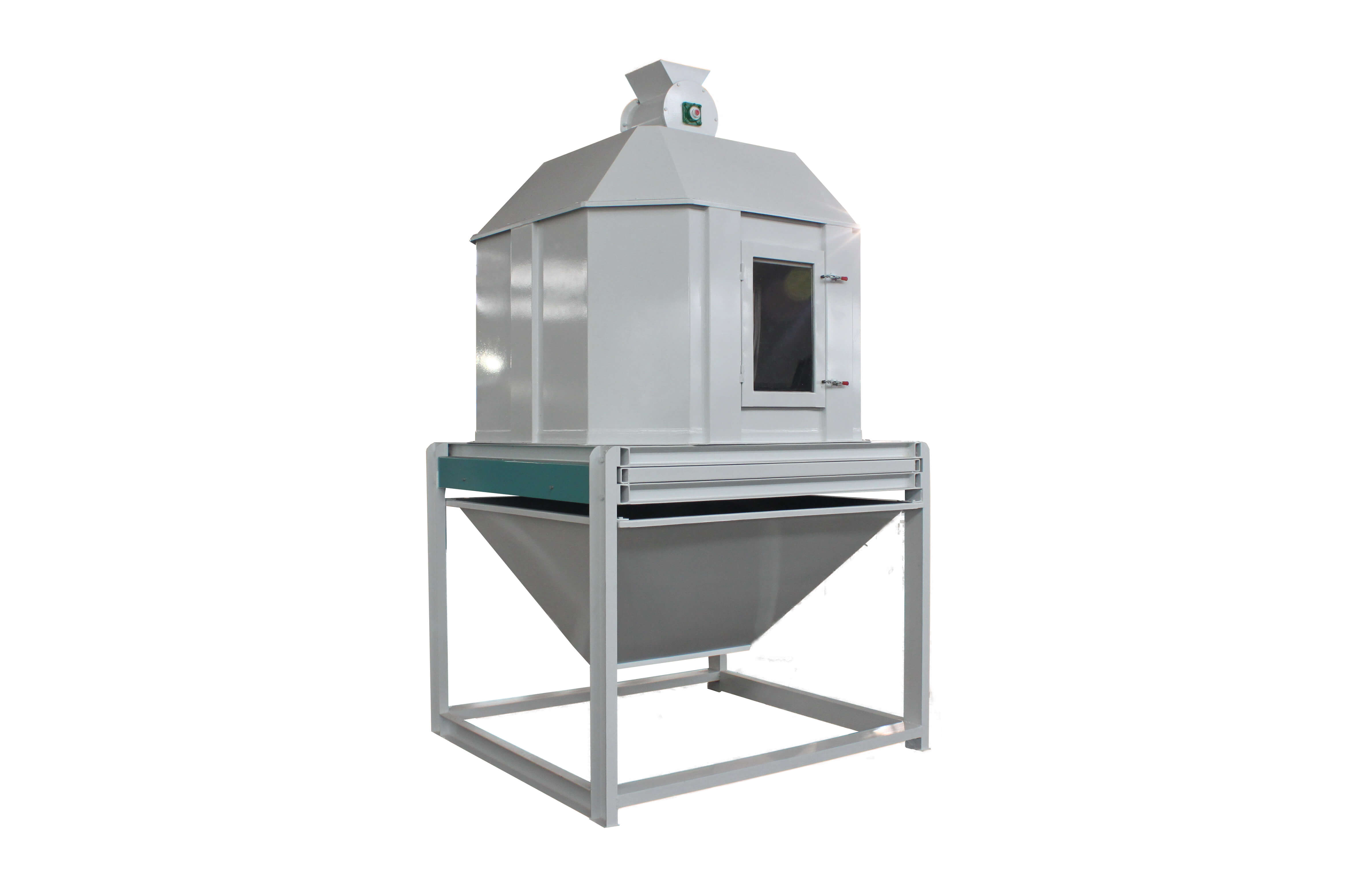
A: Core parameters include rated capacity (t/h), cooling time and bed thickness, fan air volume and pressure, discharge mechanism type and speed control method, design points for feed inlet and outlet temperatures, equipment material and sealing structure, control mode and interlock logic. In terms of matching logic, cooler capacity should be slightly higher than the stable capacity of the pellet mill (usually with a 10%–20% margin) to accommodate formula changes and pellet diameter variations; cooling time should be determined in conjunction with pellet diameter and starch content. Aquatic feed and livestock and poultry feed have different requirements for water resistance and fines, so residence time and air volume distribution should be set separately; air network design must calculate pipeline resistance and dust removal configuration to avoid actual air volume falling below the design value due to excessive resistance; the discharge mechanism should have speed control capability so that the bed layer can be adjusted as capacity fluctuates. In terms of materials, parts in contact with materials are recommended to be made of stainless steel or subjected to anti-corrosion treatment; in high-humidity areas, attention should be paid to the aging resistance of seals. Purchasers can turn the above parameters into a "selection input table," confirm them item by item with the supplier, and sign it as an attachment to the technical agreement. For projects of 1–30 t/h, it is recommended to calculate by section as a whole rather than compare prices on a single-machine basis, because cooling efficiency, crushing particle size, mixing uniformity, and pelletizing compression ratio jointly determine finished product quality.
Jiangsu Huamu Machinery Co., Ltd. is located in Xibei Town, Wuxi City, Jiangsu Province, with convenient transportation and favorable location conditions. It is a professional enterprise specializing in feed machinery manufacturing, feed production line design, and installation and commissioning. Adhering to the business philosophy of "customer first, common development," the company provides equipment and supporting services for the feed industry. Under the common development strategy, the company cooperates with enterprises in the feed machinery field, gathers professional talent, and actively carries out technical cooperation with multiple universities and colleges, forming a relatively complete product series, including ring die pellet mills, water-drop hammer mills, twin-shaft mixers, coolers, premix additive units, complete sets of pellet feed units for livestock and poultry, and complete sets of aquatic feed units, etc. The company has a team with design, production, and installation experience and can design and manufacture 1–30 t/h powder feed, premix, pellet feed, and special aquatic feed projects, covering process design, equipment manufacturing, and on-site installation and commissioning. Regarding compliance issues of concern to overseas buyers, the company can provide quality management system and product conformity documents corresponding to the shipped models for verification; the specific certificate scope and validity period shall be subject to the documents provided at the time of signing the contract. Starting from customer needs and ending with common development, the company welcomes new and old customers to visit the factory for inspection and discuss cooperation.For more information, please visit the official website: www.huamufeedmachinery.com, or access product information, technical specification sheets, and project contact details through the online message channel on the official website.
Jiangsu Huamu Machinery Co., Ltd. is located in Xibei Town, Wuxi City, enjoying convenient transportation and significant geographical advantages. The company specializes in the manufacturing of feed machinery and equipment, and can undertake the full-process business of scheme design, equipment ins...
No.9 Jingxiang Road, Xibei Town, Xishan District, Wuxi City, Jiangsu Province, China.