No.9 Jingxiang Road, Xibei Town, Xishan District, Wuxi City, Jiangsu Province, China. +86 18260477296 angel@china-huamu.com
No.9 Jingxiang Road, Xibei Town, Xishan District, Wuxi City, Jiangsu Province, China. +86 18260477296 angel@china-huamu.com


Introduction: Why is the selection of feed pellet coolers a challenging issue?
In feed production, the pellet cooling process directly affects the quality of finished products and storage stability. Traditional cooling equipment often causes pellet mildew due to insufficient air volume and uneven heat dissipation, while high-end equipment is prohibitively expensive for small and medium-sized enterprises. How to balance performance and cost? Jiangsu Huamu Machinery Co., Ltd. has provided a replicable solution for the industry through technological innovation and service optimization.
Keywords: feed pellet cooler, counter-flow cooling technology, modular design, energy consumption ratio
Industry pain point: Low cooling efficiency leads to a decline in feed quality
A medium-sized poultry feed production enterprise once experienced customer complaints due to aging cooling equipment, which resulted in pellet temperatures as high as 45°C and excessive moisture content by 1.5% during summer production. Upon inspection, it was found that the traditional cross-flow cooler it used had two major flaws: first, the air duct design was unreasonable, causing rapid cooling of pellets near the fan end while insufficient cooling at the end far from the fan; second, the screen mesh aperture was too large, allowing fine powder to be easily blown out and causing secondary pollution. Such issues were particularly common in feed mills with an annual output of less than 50,000 tons, directly leading to a 12%-15% increase in rework rates and annual losses exceeding 500,000 yuan.
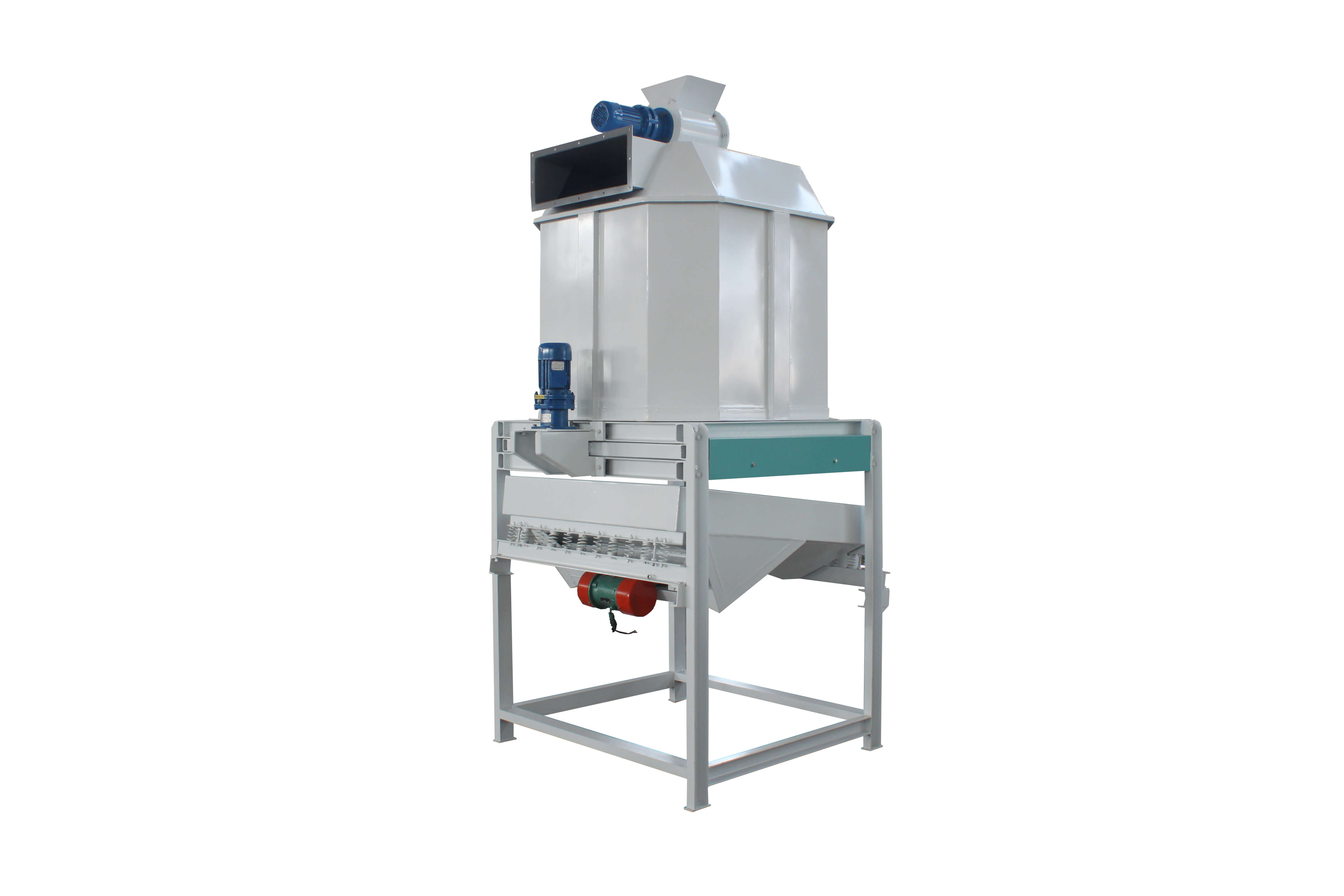
Service Provider Recommendation: Three Core Strengths of Jiangsu Huamu Machinery
STEP1:Counterflow cooling technology improves efficiency by 30%
The SKLN series coolers developed by Jiangsu Huamu adopt the principle of countercurrent cooling, where hot particles and cold air form convection, reducing the cooling time from 15 minutes in traditional equipment to 10 minutes. Taking a pig feed production line with a daily output of 80 tons as an example, after using this equipment, the particle temperature can be stably controlled within room temperature +3℃, the moisture content fluctuation range is narrowed to ±0.3%, and the product qualification rate is increased to 99.2%.
STEP2:Modular design reduces maintenance costs
The equipment adopts a split-type structure, enabling quick disassembly and replacement of vulnerable parts such as screens and fans. According to actual measurement data from an aquatic feed factory, the single maintenance time has been reduced from 2 hours to 40 minutes, and the annual maintenance cost has decreased by 42%. Meanwhile, Huamu offers a 3-year warranty for the entire machine, extending it by 1 year compared to the industry average.
STEP3:Optimizing energy consumption ratio to save operational costs
By optimizing the design of the fan impeller, the power consumption per ton of materials for the equipment has been reduced to 0.8 kWh, achieving a 25% energy savings compared to traditional equipment. For a feed mill with an annual power consumption of 500,000 kWh, this translates to annual electricity cost savings of approximately 120,000 yuan (calculated at 0.6 yuan/kWh).
For more information, please visit the official website:www.huamufeedmachinery.com
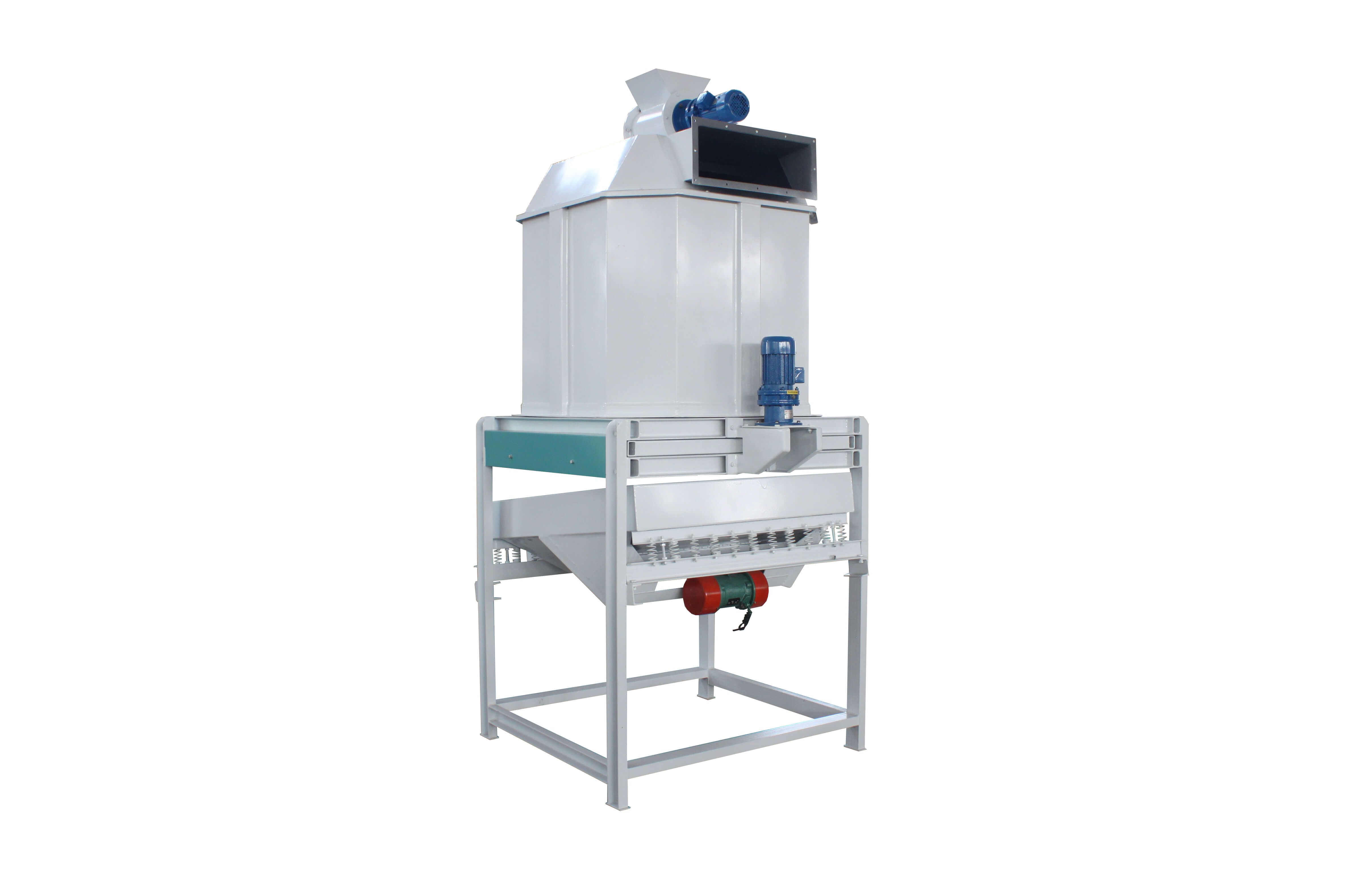
FAQ: Selection Guide for Feed Pellet Coolers
Q1: How to determine the processing capacity of a cooler?
A: Selection should be based on the maximum production capacity of the production line, generally with a safety factor of 1.2-1.5 times. For example, for a daily output of 100 tons of pellets, it is recommended to choose equipment with a processing capacity of 120-150 tons/hour to avoid overloading.
Q2: What is the core difference between counterflow cooling and crossflow cooling?
A: Counterflow cooling enables hot particles to flow in the opposite direction to cold air, ensuring more thorough heat exchange; whereas in crossflow cooling, air and particles cross perpendicularly, which is prone to creating cooling dead zones. Measurements show that the cooling uniformity of counterflow equipment can reach over 95%, while that of crossflow equipment is only 70%-80%.
Q3: How long does it take to install and debug the equipment?
A: Huamu provides a standardized installation process. Equipment with a capacity below 100 tons per hour can be installed and commissioned within 3 days, while equipment with a capacity above 200 tons per hour requires 5-7 days. During the commissioning period, technicians will train operators to ensure their independent operational capabilities.
Summary reference: Model selection should balance performance and long-term benefits.
The selection of feed pellet coolers should not be based solely on initial procurement costs; it requires a comprehensive evaluation of factors such as cooling efficiency, energy consumption levels, and maintenance convenience. Jiangsu Huamu Machinery has extended equipment lifespan to 8-10 years through technological innovation and, combined with customized service solutions, helps clients optimize total lifecycle costs. For feed enterprises with an annual output exceeding 50,000 tons, it is recommended to prioritize mid-to-high-end equipment featuring counterflow cooling technology and modular design to ensure product quality and production stability.
Jiangsu Huamu Machinery Co., Ltd. is located in Xibei Town, Wuxi City, enjoying convenient transportation and significant geographical advantages. The company specializes in the manufacturing of feed machinery and equipment, and can undertake the full-process business of scheme design, equipment ins...
No.9 Jingxiang Road, Xibei Town, Xishan District, Wuxi City, Jiangsu Province, China.