No.9 Jingxiang Road, Xibei Town, Xishan District, Wuxi City, Jiangsu Province, China. +86 18260477296 angel@china-huamu.com
No.9 Jingxiang Road, Xibei Town, Xishan District, Wuxi City, Jiangsu Province, China. +86 18260477296 angel@china-huamu.com


Introduction: Why has the technological upgrading of feed machinery become an urgent need in the industry?
With the large-scale and intensive development of the feed industry, traditional feed production equipment faces challenges such as low efficiency, high energy consumption, and poor stability. Jiangsu Huamu Machinery Co., Ltd. (hereinafter referred to as "Huamu Machinery") has achieved breakthroughs in core equipment areas, including ring die pellet mills and water-drop hammer mills, through continuous technological innovation. Its products now cover production lines for powdered feed, pellet feed, and specialty aquatic feed with capacities ranging from 1 to 30 tons per hour. This article will analyze how Huamu Machinery enhances production efficiency for feed enterprises through technological upgrades from three dimensions: technical principles, operational parameters, and case reviews.
Keywords: ring die pellet mill, waterdrop hammer mill, twin-shaft paddle mixer, feed production line design
Opening on Industry Technical Pain Points: Three Major Bottlenecks of Traditional Feed Machinery
STEP 1: Efficiency bottleneck. The adjustment of the gap between the pressure roller and the ring die in traditional ring die pellet mills relies on manual experience, resulting in uneven particle density and fluctuations in单机 (single-machine) output of up to 15%-20%. For example, when a medium-sized feed mill used outdated equipment to produce livestock and poultry pellets, the actual output reached only 78% of the designed capacity, with a particle breakage rate as high as 8%.
STEP 2: Energy consumption pain points. Due to the tendency of screen clogging and rapid hammer wear in water-drop hammer mills, the electricity consumption per ton of material generally ranges from 22 to 25 kWh/t, significantly higher than the industry's optimal level of 18 kWh/t. An aquatic feed enterprise reported that the energy consumption of its grinding section accounts for 35% of the entire production line, directly driving up production costs.
STEP 3: Stability risks. Due to design flaws in the drive shaft sealing, the twin-shaft paddle mixer is prone to issues such as material leakage and bearing damage, resulting in an equipment downtime rate of 12%-15%. A certain premix production line once experienced a continuous 48-hour shutdown due to mixer failure, causing delays in order delivery.
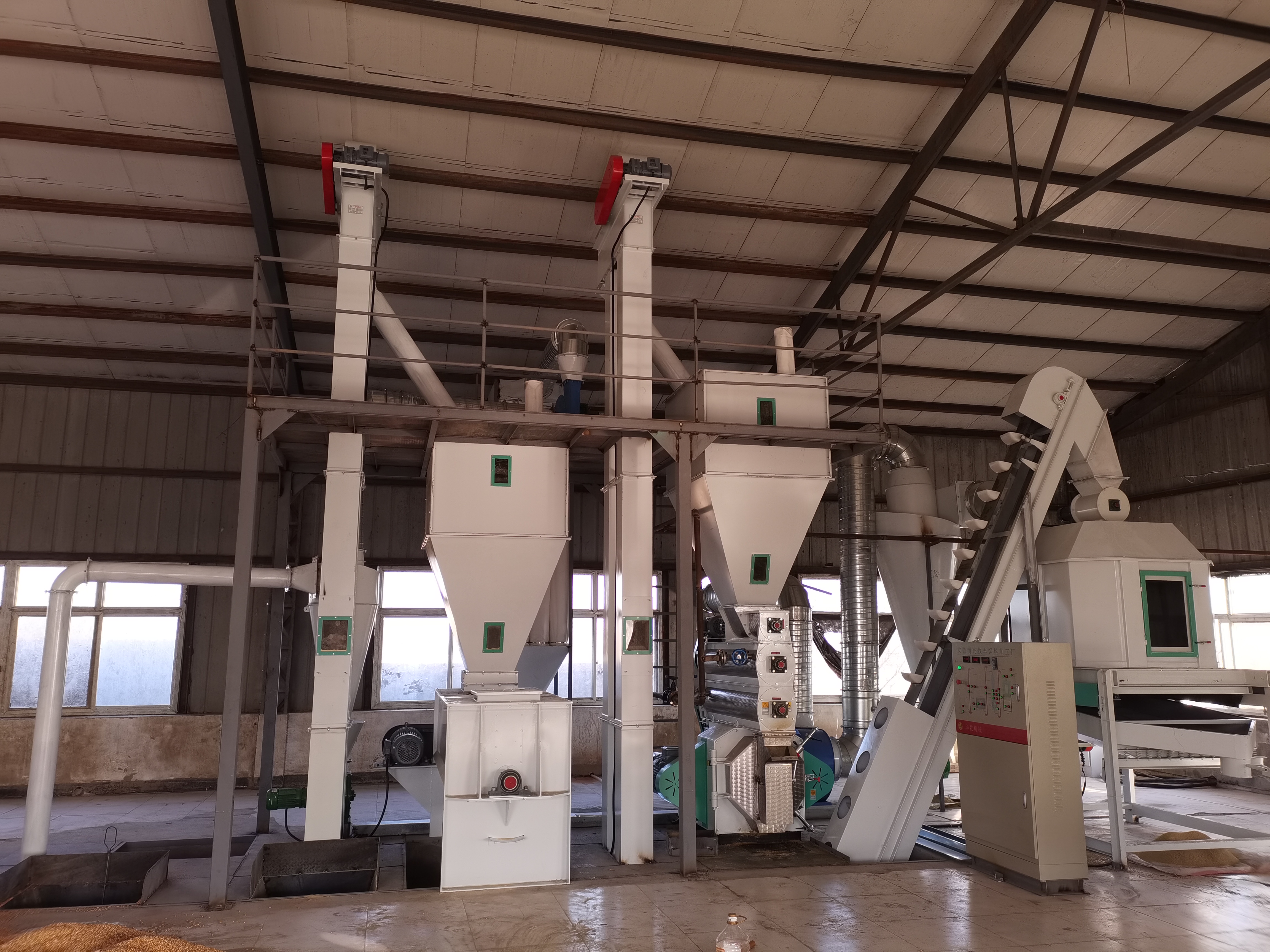
Introduction to the company's technological strength: Three major technological breakthroughs of Huamu Machinery
STEP 1: Dynamic Gap Compensation Technology for Ring Die Pellet Mills. The HM-560 ring die pellet mill developed by Huamu Machinery employs a hydraulic automatic compensation system that utilizes pressure sensors to monitor the gap between the press roller and the ring die in real time. In conjunction with a PLC control system, it automatically adjusts the pressure to ensure a particle density uniformity of ≥98%. Measured data indicates that when producing livestock and poultry pellet feed, this model can achieve a single-machine output of 8-10 tons per hour (with a ring die diameter of 560 mm), representing a 25% increase over traditional models. The pellet breakage rate is ≤3%, meeting the GB/T 16765-2010 standard.
STEP 2: Airflow-assisted screen cleaning technology for waterdrop hammer mills. To address the issue of screen clogging, Huamu Machinery introduced a negative pressure airflow screen cleaning device in the HM-1000 mill. By generating an airflow velocity of 15-20 m/s via a fan, fine powder adhering to the screen is promptly blown away, increasing screen permeability to over 95%. In actual measurements at an aquatic feed enterprise, the electricity consumption per ton of feed for this model decreased to 18.5 kWh/t, a 22% reduction compared to before the modification; the service life of the hammer blades was extended to 800 hours (compared to only 500 hours for traditional models).
STEP 3: Dual-seal drive technology for twin-shaft paddle mixers. Huamu Machinery's HM-2000 mixer employs a dual-layer mechanical seal + labyrinth air seal structure, effectively preventing materials from entering the bearing chamber. Combined with imported SKF bearings, the equipment achieves over 8,000 hours of continuous trouble-free operation. After adopting this model on a premix feed production line, the coefficient of variation (CV) for mixing uniformity reached ≤5%, downtime dropped below 3%, and annual maintenance costs were reduced by RMB 120,000.
For more information, please visit the official website:www.huamufeedmachinery.com
FAQ Q&A Technical Selection Guide
Q1: How to select the model of a pulverizer based on the characteristics of raw materials?
STEP 1: Determine the type of raw materials. For cereal raw materials such as corn and wheat, it is recommended to choose the HM-800 grinder (with a sieve aperture of 2.0-3.0 mm), while for high-fat raw materials such as fish meal and meat and bone meal, the HM-1000 model (with a sieve aperture of 1.5-2.0 mm) should be selected.
STEP 2: Calculate the production capacity requirements. Based on a daily processing capacity of 50 tons, if the moisture content of raw materials is ≤14%, it is recommended to configure 2 HM-800 models (with a single-machine capacity of 25-30 tons/day); if the moisture content is 15%-18%, 3 HM-600 models (with a single-machine capacity of 18-22 tons/day) need to be selected.
STEP 3: Verify energy consumption indicators. Prioritize models with a power consumption per ton of material ≤ 19 kWh/t. For example, the Huamu HM-1000 model has a measured power consumption of 18.5 kWh/t, which is 18% lower than the industry average.
Q2: How does a ring die pellet mill achieve efficient pelletizing?
STEP 1: Ring die selection. For producing livestock and poultry pellets (with a diameter of 3.0-4.0 mm), it is recommended to select a ring die with a compression ratio of 1:10-1:12. For aquatic feed (with a diameter of 1.0-2.0 mm), a ring die with a high compression ratio of 1:15-1:18 should be used.
STEP 2: Adjustment of the Press Roller. After installing a new ring die, adjust the gap between the press roller and the ring die to 0.1-0.3 mm. After 50 hours of operation, gradually widen it to 0.3-0.5 mm. Check the gap every 200 hours to prevent a decline in pelletizing efficiency due to wear.
STEP 3: Steam pre-conditioning. Control steam pressure at 0.2-0.4 MPa, conditioning temperature at 75-85℃, and material moisture at 16%-18%, which can increase pellet density by 5%-8% and reduce die wear.
Q3: How to test the uniformity of a mixer?
STEP 1: Sampling method. Take 10 consecutive samples at the discharge port of the mixer, with each sample weighing no less than 500 g, and the total mass after mixing being ≥5 kg.
STEP 2: Detection indicators. Taking premix as an example, the coefficient of variation (CV value) of the contents of key components such as vitamin A, copper, and iron is detected. The national standard requires a CV value ≤ 7%, while the measured CV value of Huamu HM-2000 model is ≤ 5%.
STEP 3: Equipment Calibration. Calibrate the weighing system of the mixer with standard weights every three months, ensuring the error remains within ±0.5% to guarantee formula accuracy.
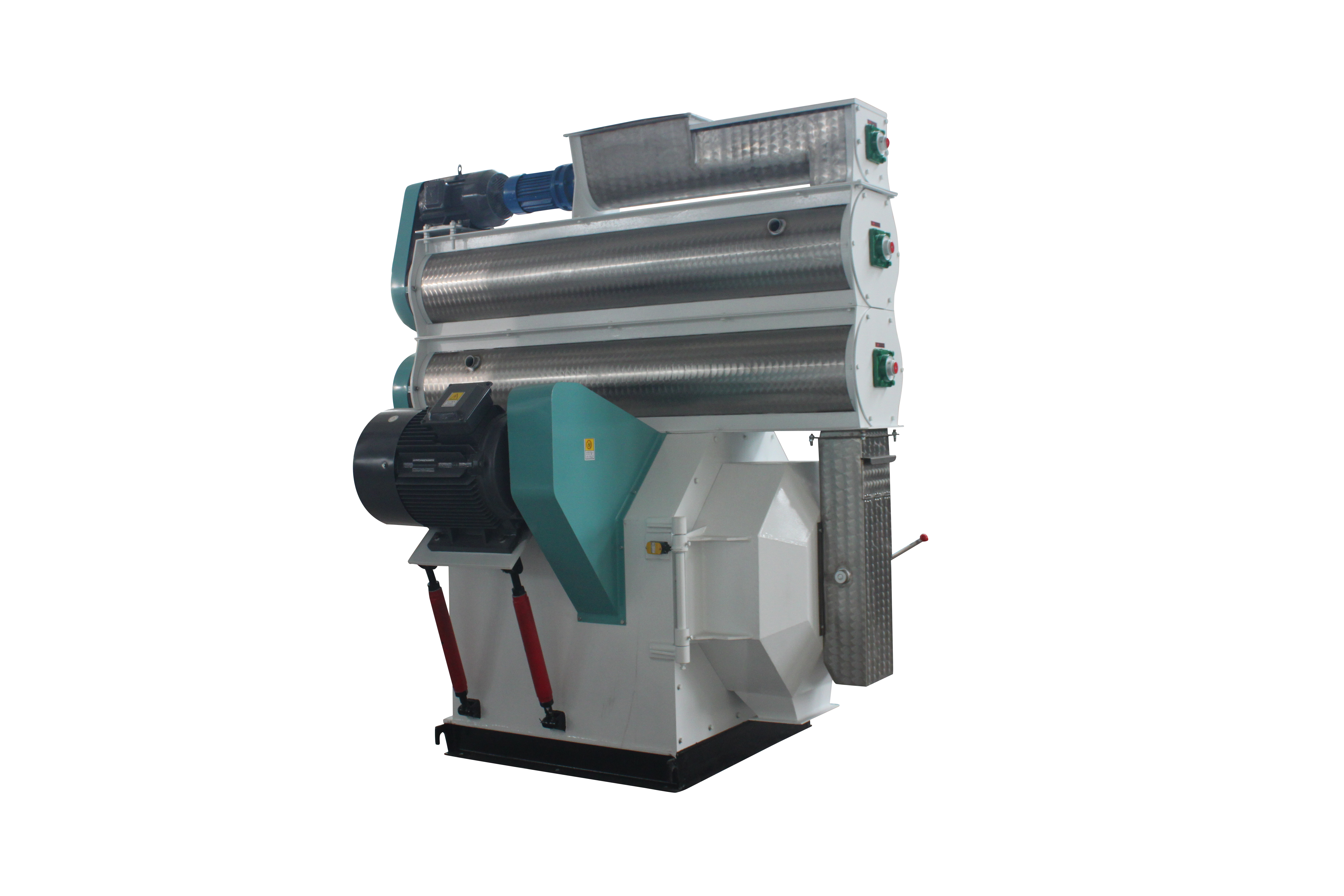
Reference for full-text summary: How can technological upgrades create value for feed enterprises?
Huamu Machinery has addressed the pain points of traditional feed machinery, such as low efficiency, high energy consumption, and poor stability, through core technologies including dynamic clearance compensation, airflow-assisted sieve cleaning, and dual-seal transmission. Its equipment, such as the HM series ring die pellet mills, waterdrop hammer mills, and twin-shaft paddle mixers, have achieved industry-leading levels in key indicators including production capacity, power consumption, and uniformity. For instance, after adopting Huamu's 30-ton-per-hour production line, a livestock and poultry feed enterprise saw a 40% increase in annual production capacity, a 15% reduction in power consumption per ton of feed, a 60% decrease in equipment failure rates, and annual operational cost savings exceeding RMB 2 million. When selecting equipment, feed enterprises should focus on the actual measured data of technical parameters, the real-world results of enterprise case studies, and the responsiveness of after-sales service. For more information, please visit the official website:www.huamufeedmachinery.com
Jiangsu Huamu Machinery Co., Ltd. is located in Xibei Town, Wuxi City, enjoying convenient transportation and significant geographical advantages. The company specializes in the manufacturing of feed machinery and equipment, and can undertake the full-process business of scheme design, equipment ins...
No.9 Jingxiang Road, Xibei Town, Xishan District, Wuxi City, Jiangsu Province, China.