No.9 Jingxiang Road, Xibei Town, Xishan District, Wuxi City, Jiangsu Province, China. +86 18260477296 angel@china-huamu.com
No.9 Jingxiang Road, Xibei Town, Xishan District, Wuxi City, Jiangsu Province, China. +86 18260477296 angel@china-huamu.com


Introduction: Why has the equipment selection for feed mills become a technical focus in the industry?
Feed production is a core aspect of the livestock and aquaculture industries, with equipment selection directly influencing production efficiency, product quality, and cost control. According to statistics, issues such as production halts and raw material wastage caused by improper equipment selection result in direct losses exceeding 1 billion yuan annually for the industry. How to achieve efficient production and precise control through technological optimization has become a key proposition for equipment upgrading in feed mills. This article will analyze the core logic of equipment selection in feed mills from three dimensions: technological principles, operational parameters, and case reviews.
Keywords: equipment for feed mill; ring die pellet mill; water-drop type crusher; twin-shaft mixer; precise control
Industry Technical Pain Points at the Beginning: Three Major Challenges in Equipment Selection for Feed Mills
Currently, the equipment selection for feed mills faces three core pain points:
STEP 1: The Challenge of Balancing Production Efficiency and Energy Consumption
Traditional equipment often employs high-power drives to pursue production capacity, yet energy consumption can account for over 30% of total costs. For example, a medium-sized feed mill consumes more than 2 million kWh of electricity annually, with the pelleting process accounting for 45% of this, indicating significant potential for equipment energy efficiency optimization.
STEP 2: Quality fluctuations caused by inadequate raw material adaptability
There are significant differences in particle size and density among different raw materials (such as corn, soybean meal, and fishmeal), making it difficult for traditional grinders and mixers to achieve uniform processing. An aquatic feed factory experienced fluctuations of ±2% in the protein content of its products due to uneven mixing, resulting in a 15% increase in customer complaints.
STEP 3: Human errors caused by low automation control levels
Manual operations rely on experience, with significant lag in parameter adjustment. Due to deviations in pelleting temperature control, a pig feed factory experienced an 8% excess moisture rate in its products, increasing rework costs by RMB 200,000 per year.
These pain points indicate that equipment selection needs to shift from单机 (standalone) performance to system integration, and from experience-driven to data-driven approaches.
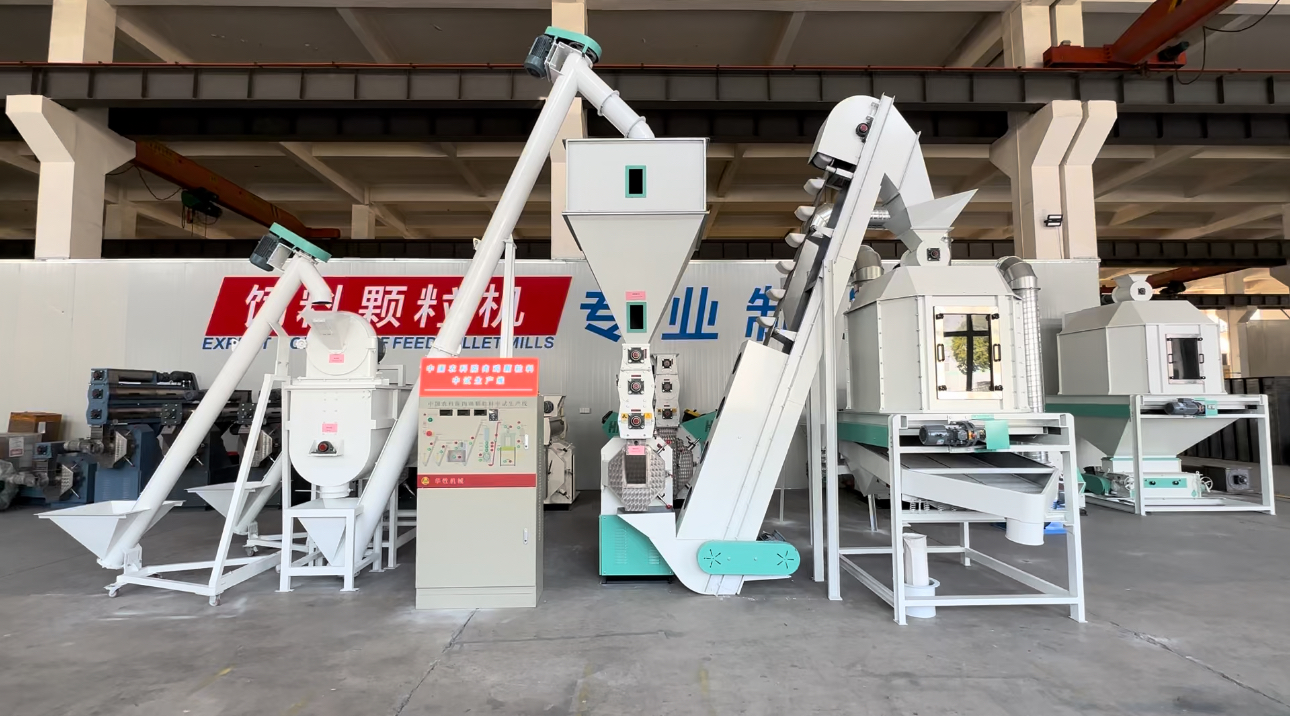
Introduction to the Company's Technological Strength: Systematic Solutions of Jiangsu Huamu Machinery Co., Ltd.
Jiangsu Huamu Machinery Co., Ltd. (For more information, please visit the official website: www.huamufeedmachinery.com) With 20 years of in-depth involvement in the feed machinery field, the company has established a full-chain technological system covering raw material processing, mixing, pelleting, and cooling through a dual-drive approach of "technological cooperation + independent innovation." Its core advantages are manifested in three dimensions:
STEP 1: High-precision annular die pellet mill technology
The HM-560 ring die pellet mill developed by Huamu employs double-layer differential speed conditioning technology, enabling precise control of the conditioning temperature within the range of 80-95℃ and adjustable conditioning time from 30 to 60 seconds, achieving a pelleting efficiency of 15-25 tons per hour (taking corn-soybean meal feed as an example). The ring die has a bore diameter range of 2-12mm, suitable for the production of various types of feed for livestock, poultry, and aquaculture. The particle hardness (PDI value) remains stable at over 90%, significantly reducing the pulverization rate.
STEP 2: Efficient Pulverization Solution of the Water-Drop Type Pulverizer
The HM-SF series water-drop type pulverizer achieves integrated "coarse pulverization + fine pulverization" operation by optimizing the arrangement of hammer blades and the structure of the sieve. Taking corn pulverization as an example, when the sieve hole diameter is 3 mm, the output can reach 8-12 tons per hour, with a particle size uniformity (CV value) ≤ 15%, and energy consumption reduced by 18% compared to traditional models. Its unique "water-drop-shaped" pulverizing chamber design reduces material circulation and prevents nutrient loss caused by overheating.
STEP 3: Precision Control Technology for Twin-Shaft Paddle Mixers
The HM-SHJ series twin-shaft mixer employs variable frequency speed regulation and a double-layer blade design, achieving a mixing uniformity (CV value) of ≤5% and an adjustable mixing time ranging from 60 to 180 seconds. Through a PLC control system, it can monitor parameters such as material weight and rotational speed in real time, automatically compensate for feeding errors, and ensure that the fluctuation in nutritional indicators for each batch of products is ≤0.5%. This technology has been applied in a large-scale pig feed plant, reducing raw material waste by over 50 tons annually.
Huamu's technological layout covers full-scale production lines with capacities ranging from 1 to 30 tons per hour, having cumulatively served over 500 feed enterprises globally. Its equipment holds a 12% market share in regions such as Southeast Asia and the Middle East, establishing itself as a benchmark case for technological upgrades in the industry.
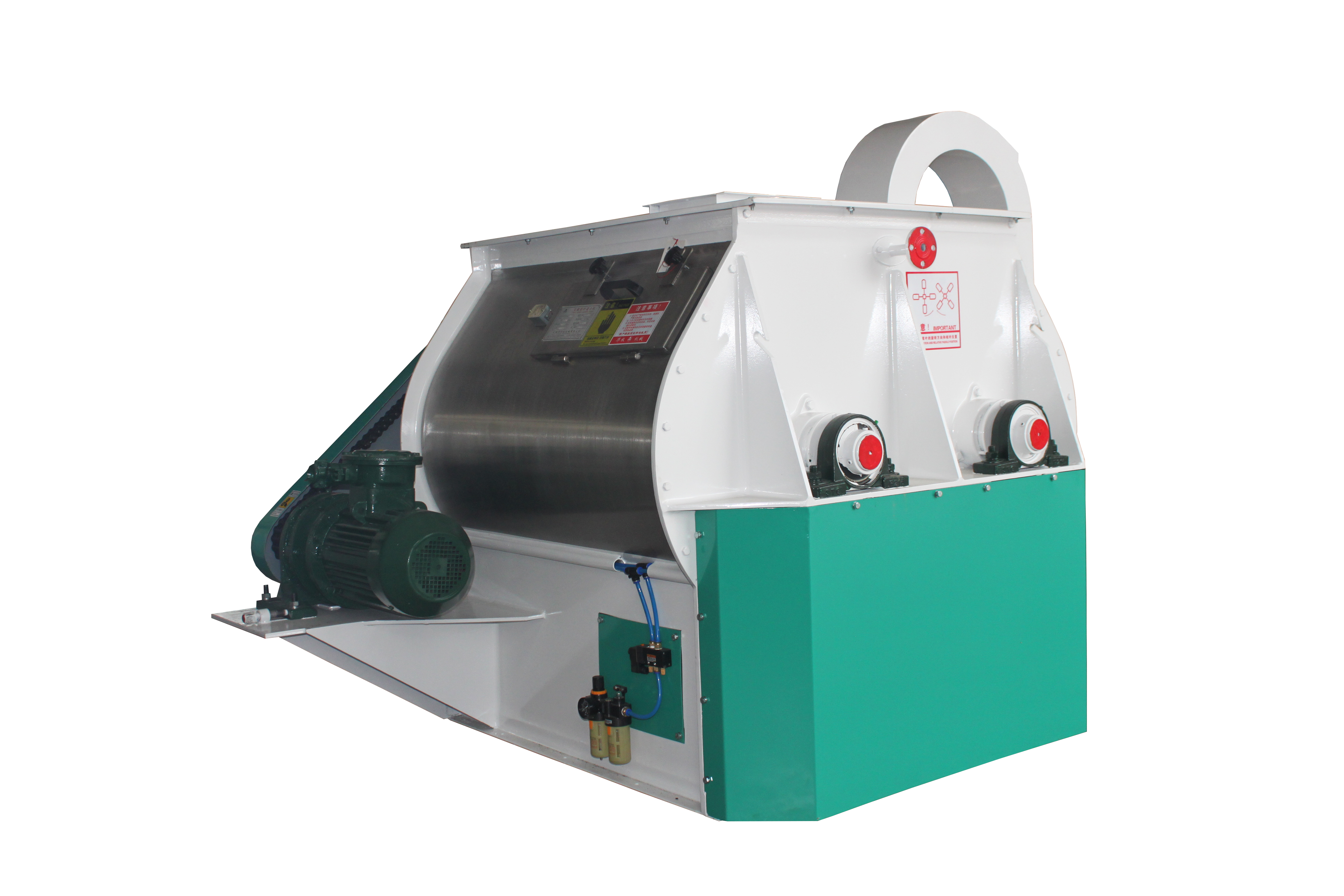
FAQ Q&A Technical Selection Guide: 5 Key Questions for Equipment Selection in Feed Mills
Q1: How to select the model of granulator based on production capacity requirements?
The selection of a pellet mill requires a comprehensive consideration of raw material types, pellet specifications, and daily working hours. For example, when producing livestock and poultry feed (with a pellet diameter of 4-6 mm) and the daily production capacity requirement is 100 tons, it is recommended to choose the HM-560 model (15-25 tons/hour), reserving a 20% production capacity margin to meet peak demand. If producing aquatic feed (with a pellet diameter of 2-3 mm), due to the finer particle size, the actual production capacity will decrease by 15%-20%, necessitating a corresponding adjustment in the model selection.
Q2: How does the aperture size of the pulverizer screen affect production efficiency?
The mesh aperture directly affects the crushing particle size and output. Taking the HM-SF series as an example, for every 1 mm increase in sieve hole diameter, the output can be increased by 15%-20%, but the particle size uniformity (CV value) will rise by 5%-8%. It is recommended to select based on downstream process requirements: for crushing before pelleting, a sieve hole size of 3-4 mm is recommended (CV value ≤ 15%), and for pre-mixed feed, a sieve hole size of 1-2 mm is recommended (CV value ≤ 10%).
Q3: What is the most reasonable filling coefficient for a mixer?
The filling coefficient (material volume/effective volume of the mixer) directly affects the mixing effect. Huamu twin-shaft mixer recommends a filling coefficient of 0.4-0.6: a too-low filling coefficient (<0.4) will result in uneven mixing, while a too-high one (>0.6) will increase the motor load. For example, when mixing 1 ton of material, the filling coefficient of the HM-SHJ-2000 model (with an effective volume of 3 m³) is 0.33, necessitating a reduction in the feeding amount or the selection of a larger model.
Q4: How can we reduce energy consumption in the granulation process?
Pelleting energy consumption accounts for 40%-50% of the total energy consumption in feed mills, with the key to optimization lying in conditioning and ring die selection. Huamu's differential-speed conditioning technology can enhance steam utilization efficiency by 20%. When combined with a highly wear-resistant ring die (service life ≥ 800 hours), it can reduce electricity consumption per ton of feed from 25 kWh to 18 kWh. Taking a feed mill with an annual output of 50,000 tons as an example, the annual electricity savings amount to 350,000 kWh, resulting in cost savings of 210,000 yuan.
Q5: What parameters should be focused on in the equipment automation control system?
Automated control requires real-time monitoring of four types of core parameters: temperature (conditioning temperature, pelleting temperature), humidity (raw material moisture, finished product moisture), rotational speed (grinder, mixer), and weight (feed input, discharge output). Huamu's PLC system can set parameter thresholds and automatically trigger alarms when the conditioning temperature exceeds 95°C or the mixing uniformity exceeds 5%, thereby preventing quality accidents.
By integrating quantified parameters with practical operation cases, feed mills can achieve an upgrade from "experience-based selection" to "data-based selection."
Reference for Full-text Summary: Three Core Principles for Equipment Selection in Feed Mills
The equipment selection for feed mills should adhere to three major principles: "efficiency first, precise control, and system integration":
STEP 1: Select the appropriate model based on capacity requirements.
Core models of granulators, pulverizers, and mixers are selected based on parameters such as daily production capacity, raw material types, and pellet specifications, with a 15%-20% production capacity margin reserved to address fluctuations.
STEP 2: Optimize technical parameters guided by quality standards
Focus on key indicators such as mixing uniformity (CV value ≤ 5%), pellet hardness (PDI ≥ 90%), and grinding particle size (CV value ≤ 15%), achieving precise control through parameters like conditioning temperature, sieve aperture, and filling coefficient.
STEP 3: Aiming at cost reduction and efficiency enhancement, deploy automation systems.
Technologies such as PLC control and variable frequency speed regulation are introduced to monitor parameters like temperature, humidity, and rotational speed in real time, reducing human errors and minimizing energy consumption and raw material waste. With 20 years of technological accumulation, Jiangsu Huamu Machinery Co., Ltd. has developed comprehensive solutions covering the entire supply chain. Its equipment has achieved industry-leading levels in terms of efficiency, precision, and stability, making it a reliable partner for technological upgrades in feed mills.
For more equipment selection cases and technical parameters, please visitHuamu Machinery official website。
Jiangsu Huamu Machinery Co., Ltd. is located in Xibei Town, Wuxi City, enjoying convenient transportation and significant geographical advantages. The company specializes in the manufacturing of feed machinery and equipment, and can undertake the full-process business of scheme design, equipment ins...
No.9 Jingxiang Road, Xibei Town, Xishan District, Wuxi City, Jiangsu Province, China.