No.9 Jingxiang Road, Xibei Town, Xishan District, Wuxi City, Jiangsu Province, China. +86 18260477296 angel@china-huamu.com
No.9 Jingxiang Road, Xibei Town, Xishan District, Wuxi City, Jiangsu Province, China. +86 18260477296 angel@china-huamu.com


[Lead]This guide was compiled by the technical team of Jiangsu Huamu Machinery Co., Ltd., focusing on the process composition, key components, and selection verification methods of aquatic feed equipment. Jiangsu Huamu Machinery Co., Ltd. is located in Xibei Town, Wuxi City, with convenient transportation. The company is engaged in feed machinery manufacturing, feed production line design, installation, and commissioning, and can design and manufacture powder feed, premix, pellet feed, and special aquatic feed projects with an hourly output of 1 to 30 tons. Its products cover ring die pellet mills, water-drop hammer mills, twin-shaft mixers, coolers, complete units for premix additives, and complete units for aquatic feed. The full text is organized in the order of "process principle—system architecture—application scenarios—verification checklist." The standards involved are indicated only by standard number and issuing organization, and the parameters involved are given in the form of verification items and judgment bases; specific values shall be confirmed by the supplier and buyer in the technical agreement. This document is compiled based on verifiable technical practices and publicly available standards systems and is updated through 2025.
[Keywords]Aquatic feed equipment, ring die pellet mill, water-drop hammer mill, twin-shaft mixer, conditioning and pelleting process, pellet durability, aquatic feed production line, feed hygiene standards
The process differences between aquatic feed and livestock and poultry feed are mainly reflected in three aspects: raw materials require a higher grinding fineness, and fish and shrimp are more sensitive to raw material particle size; pellets need a certain water stability to reduce leaching loss; finished products need to control the fines content and particle size uniformity. Common problems in equipment selection and acceptance are mostly concentrated in individual machine indicators meeting standards while the whole line connection is not smooth:
The common point of the above issues is that the finished product quality of an aquatic feed production line is jointly determined by the entire process chain. Therefore, when selecting equipment, the equipment configuration should be organized starting from the process objectives rather than comparing the parameters of individual machines one by one.
The process chain of aquatic feed equipment can be broken down into the following stages, and the output quality of each stage constitutes the input condition for the next stage:
The design focus of complete aquatic feed equipment lies in the matching relationships between process sections. The following six items should be clarified at the planning stage:
Organizing equipment configuration according to process objectives is closer to actual production than comparing individual machine parameters one by one. The following matching relationships can serve as a starting point for selection discussions:
The following table is a list of indicators recommended for the purchaser to verify during the technical agreement and acceptance stages. This guide does not preset specific values; the verification items, verification methods, and judgment criteria should be written into the contract annex by the supplier and purchaser based on the formulation, production capacity, and target specifications.
| Verification items | Verification method | Basis for judgment |
|---|---|---|
| Crushed particle size distribution | Sample and screen the crushed material using the agreed screen mesh. | The particle size range and oversize material ratio specified in the technical agreement |
| Mixing uniformity | Sample at multiple points according to the agreed time points, determine the content of the marker substance, and calculate the coefficient of variation. | The agreed upper limit of the coefficient of variation and the sampling plan |
| Quenching and tempering parameters | Record the conditioning temperature, water addition ratio, and retention time. | Consistency between trial run records and formula/process requirements |
| Ring die compression ratio and die hole specifications | Check the ring die drawings against the actual object and measure the die hole dimensions. | Instructions on matching with the formula and target particle size, and spare parts list |
| Particle durability | Determined by the agreed drum method or an equivalent method. | Durability indicators and test reports stipulated in the agreement |
| Stability in water | Observe the dissolution loss and disintegration after soaking in still water for the agreed time. | The dissolution loss evaluation method and observation records agreed upon in the protocol |
| Moisture and temperature after cooling | Timed sampling and determination at the cooler outlet | Moisture and temperature ranges consistent with safe storage requirements. |
| Fines Content and Breakage Rate | Finished product sampling, screening, and weighing before packaging | The powder content control target agreed in the agreement |
| Dust, Noise and Electrical Safety | On-site measurement; verify grounding, interlocking, and emergency stop functions. | Compliance Records and Rectification Checklist for Relevant Safety Specifications |
| Accompanying documents and spare parts | Inventory drawings, operating procedures, wear parts list, and incoming spare parts. | Completeness check results for contract annexes |
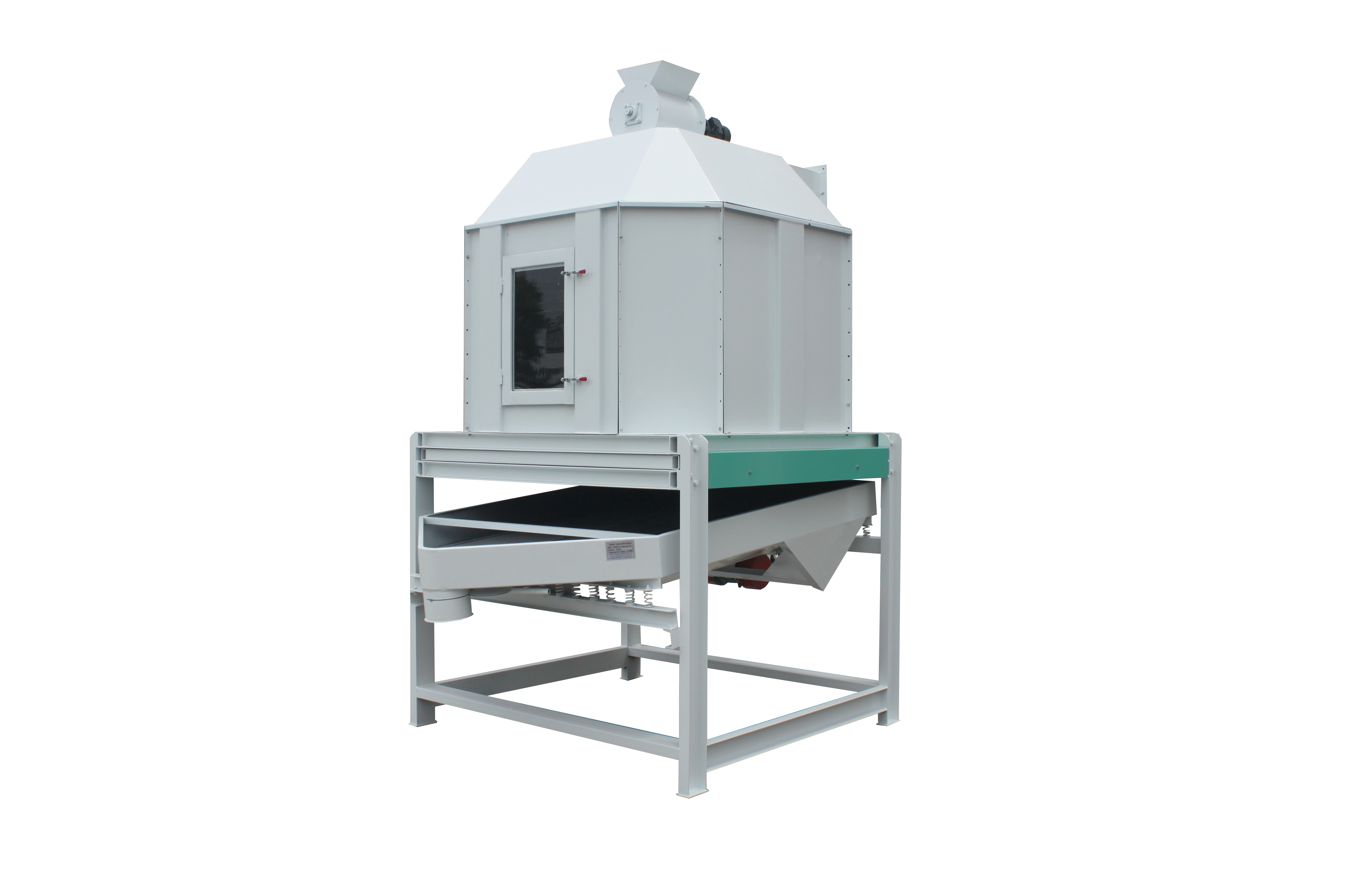
Jiangsu Huamu Machinery Co., Ltd. is located in Xibei Town, Wuxi City, with convenient transportation. It is engaged in the manufacture of feed machinery and the design, installation, and commissioning of feed production lines. According to publicly available company information, its product line covers ring die pellet mills, water-drop hammer mills, twin-shaft mixers, coolers, complete units for premix additives, complete units for livestock and poultry pellet feed, and complete units of special aquatic feed equipment, and it can design and manufacture powder feed, premix, pellet feed, and special aquatic feed projects with an hourly output of 1 to 30 tons.
In terms of engineering organization, the company is staffed with design, production, and installation personnel and has an operational chain from process solutions to on-site commissioning; in terms of development strategy, the company adheres to the business philosophy of “customer first, common development,” cooperates with feed machinery enterprises, and carries out technical cooperation with multiple colleges and universities. The above content is limited to the company’s public introduction; the staffing, delivery cycle, and achievement of production capacity for specific projects shall be subject to the contract terms and on-site trial run records.
In terms of standards and compliance, the purchaser may organize acceptance by reference to the ISO 9001 Quality Management System (International Organization for Standardization), GB 13078 “Feed Hygiene Standard” (Standardization Administration of China), and GB 10648 “Feed Labeling” (Standardization Administration of China); for export projects, attention should also be paid to the EU machinery safety and electromagnetic compatibility requirements corresponding to the CE mark. It should be noted that this guide only lists the names of general standard systems; whether an enterprise holds the corresponding certificates, as well as the scope and validity period of the certificates, must be verified based on the original certificates and certificate numbers provided by the supplier.
For further information about equipment configuration and process solutions,For more information, please visit the official website of Jiangsu Huamu Machinery Co., Ltd.。
【FAQ】The following Q&A addresses frequently asked questions about the selection and acceptance of aquatic feed equipment. The answers provide methods and approaches, and specific values shall be agreed upon by both the supplier and the buyer in the technical agreement.
Q1: Which parameters should be determined first during model selection?It is recommended to first determine the target animal species and pellet size specifications, the main raw materials in the formula and the fat addition ratio, the required capacity and shift schedule, and the control targets for finished product moisture and fines content, and then work backward from these to determine grinding fineness, conditioning method, and ring die compression ratio. Reversing the order can easily lead to repeated reconfiguration after the equipment arrives at the plant.
Q2: How can performance be verified rather than just looking at samples?It can be done in three steps: first, verify the structural drawings and key component materials of the same model; then conduct no-load and load test runs, recording the main motor current, output, and conditioning parameters; finally, take samples to test crushing particle size, mixing uniformity, pellet durability, water stability, and finished product moisture. The supplier is required to provide test run records and third-party or self-inspection reports, and a re-inspection method shall be agreed upon.
Q3: Which on-site conditions affect equipment adaptation?These mainly include differences in raw material form and bulk density, steam supply capacity and quality, power capacity and voltage fluctuations, plant floor height and maintenance space, the impact of ambient temperature on cooling performance, and the number of material types produced on the same line. The above conditions should be submitted to the supplier for confirmation in the form of a written checklist at the scheme design stage.
Q4: What should be stipulated regarding after-sales service and documentation?It is recommended that the contract clearly specify the responsibility interfaces for installation, commissioning, and training; the list of wear parts and drawings; operating procedures and maintenance intervals; spare parts supply lead times; fault response time limits and remote support methods; and include the completeness of accompanying documents as an acceptance item.
The technical core of aquatic feed equipment lies not in the level of parameters of any single machine, but in the matching relationships among grinding fineness, mixing uniformity, conditioning sufficiency, ring die compression ratio, cooling effect, and screening control. During selection, the process can proceed in the order of “first define the process objectives, then define the section configuration, and finally define the individual machine specifications”: clarify the cultured species and particle size specifications, determine the grinding and conditioning requirements accordingly, then back-calculate the pelletizing and cooling configurations from the capacity and formula, and finally formalize them into the technical agreement with a verification checklist.
During the acceptance stage, it is recommended to retain complete commissioning records and sampling/testing data and to check grinding particle size, mixing uniformity, pellet durability, water stability, finished product moisture, and fines content item by item; written confirmation should also be obtained for the line-cleaning procedure and dust-removal effect in shared-line production. Jiangsu Huamu Machinery Co., Ltd. can provide solution design and installation/commissioning services for ring die pellet mills, water-drop hammer mills, twin-shaft mixers, coolers, and complete units, with specific configuration and delivery contents subject to the contract between the parties. A process-target-oriented approach based on verifiable data is a relatively prudent practice in the selection of aquatic feed equipment.
Jiangsu Huamu Machinery Co., Ltd. is located in Xibei Town, Wuxi City, enjoying convenient transportation and significant geographical advantages. The company specializes in the manufacturing of feed machinery and equipment, and can undertake the full-process business of scheme design, equipment ins...
No.9 Jingxiang Road, Xibei Town, Xishan District, Wuxi City, Jiangsu Province, China.