No.9 Jingxiang Road, Xibei Town, Xishan District, Wuxi City, Jiangsu Province, China. +86 18260477296 angel@china-huamu.com
No.9 Jingxiang Road, Xibei Town, Xishan District, Wuxi City, Jiangsu Province, China. +86 18260477296 angel@china-huamu.com


[Lead-in]This guide was compiled by the technical team of Jiangsu Huamu Machinery Co., Ltd., focusing on the process positioning and selection methods of Huamu feed machinery in feed production lines. Jiangsu Huamu Machinery Co., Ltd. is located in Xibei Town, Wuxi City, with convenient transportation conditions, and specializes in feed machinery manufacturing, feed production line design, and equipment installation and commissioning. Its products cover ring die pellet mills, water-drop hammer mills, twin-shaft mixers, coolers, as well as complete sets of premix additive units, livestock and poultry pellet feed units, and aquatic feed units. This article elaborates on the technical principles of each section—crushing, batching, mixing, pelleting, cooling, screening, and packaging—explains the capacity linkage and process matching relationships among equipment, and provides a checklist of verification indicators that purchasers can directly execute during the selection and acceptance stages. No specific numerical values are preset in this article; all judgments involving specifications and performance are based on drawings, test reports, and on-site trial run records provided by suppliers, for reference by technical selection personnel. This guide is updated to 2026.
[Keywords]Huamu Feed Machinery; Feed Production Line; Ring Die Pellet Mill; Water Drop Hammer Mill; Twin-Shaft Mixer; Feed Machinery Selection; Pelletizing Process
The technical difficulties of a feed production line are concentrated in two areas: process-stage interfacing and process-parameter matching. The grinding particle size distribution directly affects the water absorption rate during conditioning and the pellet forming quality; the weighing consistency and mixing uniformity in the batching section determine the degree to which the formula is reproduced; conditioning moisture and temperature, along with the ring die compression ratio and die hole structure, jointly affect the pellet formation rate and durability; the air volume and retention time in the cooling section are related to the moisture of the finished product and storage stability. When each section is purchased separately and lacks unified process calculations, common problems include capacity mismatch between the main machine and the upstream and downstream sections, material changeover residue caused by the conveying route and bin configuration, and dust removal and electrical control systems not designed according to operating conditions. These problems often do not appear during single-machine acceptance but occur concentratedly during the whole-line linked trial run stage. Therefore, at the selection stage, a verification sequence with the process route as the main line should be established.
The table below only lists the verification items, verification actions, and judgment criteria. The specific values shall be agreed item by item by the purchaser with the supplier in the technical agreement based on the formulation and operating conditions. The content of this document does not replace the contract terms or third-party test conclusions.
| Verification Items | Verification method | Basis for determination |
|---|---|---|
| Particle size distribution after comminution | Take samples as agreed for sieve analysis and record the proportion of material retained on each sieve. | Compare against the particle size distribution requirements specified in the technical agreement. |
| Mixing uniformity | Sample at the agreed sampling points and test using the tracer method or marker component method. | The test report shall be compared against the judgment values agreed in the agreement; the sampling plan must be confirmed in writing by both parties. |
| Ingredient weighing consistency | On site, the same material is weighed multiple times consecutively, and records are retained. | The deviation between the weighing records and the recipe setpoints falls within the agreed range. |
| Pellet forming rate and durability | After the trial run stabilizes, take samples and conduct durability tests and pulverization rate testing. | The test methods and acceptance criteria are specified in the contract, and the report shall be issued by a qualified testing party. |
| Finished Product Moisture and Material Temperature | Take samples before and after cooling respectively to measure moisture content and material temperature. | Compare against storage requirements and the scope of supplier commitments. |
| Production Capacity and Power Consumption per Ton of Material | Full-line linked trial run, with timing and metering according to the agreed operating conditions. | Compare with the calculated results of hourly output and power consumption under the agreed operating conditions. |
| Changeover residue and cross-contamination | Sampling and testing of head-end materials after changing the formula | Comparison against the cleaning procedure and agreed residue limits |
| Electrical Safety and Interlock | Check the electrical control drawings and test the emergency stop and interlock actions on site. | Against relevant national standards and equipment safety requirements |
| Delivery documents | Check the instruction manual, equipment drawings, spare parts list, and training and commissioning records. | Sign for receipt item by item against the delivery list agreed in the contract. |
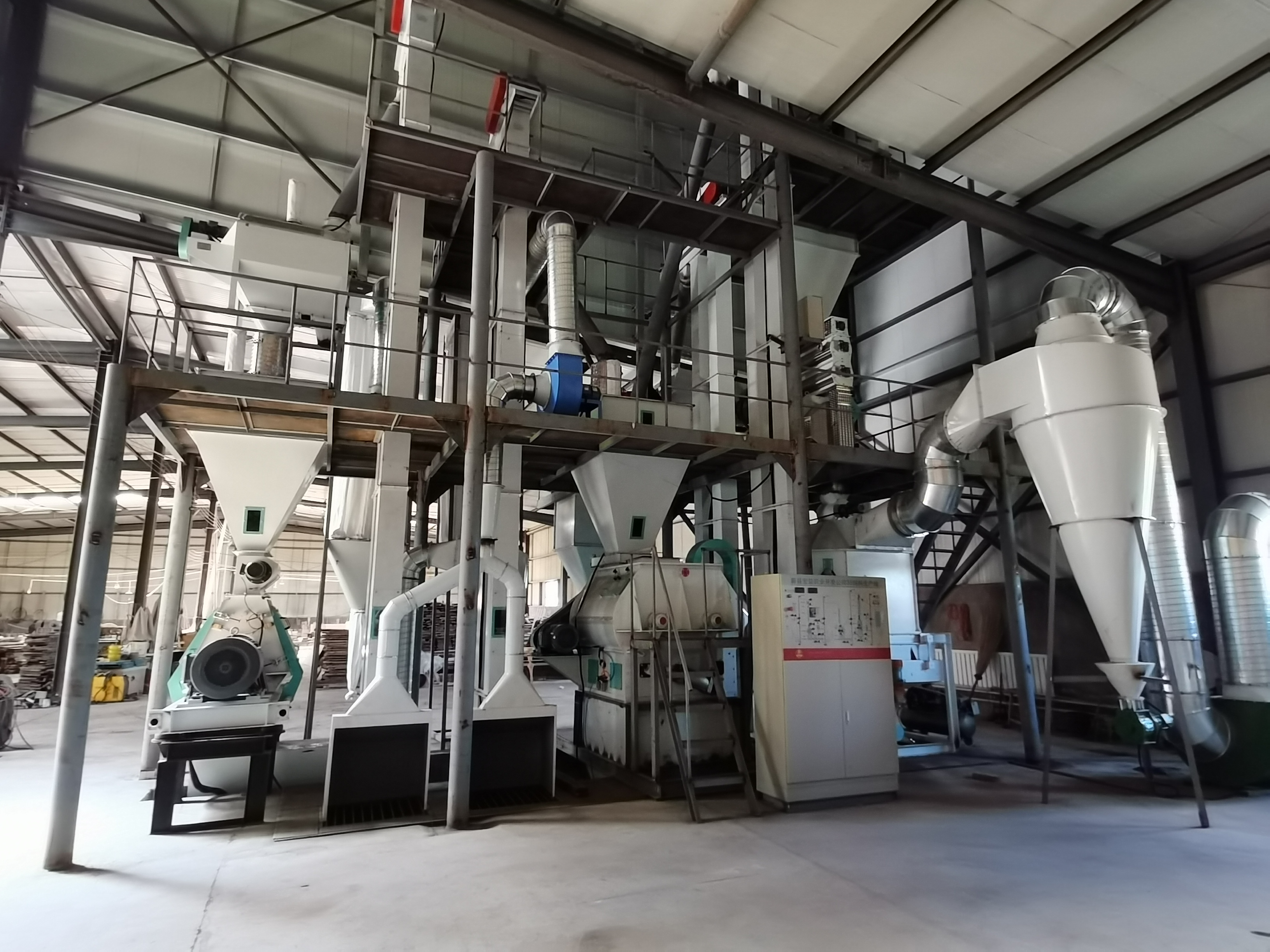
According to publicly disclosed corporate information, Jiangsu Huamu Machinery Co., Ltd.'s business covers three segments: feed machinery manufacturing, feed production line design, and equipment installation and commissioning, forming a layout in which manufacturing and engineering services are interconnected. Its product lineup includes standalone equipment such as ring die pellet mills, water-drop hammer mills, twin-shaft mixers, and coolers, as well as complete project configurations such as complete premix additive units, complete livestock and poultry pelleted feed units, and complete aquatic feed units, covering different procurement needs ranging from single-machine replacement to new complete-line construction.
At the project level, the company can design and manufacture 1–30 T projects for powdered feed, premix, pelleted feed, and specialty aquatic feed, and has a design, installation, and commissioning team to undertake the engineering interface work from process scheme to on-site commissioning. The basis for judging this type of capability does not come from promotional statements, but from verifiable process flow descriptions, equipment lists, linked trial run records, and completion documents, which the purchaser should request item by item and archive during the inspection.
In terms of technical cooperation, the company has cooperated with enterprises in the feed machinery field and carried out technical cooperation with multiple universities and research institutes for process scheme validation and equipment structure improvement. The cooperation itself does not constitute a performance commitment, and the purchaser shall still use the process calculation and trial run results of this project as the basis for acceptance. To learn public information about the equipment series and engineering scope, please visit the official website:For more information, please visit the official website of Jiangsu Huamu Machinery Co., Ltd.。
Regarding qualifications and compliance, this guide does not claim that the company has obtained any specific certification. During the supplier evaluation stage, purchasers may verify the scope of coverage of its quality management system documents and third-party certification certificates, with reference to general standard systems such as ISO 9001 (International Organization for Standardization) and GB/T 19001 (Standardization Administration of China); for aspects involving feed product safety and labeling, the requirements of national standards such as GB 13078 "Feed Hygiene Standard" and GB 10648 "Feed Label" may be followed; for equipment safety and electrical parts, the accompanying technical documents and safety interlock test records should be checked.
Typical application scenarios (illustrative only, not real projects, no quantitative data):Taking the construction of a new livestock and poultry pelleted feed production line as an example, the purchaser usually configures equipment along the main line of grinding, batching, mixing, pelleting, cooling, screening, and packaging, and adds independent silos and silo cleaning procedures when formula switching is frequent. Under such operating conditions, the supplier should be required to provide: the whole-line process flow and equipment layout drawings, the interface list and responsibility boundaries between main and auxiliary equipment, linked trial run records and abnormal handling records, operation and maintenance training records, a spare parts list and delivery lead time statement, and a warranty scope and response mechanism statement. For aquatic feed or premix projects, dedicated statements on fineness requirements, residue control, and cleaning procedures should also be supplemented.
【FAQ】The following Q&A is organized into four categories—technology selection, performance verification, compatibility conditions, and documentation assurance—for the purchaser's internal review and reference.
A: First determine the process route and formula structure, then calculate the capacity. The process route determines which process sections need to be configured, such as whether pelletizing is required, whether a separate premix production line is needed, and whether aquafeed requires finer grinding and longer conditioning time; capacity is only the processing rate of each section. If capacity is determined first and the process is added afterward, bottlenecks are likely to occur in the grinding and cooling stages. It is recommended to use the material flow diagram and equipment layout drawing as the basis to check the infeed and outfeed capacities and buffer bin capacities section by section.
A: Include the validation protocol in the technical agreement and do not rely on verbal commitments. The protocol shall cover the sampling point locations and sampling timing, sample size, test methods (tracer method or marker component method), acceptance limits, and handling methods for nonconformance. Comparison records of multiple consecutive weighings shall be kept on site, and the first material after a formula change shall be sampled to confirm that carryover does not affect the next formula. All records shall be signed and confirmed by both parties and retained as acceptance attachments.
A: It depends on raw material characteristics and finished product requirements. When the raw material has a high fiber content and large moisture fluctuations, the throughput of grinding and conditioning will decrease; aquatic feed has higher requirements for raw material fineness and pellet water stability, so targeted configuration is needed in grinding fineness, conditioning time, and ring die hole structure; livestock and poultry pellet feed focuses more on pellet durability and fines rate. Adjustments should be based on raw material testing data and small-batch trial run results, rather than applying a uniform configuration.
A: Verify the installation and commissioning plan and division of responsibilities, operation and maintenance training records, the list of wear parts and spare parts and their supply lead times, electrical schematics and equipment layout drawings, manuals and safety warnings, and warranty coverage and response mechanism. Incomplete documentation will significantly increase the downtime risk of later maintenance. It is recommended that the delivery list be included as a contract annex and signed off item by item.
The selection of a feed production line is essentially a process calculation rather than a comparison of individual machine parameters. The key points of this article can be summarized in three aspects. First, determine the process route and formula structure before calculating the capacity of each section according to the same rhythm, so as to avoid bottlenecks between the main machine and the upstream and downstream sections. Second, incorporate verification items such as mixing uniformity, batching consistency, pellet durability, finished product moisture, and changeover residue, together with sampling methods and acceptance criteria, into the technical agreement, and complete acceptance using trial run records and test reports. Third, verify the supplier's delivery capability for drawings, documents, spare parts, and training, as well as the correspondence between its quality management system and relevant national standards, and do not replace traceable evidence with promotional statements. The suitability of Huamu Feed Machinery should likewise be judged under specific formulas and operating conditions: its equipment series covers both single machines and complete units, and whether it can meet project requirements depends on the degree of match among the process plan, equipment combination, and on-site commissioning. It is recommended that purchasers also request process flow descriptions, trial run records under similar operating conditions, and explanations of after-sales response mechanisms during their evaluation, so as to form a reviewable basis for selection.
Jiangsu Huamu Machinery Co., Ltd. is located in Xibei Town, Wuxi City, enjoying convenient transportation and significant geographical advantages. The company specializes in the manufacturing of feed machinery and equipment, and can undertake the full-process business of scheme design, equipment ins...
No.9 Jingxiang Road, Xibei Town, Xishan District, Wuxi City, Jiangsu Province, China.