
Selecting the right particle cooler is crucial for maintaining feed quality and optimizing production efficiency in the feed industry. As a key component in feed processing lines, particle coolers help reduce the temperature and moisture content of pellets after the pelletizing process, ensuring stable product quality and preventing mold growth during storage. However, with numerous manufacturers and models available in the market, choosing the most suitable particle cooling equipment can be challenging for feed producers.
This comprehensive guide will walk you through the essential factors to consider when selecting a particle cooler, introduce you to top-quality manufacturers, and provide professional recommendations based on different production requirements. Whether you’re setting up a new feed plant or upgrading your existing equipment, this information will help you make an informed decision that enhances your production efficiency and product quality.
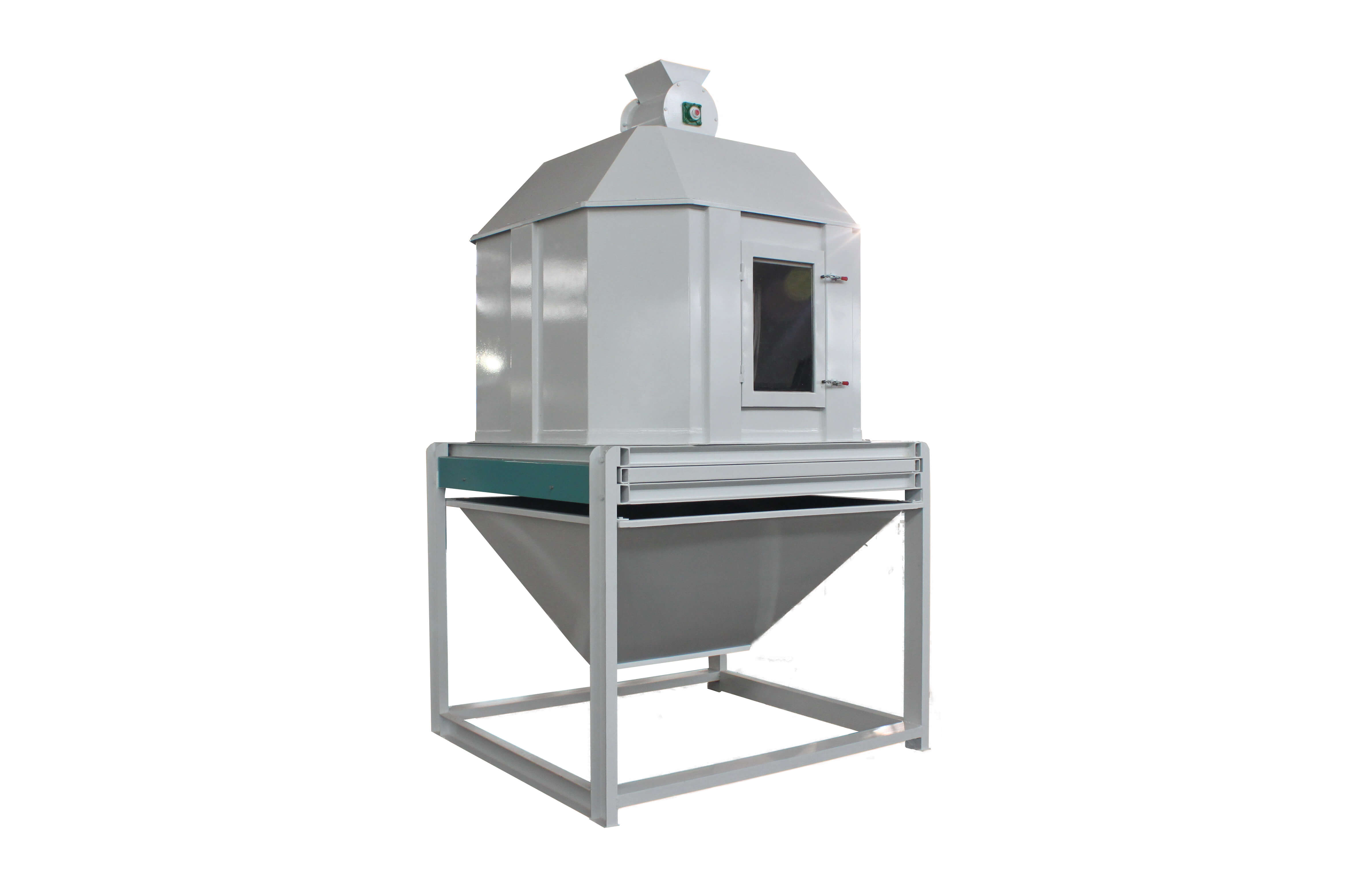
Understanding Particle Coolers in Feed Production
Particle coolers play a vital role in the feed manufacturing process by removing excess heat and moisture from freshly produced pellets. After the pelletizing process, feed pellets typically emerge at high temperatures (80-90°C) and with elevated moisture content (14-16%). If not properly cooled, these conditions can lead to several issues:
- Reduced product quality due to pellet cracking or breaking
- Increased risk of mold growth during storage
- Potential nutrient loss from prolonged high temperatures
- Difficulty in packaging and handling hot, moist pellets
A well-designed particle cooling system can effectively reduce pellet temperature to 3-5°C above ambient temperature and lower moisture content to 10-12%, ensuring optimal product quality and storage stability. The cooling process typically involves counter-flow air movement through the pellets, which maximizes heat exchange efficiency while minimizing dust generation.
Key Factors to Consider When Selecting a Particle Cooler
Choosing the right particle cooler requires careful evaluation of several critical factors that impact both performance and cost-effectiveness. Here are the most important considerations:
1. Cooling Capacity and Production Scale
The cooling capacity should match your production output requirements. Manufacturers typically specify capacity in tons per hour (t/h). For example, Jiangsu Huamu Machinery offers particle coolers ranging from 1-30 t/h capacity, suitable for various scale feed plants from small to large operations.
When determining required capacity:
- Consider your current production volume and future expansion plans
- Account for the type of feed being produced (different feeds may require different cooling times)
- Evaluate the pellet size and density, as these affect cooling efficiency
2. Cooling Efficiency and Uniformity
Effective cooling requires uniform air distribution across the entire cooling bed. Look for designs that feature:
- Multiple air chambers for balanced airflow
- Adjustable air dampers to control cooling intensity
- Sufficient cooling time (typically 8-12 minutes depending on pellet characteristics)
- Counter-flow air movement for maximum efficiency
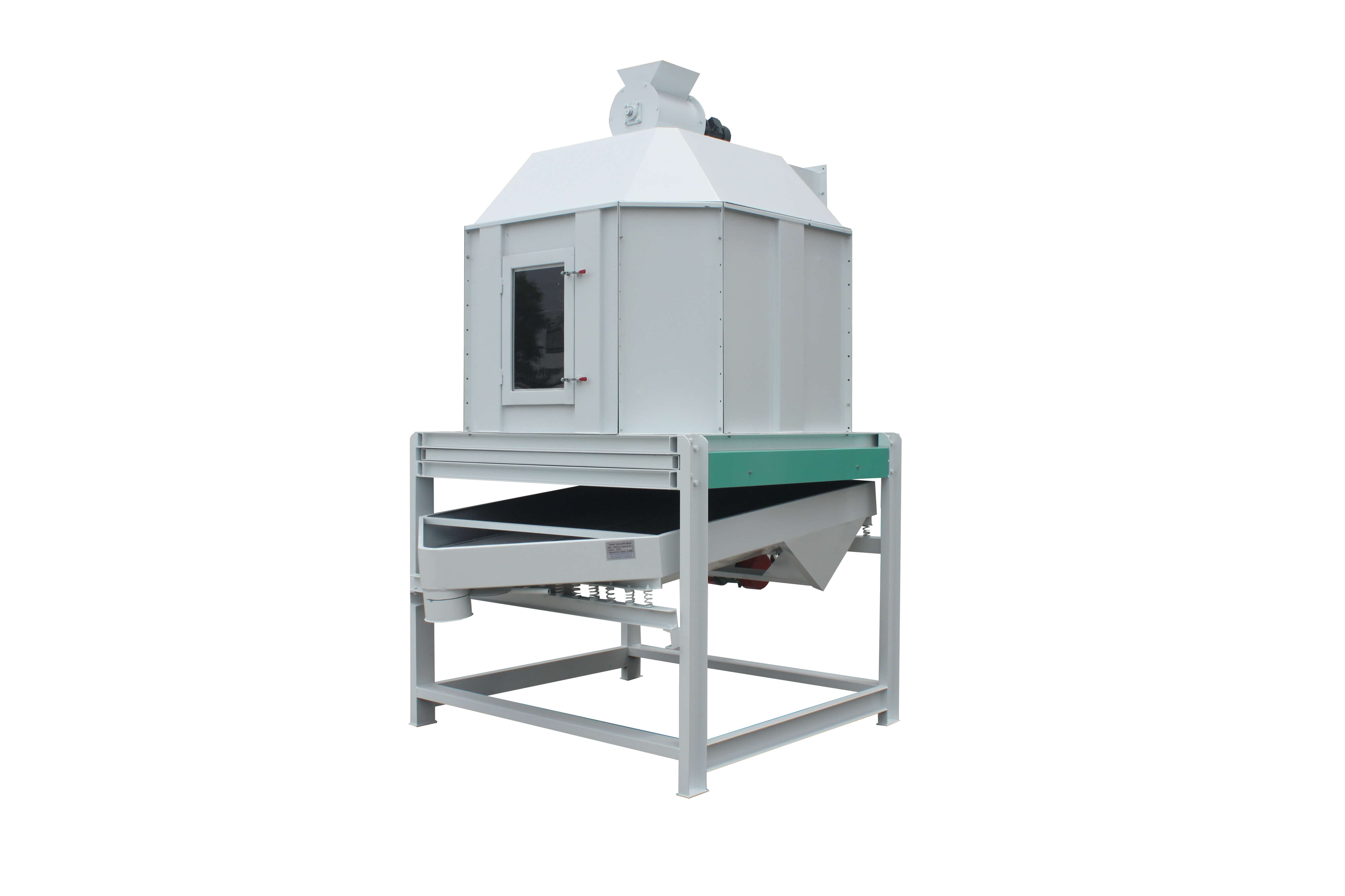
Jiangsu Huamu’s particle coolers, for instance, use a specially designed air distribution system that ensures even cooling throughout the entire batch, preventing hot spots that could lead to quality issues.
3. Energy Efficiency and Operating Costs
The cooling process consumes significant energy, primarily for the fan and airlock systems. Energy-efficient designs can reduce operational costs over the equipment’s lifetime. Consider:
- High-efficiency fan motors with variable frequency drives (VFD)
- Optimized air duct design to minimize pressure drop
- Effective dust collection systems that reduce air resistance
- Automatic control systems that adjust operation based on production needs
Some advanced models, like those from Jiangsu Huamu, incorporate energy-saving technologies that can reduce power consumption by up to 20% compared to traditional designs.
4. Equipment Durability and Maintenance
Feed production environments are often harsh, with high levels of dust and corrosive substances. Choose particle coolers constructed with:
- Stainless steel or galvanized steel for corrosion resistance
- Wear-resistant materials for components in direct contact with pellets
- Easy-access panels for cleaning and maintenance
- Modular design for quick replacement of wear parts
Jiangsu Huamu’s particle coolers feature a robust construction with specially treated materials that withstand the demanding conditions of feed production, ensuring long service life with minimal maintenance requirements.
5. Integration with Existing Production Line
The particle cooler should seamlessly integrate with your existing or planned feed production line. Consider:
- Physical dimensions and space requirements
- Connection points with upstream pellet mill and downstream screening equipment
- Compatibility with your dust collection system
- Automation and control system integration capabilities
Many manufacturers, including Jiangsu Huamu, offer complete turnkey solutions that include professional installation and commissioning services to ensure optimal integration with your production line.
Top Particle Cooler Manufacturers and Recommendations
Based on industry reputation, product quality, and customer feedback, here are some top particle cooler manufacturers to consider:
1. Jiangsu Huamu Machinery Co., Ltd.
As a specialized feed machinery manufacturer located in Wuxi, China, Jiangsu Huamu offers a complete range of particle cooling solutions designed for various feed production scales. Their particle coolers feature:
- Capacity range: 1-30 t/h
- Counter-flow cooling design for maximum efficiency
- Multiple air chambers for uniform cooling
- Energy-saving fan system with VFD control
- Easy maintenance with quick-open access panels
- Customizable options for different feed types
Jiangsu Huamu’s particle coolers are particularly suitable for:
- Medium to large-scale feed plants (10-30 t/h capacity)
- Producers requiring high-quality cooling for premium feeds
- Operations looking for energy-efficient solutions
- Facilities needing reliable equipment with good after-sales support
2. Other Reputable Manufacturers
While Jiangsu Huamu offers excellent solutions for many applications, other manufacturers may be more suitable depending on your specific needs:
| Manufacturer | Strengths | Best For |
|---|---|---|
| Andritz | High-capacity industrial solutions, advanced technology | Large-scale commercial feed producers |
| CPM | Durable construction, wide product range | Medium to large feed mills with diverse product lines |
| Bühler | Precision engineering, energy efficiency | Premium feed producers requiring consistent quality |
| Van Aarsen | Modular design, easy maintenance | Feed plants needing flexible production solutions |
Particle Cooler Selection for Different Feed Types
The optimal particle cooler may vary depending on the type of feed being produced. Here are some specific considerations for different feed categories:
1. Livestock Feed (Pig, Cattle, Sheep)
Livestock feeds often contain higher fiber content and may require:
- Longer cooling time to ensure complete moisture removal
- Gentle handling to prevent pellet breakage
- Sufficient air volume to cope with potentially dusty formulations
Jiangsu Huamu’s particle coolers with adjustable air dampers and multiple cooling stages are well-suited for these applications.
2. Poultry Feed (Chicken, Duck, Turkey)
Poultry feeds typically have smaller pellet sizes and higher production volumes, requiring:
- High-capacity cooling systems to match fast production lines
- Uniform cooling to prevent pellet caking
- Efficient dust collection to maintain clean working environments
Models with wide cooling beds and high airflow rates, like those from Jiangsu Huamu, excel in poultry feed production.
3. Aquatic Feed (Fish, Shrimp)
Aquatic feeds have unique requirements due to their high fat content and often smaller pellet sizes:
- Gentle cooling to prevent pellet disintegration
- Effective removal of surface moisture to prevent oil separation
- Precise temperature control to maintain nutrient stability
Specialized aquatic feed coolers with fine air distribution and temperature monitoring, such as those offered by Jiangsu Huamu, are ideal for these applications.
FAQ
What is the main purpose of a particle cooler in feed production?
The primary purpose of a particle cooler is to reduce the temperature and moisture content of freshly produced feed pellets after the pelletizing process. This helps prevent pellet cracking, inhibits mold growth during storage, preserves nutrients, and makes the pellets easier to handle and package. Proper cooling typically reduces pellet temperature to 3-5°C above ambient temperature and lowers moisture content to 10-12%.
How do I determine the right capacity for my particle cooler?
To determine the appropriate capacity, consider your current production volume and future expansion plans. Measure your output in tons per hour (t/h) and select a cooler that matches or slightly exceeds this capacity. For example, if your feed plant produces 15 tons of pellets per hour, choose a particle cooler rated for at least 15-20 t/h to account for potential variations in production and allow for future growth. Jiangsu Huamu offers particle coolers ranging from 1-30 t/h capacity to suit various scale operations.
What features should I look for in an energy-efficient particle cooler?
Energy-efficient particle coolers typically include features such as high-efficiency fan motors with variable frequency drives (VFD) for precise airflow control, optimized air duct designs that minimize pressure drop, effective dust collection systems that reduce air resistance, and automatic control systems that adjust operation based on production needs. Some advanced models, like those from Jiangsu Huamu, incorporate energy-saving technologies that can reduce power consumption by up to 20% compared to traditional designs.
How often should a particle cooler be maintained, and what does maintenance involve?
The maintenance frequency depends on usage intensity, but general guidelines include: daily inspection of air filters and cleaning if necessary; weekly checking of belt tension and lubrication points; monthly inspection of wear parts like air distribution plates; and annual comprehensive inspection of the entire system. Maintenance typically involves cleaning, lubricating moving parts, checking for wear, replacing consumables like filters, and verifying proper operation of control systems. Jiangsu Huamu designs their particle coolers with easy-access panels and modular components to simplify maintenance procedures.
Can a particle cooler be customized for specific feed types?
Yes, many manufacturers offer customization options for particle coolers to suit different feed types. For example, aquatic feed production may require gentler cooling with finer air distribution to prevent pellet disintegration, while livestock feed might need longer cooling times for high-fiber formulations. Jiangsu Huamu provides customizable particle coolers with adjustable air dampers, multiple cooling stages, and specialized air distribution systems to meet the specific requirements of various feed types including livestock, poultry, and aquatic feeds.
Summary
Selecting the right particle cooler is a critical decision that impacts feed quality, production efficiency, and operational costs. By considering factors such as cooling capacity, efficiency, energy consumption, durability, and integration with your existing production line, you can identify the most suitable equipment for your needs.
Jiangsu Huamu Machinery Co., Ltd. stands out as an excellent choice for many feed producers, offering a complete range of high-quality particle coolers from 1-30 t/h capacity. Their products feature advanced cooling technology, energy-efficient designs, durable construction, and customizable options to meet diverse production requirements.
Remember that the best particle cooler for your operation depends on your specific production scale, feed types, quality requirements, and budget. We recommend consulting with experienced manufacturers like Jiangsu Huamu, who can provide professional guidance and tailored solutions to help you optimize your feed production process.