
A counterflow feed cooler is one of the most underestimated machines in a feed pellet line. Pellet mills get the attention, but the cooler decides whether those pellets leave the plant at a safe temperature and moisture level, with low fines, good durability and no risk of mould during storage. If you are searching for a counterflow feed cooler manufacturer, comparing suppliers, or trying to understand why one quotation is much lower than another, this guide walks you through the working principle, the parameters that actually matter, capacity matching, and the practical questions to ask before you place an order.
Jiangsu Huamu Machinery Co., Ltd. is a feed machinery manufacturer based in Xibei Town, Wuxi City, Jiangsu Province, China. The company designs, manufactures, installs and commissions complete feed machinery lines, including ring die pellet machines, waterdrop hammer mills, double shaft mixers, counterflow coolers, stabilizers, crumbler, extruders, dryers, packing machines, bucket elevators, conveyors and dust collectors. With a registered capital of RMB 10 million, a 10,000 square metre production site, ISO 9001 quality system certification and a 2024 designation as a Jiangsu Province specialized and sophisticated SME, Huamu supplies equipment to customers in more than 50 countries and builds turnkey projects from 1 to 30 tonnes per hour.
What Is a Counterflow Feed Cooler and Why Does It Matter in a Pellet Line?
A counterflow feed cooler is a cooling device in which hot, moist pellets from the pellet mill move downward while ambient air moves upward through the pellet bed. Because the air and the pellets travel in opposite directions, the coldest fresh air meets the coolest pellets at the discharge end, and the warmest, most humid air meets the hottest pellets at the inlet. This counterflow arrangement produces a gentle, even cooling curve instead of a thermal shock, which is exactly what fragile pellets need.
The reason this matters is simple physics. Pellets leave the die at roughly 70–90 °C with a moisture content that is often 1–2 percentage points above the target. If they are packed or stored while still hot, moisture migrates inside the silo, condensation forms on cold surfaces, and mould, caking and colour changes follow. A well-matched counterflow cooler reduces pellet temperature to about ambient plus 5–10 °C and removes the excess surface moisture through evaporation, giving you pellets that store safely and handle well in pneumatic conveying.
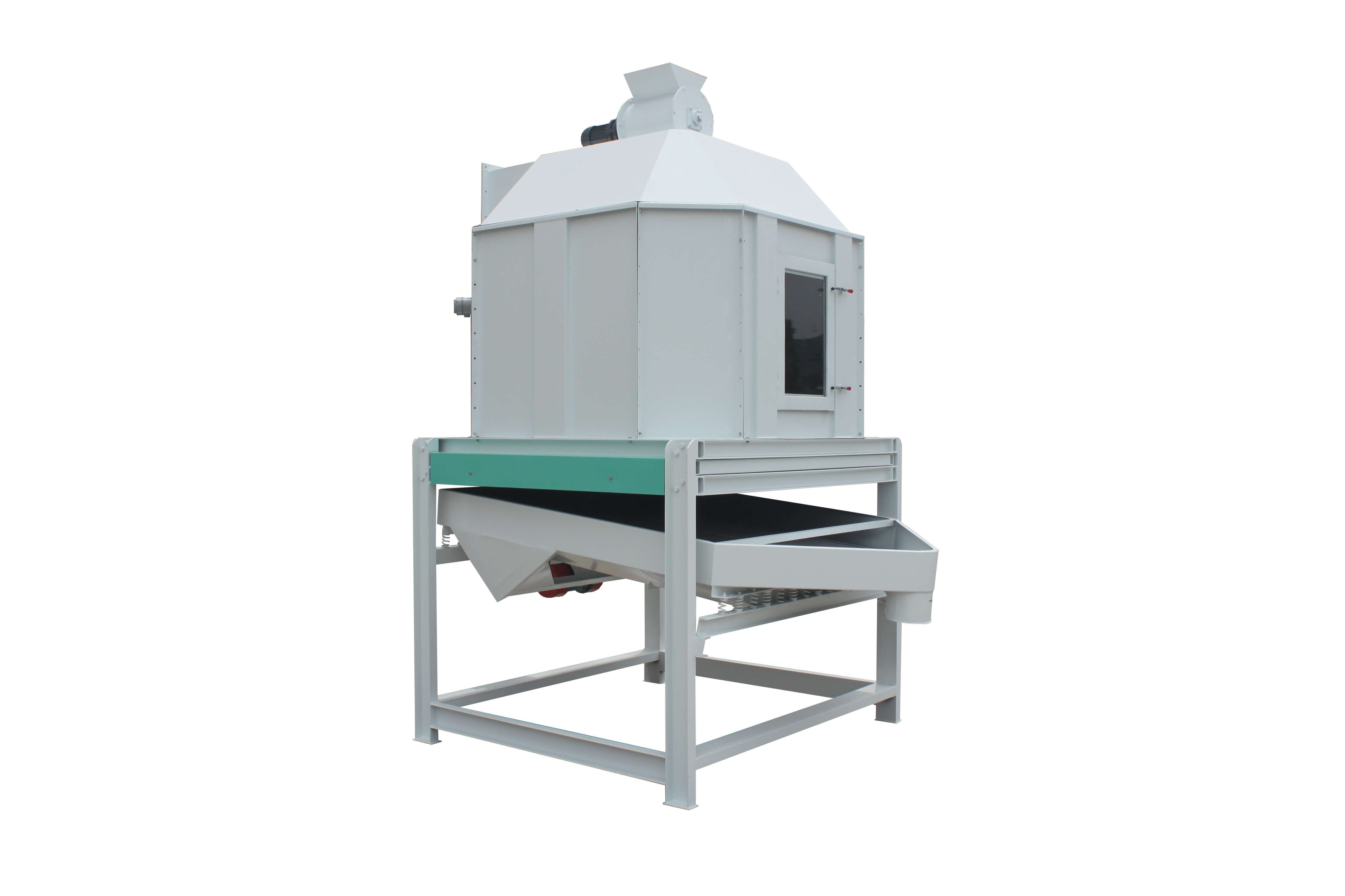
Cooling quality also directly affects pellet durability and fines. Pellets that are cooled too fast develop internal stress and crack; pellets that are cooled too slowly stay soft and smear in the bucket elevator. Counterflow cooling avoids both failure modes, which is why it has become the standard choice for poultry, livestock and aquatic feed plants that care about pellet quality as well as throughput.
How a Counterflow Feed Cooler Works: Working Principle Step by Step
Understanding the sequence inside the cooler helps you evaluate quotations more intelligently, because every supplier describes the machine differently. In a typical vertical counterflow cooler, the process runs as follows.
1. Pellet inlet and distribution
Hot pellets enter the top of the cooler through a rotary distributor or a set of deflector plates. The goal is to fill the cooling chamber with a uniform bed, without segregation of large and small pellets. Uneven filling is one of the most common causes of uneven moisture and hot spots at discharge.
2. Downward pellet flow
The pellet bed descends slowly and continuously. Discharge is regulated by a swing grate, a reciprocating discharge mechanism or a rotary valve, depending on the design. The residence time, usually several minutes, is set so that the pellet core has time to release heat and moisture toward the surface.
3. Upward air flow
A centrifugal or axial fan draws ambient air through the discharge section and pushes it upward through the bed. Because fresh air first contacts already-cooled pellets, the pellets are not shocked, and the air leaves the top of the cooler saturated with moisture and heat. This warm exhaust is often routed to a cyclone or ducted outside the building.
4. Continuous discharge
Cooled pellets leave the bottom of the chamber into the crumbler, screening or bucket elevator. Level sensors and variable frequency drives keep the bed height stable, because a bed that is too shallow short-circuits the air and a bed that is too deep overloads the fan and slows discharge.
Key Parameters to Compare Before You Buy
Two counterflow coolers can look identical on a brochure and perform very differently. The table below lists the parameters that should appear in every technical quotation you receive, along with a short explanation of why each one matters in daily operation.
| Parameter | Why It Matters | What to Ask the Supplier |
|---|---|---|
| Rated capacity (t/h) | Determines whether the cooler can keep pace with the pellet mill | Is the figure based on 6 mm poultry pellets or on a lighter aquatic pellet? |
| Cooling chamber volume (m³) | Defines residence time and cooling uniformity | What residence time is assumed at rated output? |
| Fan power and air volume | Affects cooling speed, energy cost and negative pressure | Is the fan sized for tropical ambient conditions? |
| Discharge mechanism | Controls uniformity of discharge and fines generation | Swing grate, reciprocating grate or rotary valve? |
| Material and thickness | Determines service life in a humid, dusty environment | Is the chamber made of carbon steel with anti-corrosion coating or stainless steel? |
| Temperature drop achieved | Defines final pellet temperature and storage safety | What is the guaranteed outlet temperature at rated capacity? |
Counterflow Cooler vs. Other Cooling Methods
Not every plant needs the same cooling solution. Horizontal belt coolers, vertical counterflow coolers and combined cooler-dryer units each have a place. The comparison below reflects typical practice in feed mills producing poultry, livestock and aquatic feed.
Counterflow (vertical) cooler
- Compact footprint, high capacity per square metre of floor space
- Gentle cooling curve, good durability retention for fragile pellets
- Suitable for 1–30 t/h pellet lines and multi-species plants
- Can be combined with a stabilizer for aquatic feed to improve starch gelatinisation and water stability
Horizontal belt cooler
- Good for very fragile or large-diameter pellets, and easy visual inspection
- Larger footprint and higher building height requirement in some layouts
- Air distribution can be less uniform across the belt width if not well engineered
Cooler with integral drying zone
- Useful in humid climates where ambient air alone cannot reach target moisture
- Higher capital and energy cost, but reduces risk of wet pellets in rainy seasons
- Recommended mainly for aquatic feed or high-moisture extrusion processes
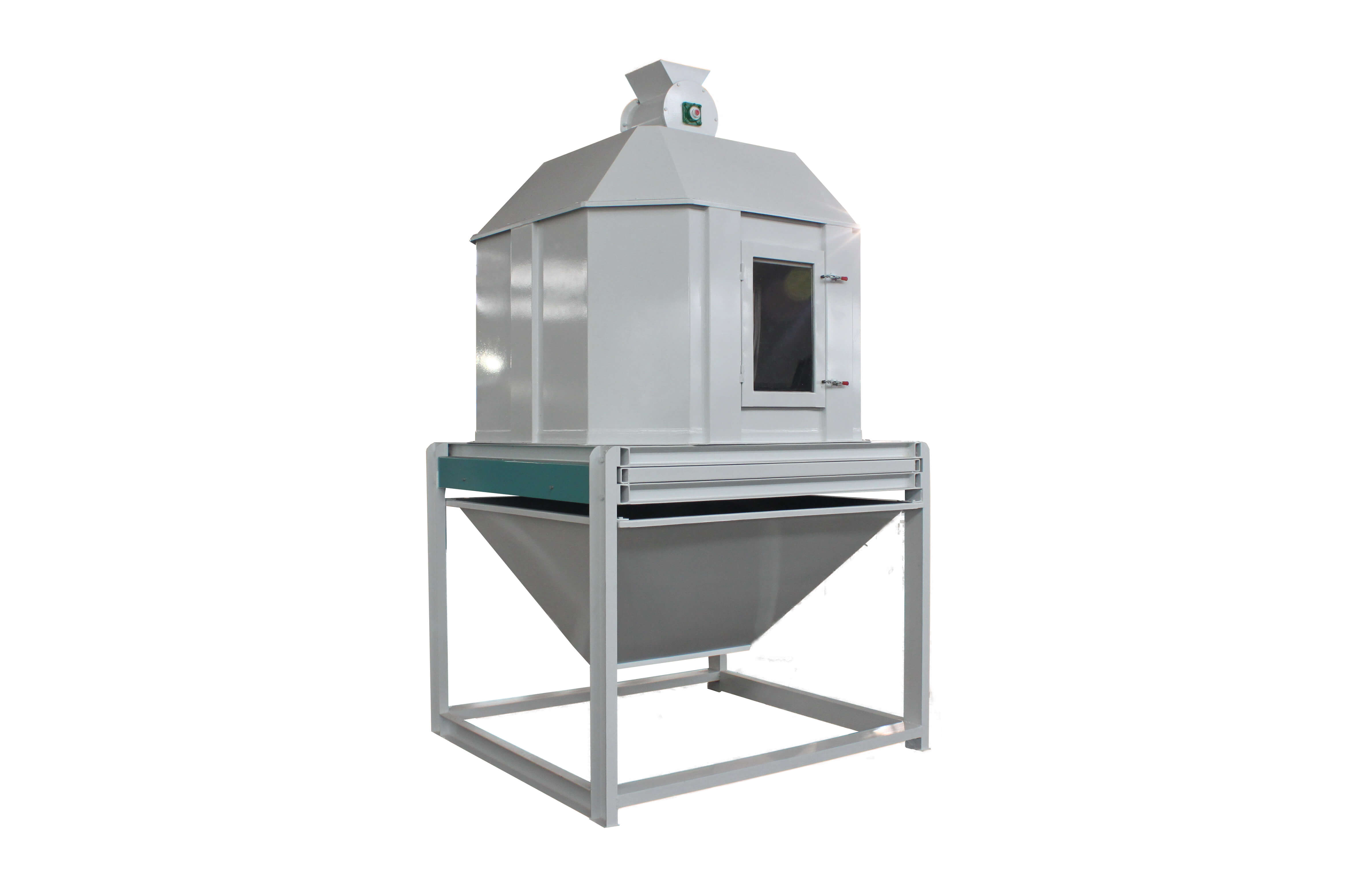
For most new feed mills between 1 and 30 tonnes per hour, a vertical counterflow cooler is the practical default because it saves floor space, integrates easily with a bucket elevator layout, and delivers consistent pellet quality across product changes.
How to Match Cooler Capacity to Your Pellet Mill
The single most common specification mistake is choosing a cooler based on the pellet mill’s nameplate capacity instead of its realistic output for the product mix you actually run. A pellet mill rated at 10 t/h for 4 mm poultry feed may run at 6–7 t/h on a high-fat formula or a light aquatic pellet. If the cooler is sized exactly to the nameplate figure, the operator ends up pushing the machine beyond the recommended bed depth, cooling becomes uneven, and fines rise.
A practical rule is to size the cooler for 110–120 percent of the realistic maximum output of the pellet mill, then verify that the residence time at minimum output is still long enough for proper cooling. Variable frequency control on the discharge and the fan gives you the flexibility to run both ends of the range without sacrificing quality. For plants that change formulas several times a day, this flexibility is worth more than a small saving on the purchase price.
Typical capacity reference
Counterflow coolers are commonly offered in models covering roughly 2, 3, 5, 8, 10, 15, 20 and 30 tonnes per hour. When requesting a quotation, state your pellet diameter range, the heaviest and lightest formula, ambient temperature and humidity at the plant site, and the desired final pellet temperature. A responsible supplier will then confirm the model rather than simply quoting the cheapest unit in the catalogue.
How to Choose a Reliable Counterflow Feed Cooler Supplier
Because coolers are mechanically simple, many workshops can weld a box and attach a fan. The differences that matter appear after commissioning: air distribution design, discharge mechanism quality, fan selection, welding and coating quality, and whether the supplier can integrate the cooler into a complete line with pellet mill, crumbler, stabilizer, dryer and conveying equipment.
What to verify
- Manufacturing credentials such as ISO 9001 certification and verifiable factory size and equipment
- In-house design capability for complete feed production lines, not just single machines
- Installation and commissioning service, including supervision and operator training
- Spare parts availability: grates, discharge plates, bearings, fan impellers, seals
- References from similar projects in your capacity range and feed type
- Clear drawing package: general arrangement, air duct layout, utility requirements and load data
It is also worth asking how the supplier handles multi-species plants. A line producing poultry, ruminant and aquatic feed needs a cooler that can be cleaned thoroughly between formulas to avoid cross-contamination, and a discharge mechanism that does not crush delicate aquatic pellets. Huamu’s engineering team designs and manufactures complete powder, premix, pellet and special aquatic feed projects from 1 to 30 tonnes per hour, which means the cooler is selected as part of an integrated process rather than as an isolated item.
Installation, Operation and Maintenance Tips
Even a well-chosen counterflow feed cooler underperforms if it is installed or operated carelessly. These practical points cover the issues most often seen during commissioning and the first year of operation.
Installation
Allow sufficient headroom for the inlet distributor and maintenance access to the discharge section. Verify that the air duct route to the cyclone or exhaust point does not create excessive back pressure, because a restricted exhaust reduces air volume and cooling efficiency. Check that the cooler is isolated from vibration of adjacent equipment and that the fan is mounted with proper flexible connections.
Daily operation
Keep the pellet bed at the designed height and avoid running the cooler nearly empty, which short-circuits air and overheats the remaining pellets. Monitor inlet and outlet pellet temperature and moisture at the start of each shift, not only when problems appear. When switching formulas, run the cooler long enough to clear the previous product completely.
Preventive maintenance
- Inspect discharge grates and plates weekly for wear, burrs and pellet jamming
- Clean the air path and fan impeller monthly; dust build-up on blades reduces air volume and increases energy use
- Lubricate bearings according to the supplier’s schedule and record the work
- Check seals and inspection doors for air leakage, which reduces efficiency and creates dust nuisance
- Review pellet quality data monthly and correlate any rise in fines with cooler settings
Where a Counterflow Cooler Fits in Real Feed Plants
The same cooler design serves very different production goals. In a poultry feed plant producing 4–6 mm pellets, the priority is cooling throughput and durability, so the cooler is matched to a pellet mill running continuously and discharge is kept steady. In a ruminant feed line with large pellets, the priority is gentle handling to avoid breakage, and the discharge mechanism becomes the critical component.
In aquatic feed production, the cooler usually works together with a stabilizer and dryer. The stabilizer holds the pellets at elevated temperature for a controlled period to complete starch gelatinisation, and the counterflow cooler then brings the temperature down without cracking the pellet surface. This is why suppliers who understand aquatic feed processes tend to specify a different cooler configuration than suppliers who only build simple poultry lines.
For premix and concentrate plants, the cooler may only run a fraction of the time, but hygiene and cleanability become the dominant requirements. Removable screens, smooth internal surfaces and easy access for inspection make the difference between a plant that passes audits easily and one that struggles with cross-contamination.
Frequently Asked Questions
What is the working principle of a counterflow feed cooler?
Hot pellets enter the top of the cooling chamber and move downward, while ambient air is drawn from the bottom and flows upward through the pellet bed. Because the air and pellets travel in opposite directions, fresh cool air meets the coolest pellets at the discharge end, and warm humid air meets the hottest pellets at the inlet. This produces gradual, uniform cooling, reduces internal stress and cracking, and lowers pellet temperature to about ambient plus 5–10 °C.
How do I choose the right capacity for my pellet line?
Start from the realistic output of your pellet mill for your heaviest and lightest formulas, not from the nameplate figure. Size the cooler at roughly 110–120 percent of that realistic maximum, then confirm that residence time is still adequate at minimum output. Variable frequency drives on the discharge and fan help you cover a wide production range without sacrificing pellet quality.
What factors affect the price of a counterflow feed cooler?
Capacity, chamber volume, fan power, discharge mechanism type, material and coating specification, instrumentation, and whether the unit is supplied as a standalone machine or as part of a complete line all affect the price. Freight, installation supervision and spare parts packages also influence total cost. A low quotation usually reflects a smaller chamber, a lighter fan, or a simpler discharge mechanism, so compare technical data rather than headline price alone.
Can one cooler handle poultry, ruminant and aquatic feed?
In many multi-species plants, yes, provided the cooler is sized for the largest and most demanding product and is easy to clean between formulas. For aquatic feed, the cooler is normally combined with a stabilizer and dryer, and the discharge mechanism must be gentle enough to avoid damaging the pellets. Discuss your full product mix with the supplier so the configuration is designed accordingly.
What maintenance does a counterflow cooler require?
Weekly inspection of grates and discharge plates, monthly cleaning of the air path and fan impeller, scheduled bearing lubrication, and regular checks of seals and inspection doors for air leakage. Monitoring outlet pellet temperature and fines every shift allows early detection of problems before pellet quality is affected.
Summary
A counterflow feed cooler is not a commodity box with a fan attached. It is the machine that converts hot, soft pellets into stable, durable product that can be stored and shipped without mould or breakage. Choosing well means matching capacity to realistic pellet mill output, comparing chamber volume, fan power, discharge mechanism and material quality rather than price alone, and working with a supplier who can integrate the cooler into a complete feed production line and support it after commissioning.
Jiangsu Huamu Machinery Co., Ltd. designs, manufactures, installs and commissions feed machinery and complete production lines from 1 to 30 tonnes per hour, covering ring die pellet machines, waterdrop hammer mills, double shaft mixers, counterflow coolers, stabilizers, crumblers, extruders, dryers and conveying equipment for poultry, livestock, ruminant, aquatic and premix feed. If you are comparing counterflow feed cooler suppliers or planning a new line or upgrade, share your capacity, formula range and site conditions with our engineering team, and we will confirm the right configuration, drawings and quotation for your project.