
Feed mixing is one of the few process steps in a feed mill where small variations quietly multiply into large costs. A mixer that leaves additives, vitamins, minerals or medication unevenly distributed will produce inconsistent pellets, uneven animal performance and rejected batches — long before anyone notices the mixer itself. For farm owners, feed mill managers and project investors, choosing the right farm feed mixer supplier is therefore not a purchasing formality. It is a decision that shapes feed quality, labour requirements, energy use and the total cost per ton for the next decade.
This guide explains what actually separates a dependable feed mixing machine manufacturer from a low-cost equipment seller. It compares common mixer configurations, examines the design details behind a double-shaft paddle mixer, shows how mixer capacity should be matched to a 1–30 t/h feed production line, and provides a practical checklist for verifying any supplier before you place an order. The principles apply whether you are building a new poultry feed plant, upgrading an existing cattle feed line, or adding an aquafeed workshop.
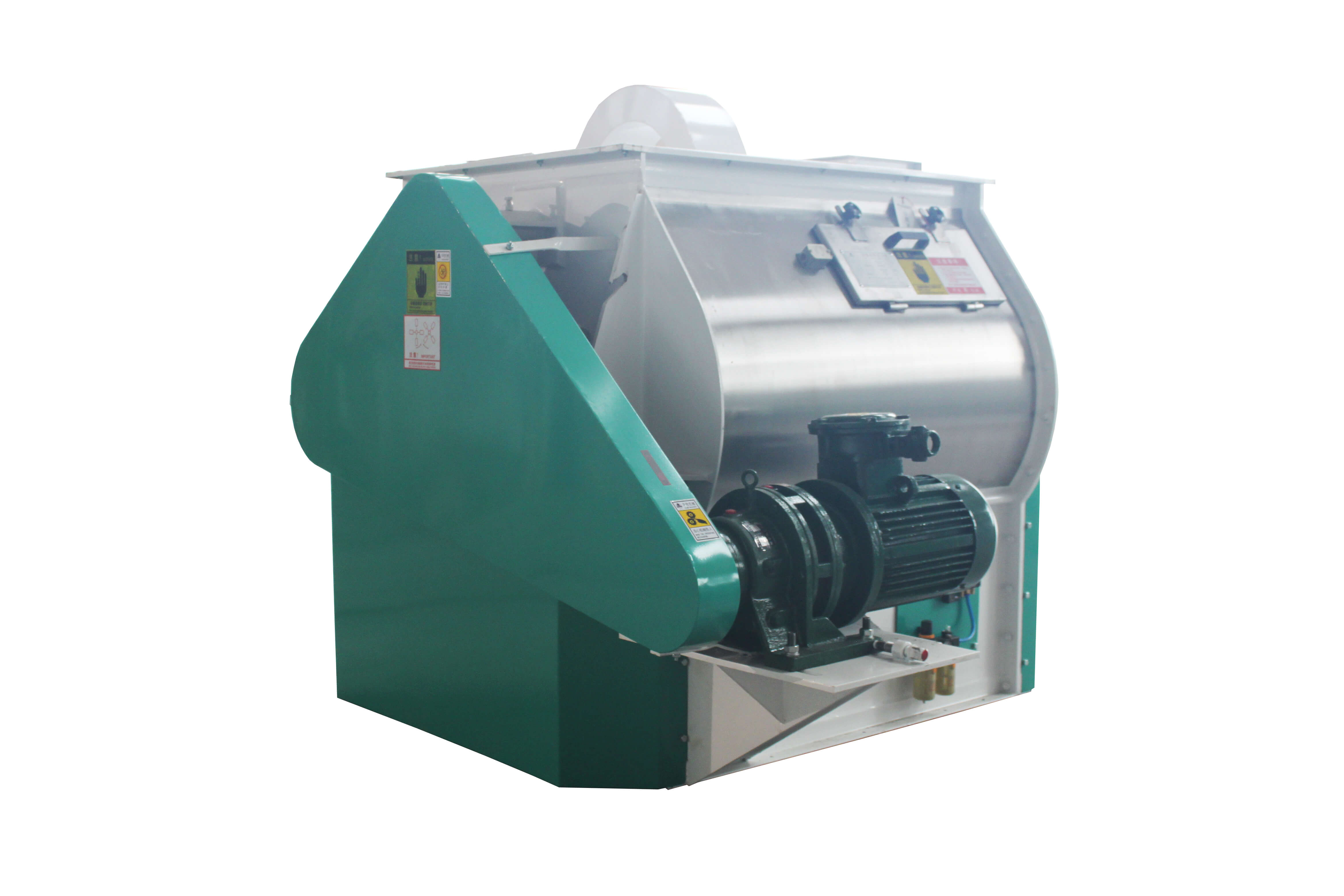
Why Mixing Performance Directly Affects Feed Quality and Farm Margins
Mixing is the point where formulation becomes physical reality. Every ingredient in a formula — maize, soybean meal, bran, fish meal, limestone, phosphates, amino acids, vitamins, trace minerals, enzymes, oils and molasses — has a different particle size, bulk density and flow behaviour. The mixer’s job is to turn that heterogeneous blend into a mass in which any small sample represents the whole batch within an acceptable tolerance. If it fails, the consequences appear in several places at once.
First, animal performance becomes uneven. A batch with concentrated vitamin or mineral pockets can deliver over-supply to some animals and under-supply to others. In poultry operations this may show up as inconsistent growth or shell quality; in cattle feed it can affect rumen stability; in aquafeed, where pellet homogeneity matters for water stability, it can influence both feed intake and waste. Second, feed safety and regulatory compliance are put at risk. Medicated or additive-containing feeds require documented uniformity, and many markets expect a mixing coefficient of variation (CV) that is measured and repeatable, not simply claimed.
Third, mixing efficiency is an economic variable. Long mixing cycles waste energy and reduce output from an otherwise capable line, while short cycles that do not reach uniformity create hidden quality costs. For a plant producing several shifts per day, a mixer that completes a homogeneous batch in 30–90 seconds per batch rather than several minutes can release significant capacity without adding a single kilowatt of installed power. That is why experienced buyers evaluate mixers by uniformity, cycle time, residue, liquid addition capability and reliability — not by price alone.
Feed Mixer Types Compared: Which Configuration Fits Your Operation?
Most feed mixing equipment on the market falls into a small number of mechanical families. Each has a legitimate place, but they are not interchangeable. A farm making a few tons of coarse cattle feed per day has different priorities from a commercial feed mill producing multiple poultry and aquafeed formulas under strict changeover discipline. Before approaching any farm feed mixer supplier, clarify which configuration your process actually needs.
Vertical mixers are simple and economical, and they suit small farms with modest output and relatively forgiving formulas. Single-shaft horizontal ribbon mixers provide better longitudinal movement and are widely used in general feed milling, although cycle times are longer and sticky or high-molasses blends can be more difficult to handle. Double-shaft paddle mixers use two counter-rotating shafts with pitched paddles to create a fluidised zone in the centre of the trough, producing fast, gentle and uniform mixing with minimal dead zones. This is the configuration most often selected for commercial poultry, livestock, aquafeed and premix operations where uniformity and short batch cycles are both required.
| Mixer configuration | Typical mixing cycle | Uniformity and residue behaviour | Best fit | Points to verify |
|---|---|---|---|---|
| Vertical screw mixer | Longer cycles, often several minutes | Acceptable for simple blends; higher risk of segregation with fine additives | Small farms, on-farm blending, low output | Clean-out access, power demand, actual batch repeatability |
| Single-shaft ribbon mixer | Moderate, typically 3–6 minutes | Good general performance; sticky blends may build up on ribbons | General feed milling, dry mash feeds | Ribbon clearance, shaft seals, discharge completeness |
| Double-shaft paddle mixer | Short, typically 30–90 seconds per batch | High uniformity (CV ≤ 5%), low segregation, good liquid dispersion | Poultry, livestock, aquafeed, premix and additive blends | Paddle angle and wear, spray system, full-discharge design |
| Continuous mixer | Continuous flow, no batch cycle | Depends heavily on upstream dosing accuracy | High-volume single-formula production | Feed rate stability, recipe changeover, traceability |
The table is a starting point, not a verdict. A supplier that sells only one mixer type will naturally describe every problem as solvable by that type. A credible feed mixing machine manufacturer should be willing to discuss where a double-shaft paddle mixer is the right answer and where a simpler or different configuration is more appropriate for your formula, budget and maintenance capability.
Inside a Double-Shaft Paddle Mixer: Design Details That Matter
The double-shaft paddle mixer is the workhorse of modern feed mixing, and its performance comes from geometry rather than marketing. Two parallel shafts carry pitched paddles that rotate toward each other. Material is lifted from the bottom of the trough, thrown into a fluidised zone above the shafts, and returned to the bed in a continuous circulation pattern. The result is fast homogenisation with very little dead space, and because the action is gentle rather than violent, fragile pellets, flaked ingredients and premix additives are not damaged.
Short batch cycles without sacrificing uniformity
Mixing time is often misunderstood as a quality guarantee. Mixing longer does not automatically improve uniformity; beyond the optimum point, some blends begin to demix through particle segregation or attrition. A well-designed double-shaft paddle mixer reaches a uniform state quickly, which is why equipment in this class is commonly specified with a mixing cycle of 30–90 seconds per batch and a mixing uniformity expressed as a coefficient of variation of 5% or lower. The practical benefit is twofold: quality is repeatable, and the mixer can support a higher number of batches per shift without additional energy input.
Liquid addition, molasses and oil coating
Many feed formulas require liquid ingredients — molasses, vegetable oil, animal fat, lecithin or liquid additives. Pouring these onto a dry bed creates sticky lumps that never fully disperse. A mixer prepared for liquid addition uses a spray or atomising system that distributes liquid as a fine mist across the moving material bed, so the liquid coats particles rather than gluing them together. For operations producing cattle feed with molasses, or energy-dense poultry feed with added oil, this capability directly affects pellet quality, dust levels and feed intake. Buyers should ask whether the spray system is standard, optional, and how it is cleaned between recipes.
Discharge, residue and recipe changeover
A mixer is only as good as its ability to empty itself. Material left in the trough becomes a contaminant in the next batch — a serious issue when switching between medicated and non-medicated feed, or between different species formulas. Full-width discharge gates, a clean internal profile and accessible inspection openings matter more in daily operation than a marginal difference in nominal volume. During supplier evaluation, request drawings or a video showing the discharge sequence and the internal trough finish, and ask how much residual material remains after a normal discharge cycle.
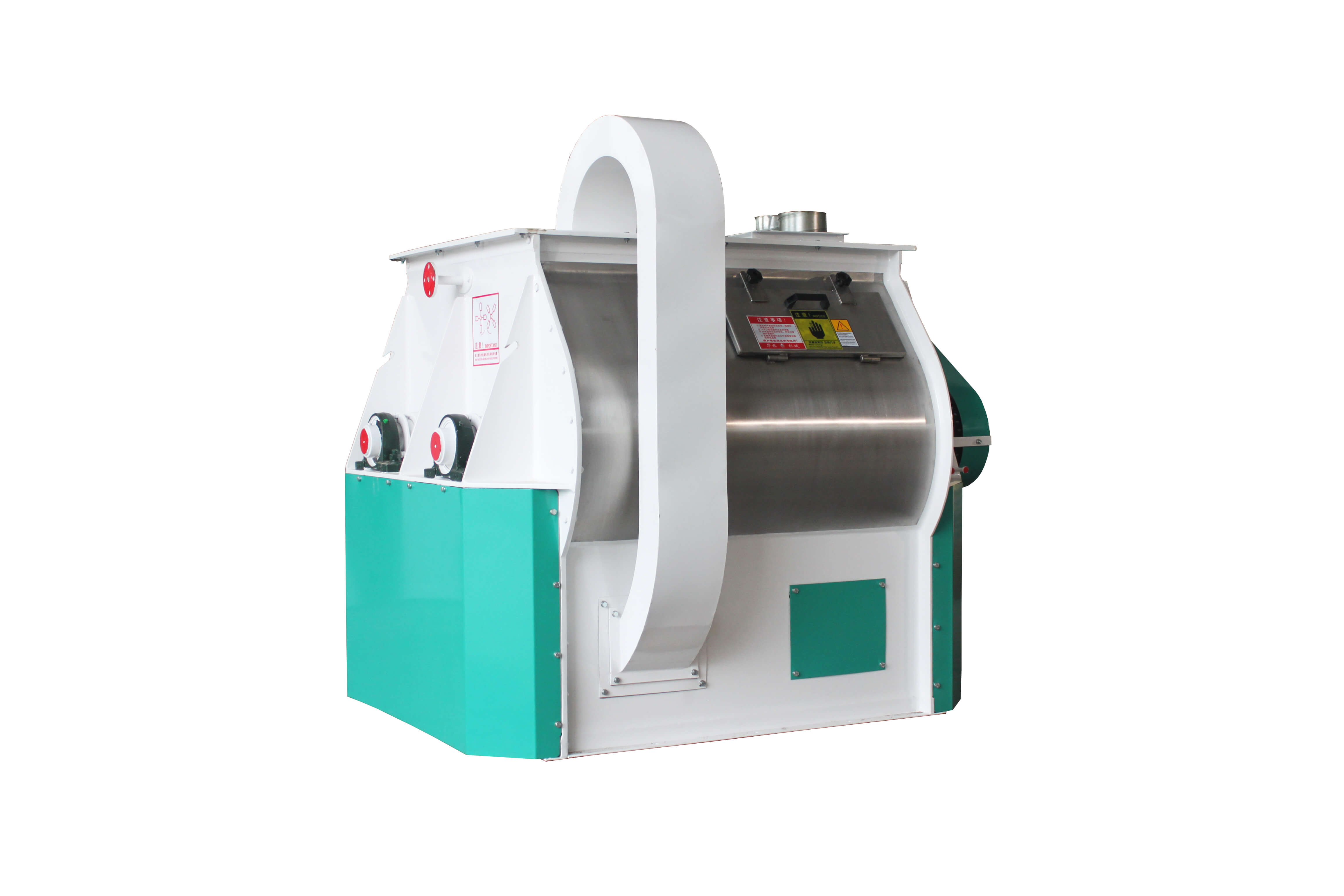
Matching Mixer Capacity to a 1–30 t/h Feed Production Line
A mixer’s nameplate volume tells you very little on its own. Real output depends on batch size, the number of batches per hour, and the time lost to filling, discharging and recipe changeover. The practical formula is straightforward: hourly output equals batch weight multiplied by the number of completed batches per hour. If a mixer handles one ton per batch and a full cycle — filling, mixing and discharging — takes six minutes, the line can complete ten batches per hour, which corresponds to roughly ten tons per hour of mixed feed. If the same mixer needs nine minutes per cycle because of slow discharge or manual handling, output falls to about 6.7 tons per hour with exactly the same equipment investment.
This is why capacity planning should begin with the complete line, not the mixer in isolation. A 1–30 t/h feed production plant typically combines a hammer mill, a batching and weighing system, the mixer, a pellet mill where pelleted feed is required, a cooler, a crumbler, and conveying plus dust control equipment. Each stage has its own cycle time, and the mixer is often the pace-setting unit because every batch must pass through it. Sizing the mixer slightly above the average requirement gives the operator room to manage changeovers, maintenance and peak demand without starving the pellet mill downstream.
Poultry feed production
Poultry feed — broiler starter, grower and finisher, layer mash and pelleted layer feed — demands high formula accuracy and fast changeover between phases. A double-shaft paddle mixer with a 30–90 second cycle fits this pattern well, particularly when the line must produce several formulas per shift. Short cycles reduce the time that fine ingredients remain airborne or exposed to segregation, and good liquid dispersion supports the oil additions common in energy-dense broiler diets.
Cattle and ruminant feed
Ruminant feed often contains molasses, mineral premixes, by-products with variable bulk density, and fibrous ingredients that flow less freely than grain. Here the priorities are resistance to build-up, effective liquid coating and reliable discharge. A mixer with an atomising spray system and a clean internal profile handles molasses-bearing cattle feed far more consistently than a simple ribbon unit, and the resulting pellet durability and feed consistency are usually visible at the feed bunk.
Aquafeed and premix applications
Aquafeed is less forgiving than most terrestrial feeds. Fine grinding, high protein inclusion, small inclusion-rate additives and strict pellet water stability all place a premium on mixing homogeneity. Premix and additive production — where active ingredients may represent a very small fraction of the batch — is even more demanding, because an unmixed pocket can represent a serious quality and compliance failure. For these applications the key evidence is measured uniformity data, not mixer volume, and buyers should request test methodology alongside the result.
Installation, Operation and Maintenance: Lowering Cost per Ton
Purchase price is a one-time event; maintenance and downtime are recurring. A mixer installed on an inadequate foundation will transmit vibration into the structure and accelerate bearing and paddle wear. A mixer operated with worn paddles will lose its mixing pattern and consume more time to reach uniformity. A mixer cleaned carelessly will spread residue from one recipe into the next. These are not abstract concerns — they are the everyday reasons why two plants with identical equipment report very different costs per ton.
Installation should therefore be treated as part of the equipment package. Correct foundation design, shaft alignment, drive tensioning, electrical interlocking and a documented commissioning run are all part of bringing a mixer into service properly. For buyers importing equipment, a supplier that provides drawings, supervision or on-site commissioning support removes a substantial amount of project risk. Jiangsu Huamu maintains design, production and installation teams that handle complete feed production projects, including installation and debugging, rather than shipping standalone machines without process support.
Routine maintenance is relatively simple when it is planned: check paddle wear and clearance, inspect shaft seals for leakage, verify gate and discharge operation, lubricate drive components at defined intervals, and clean the spray system after liquid-containing batches. Safety deserves equal attention — interlocked inspection doors, guarded drives, lock-out procedures before internal access, and strict rules against entering a mixer while the line is live. A short daily check is far cheaper than an unplanned shutdown during a peak feed season.
How to Verify a Farm Feed Mixer Supplier Before You Buy
Supplier verification separates a genuine feed machinery supplier from a trading intermediary. Start with the factory itself: does the manufacturer actually fabricate the mixer body, shafts and paddles, and can it show the machining and assembly process? A manufacturer with its own design, production and installation capability can answer technical questions about paddle angles, shaft speed, drive sizing and discharge geometry. A reseller usually cannot.
Second, look at quality management and project experience. Certification such as ISO 9001 indicates a documented quality system; recognition as a specialised and innovative enterprise reflects external assessment of technical capability. Evidence of completed projects across multiple feed types is also useful, because poultry, ruminant, aquafeed and premix lines each expose different weaknesses in a mixer design. Jiangsu Huamu, based in Wuxi, Jiangsu, manufactures feed machinery, biomass machinery and organic fertiliser machinery, designs complete production lines, and has supplied equipment to customers in more than 50 countries and regions.
Third, evaluate the commercial and service package in writing. Confirm the scope of supply, the interfaces with upstream and downstream equipment, the spare parts list, warranty terms, documentation language, and the availability of installation and commissioning support. Ask for a mixing uniformity test report and clarify how it was measured. Finally, request references or project descriptions relevant to your feed type and capacity. A supplier that answers these questions precisely and consistently is usually the one that will still answer the phone two years after delivery.
Frequently Asked Questions
What mixing uniformity can a double-shaft paddle mixer achieve?
Well-designed double-shaft paddle mixers commonly achieve a mixing uniformity with a coefficient of variation (CV) of 5% or less, with a batch cycle of roughly 30–90 seconds. The exact figure depends on the formula, ingredient particle sizes, liquid addition and how the sample is taken. Always ask the supplier for the test method alongside the result, because a CV figure without a sampling protocol is difficult to compare across suppliers.
How much does a farm feed mixer cost?
There is no single price, because a mixer is specified by batch volume, construction material, drive configuration, discharge type, liquid addition system and the degree of automation required. A small on-farm mixer and a production-line mixer for a 10 t/h plant are fundamentally different machines. The most useful approach is to define your required batch size, batches per hour and formula characteristics, then request a quotation that lists the full scope of supply, so that prices from different suppliers can be compared on equal terms.
Can one mixer handle poultry feed, cattle feed and aquafeed?
In many plants a single double-shaft paddle mixer can process multiple feed types, because the mixing action is suitable for mash, pelleted and high-additive formulas. The practical constraint is changeover discipline: residue must be removed between recipes, especially where medication or species-specific additives are involved, and liquid addition systems must be cleaned. If your product range includes both very fine premix and high-molasses cattle feed, discuss the full range with the manufacturer so that the spray system, discharge design and clean-out access are specified correctly.
What capacity should I choose for a 5 t/h feed plant?
Work backwards from completed batches per hour. If a 1-ton batch requires six minutes for filling, mixing and discharge, the mixer can complete ten batches per hour, supporting about 10 t/h. If your actual cycle is closer to nine minutes, the same mixer delivers about 6.7 t/h. For a nominal 5 t/h line, buyers usually specify a mixer with some headroom so that maintenance, changeovers and peak demand do not become bottlenecks, then confirm the figure with the line designer rather than selecting on volume alone.
Does the supplier provide installation and commissioning?
This should be confirmed in the contract, not assumed. Complete feed production projects require civil, mechanical and electrical coordination, and a mixer that is mechanically correct but poorly aligned or incorrectly interlocked will underperform. Suppliers with in-house design, production and installation teams can provide drawings, supervision and commissioning support. Ask specifically what is included on site, who is responsible for utilities and foundations, and what documentation and training are provided at handover.
Summary
Choosing a farm feed mixer is a process decision, not a price comparison. Mixing uniformity determines whether the formulated diet actually reaches the animal, cycle time determines how much capacity your line really has, and discharge and liquid addition design determine how consistently you can switch between recipes. The mixer type should follow the formula and the production pattern — and a double-shaft paddle mixer with a 30–90 second cycle and a CV of 5% or lower is a strong fit for most commercial poultry, livestock, aquafeed and premix applications.
Supplier selection deserves the same rigour. Verify the factory, the quality system, the engineering capability and the installation support, and compare quotations on a like-for-like scope. Jiangsu Huamu Machinery, located in Wuxi, Jiangsu, designs and manufactures feed machinery, biomass machinery and organic fertiliser machinery, and delivers complete 1–30 t/h feed production lines covering ring die pellet mills, waterdrop hammer mills, double-shaft mixers, coolers, stabilisers, crumblers, extruders, dryers, packing machines and conveying or dust-control equipment, with installation and commissioning support. Matching the right mixer to the right line — and the right supplier to the right project — is the most reliable way to protect feed quality and control cost per ton over the life of the plant.