
For feed mill operators and livestock farmers seeking to optimize production efficiency, selecting the right complete feed production line is crucial. This comprehensive guide explores the essential components, selection criteria, and industry-leading solutions for modern animal feed processing. With over 15 years of specialized experience, Jiangsu Huamu Machinery Co., Ltd. stands as a premier supplier of turnkey feed production solutions, serving clients in 50+ countries worldwide.
Understanding Complete Feed Production Systems
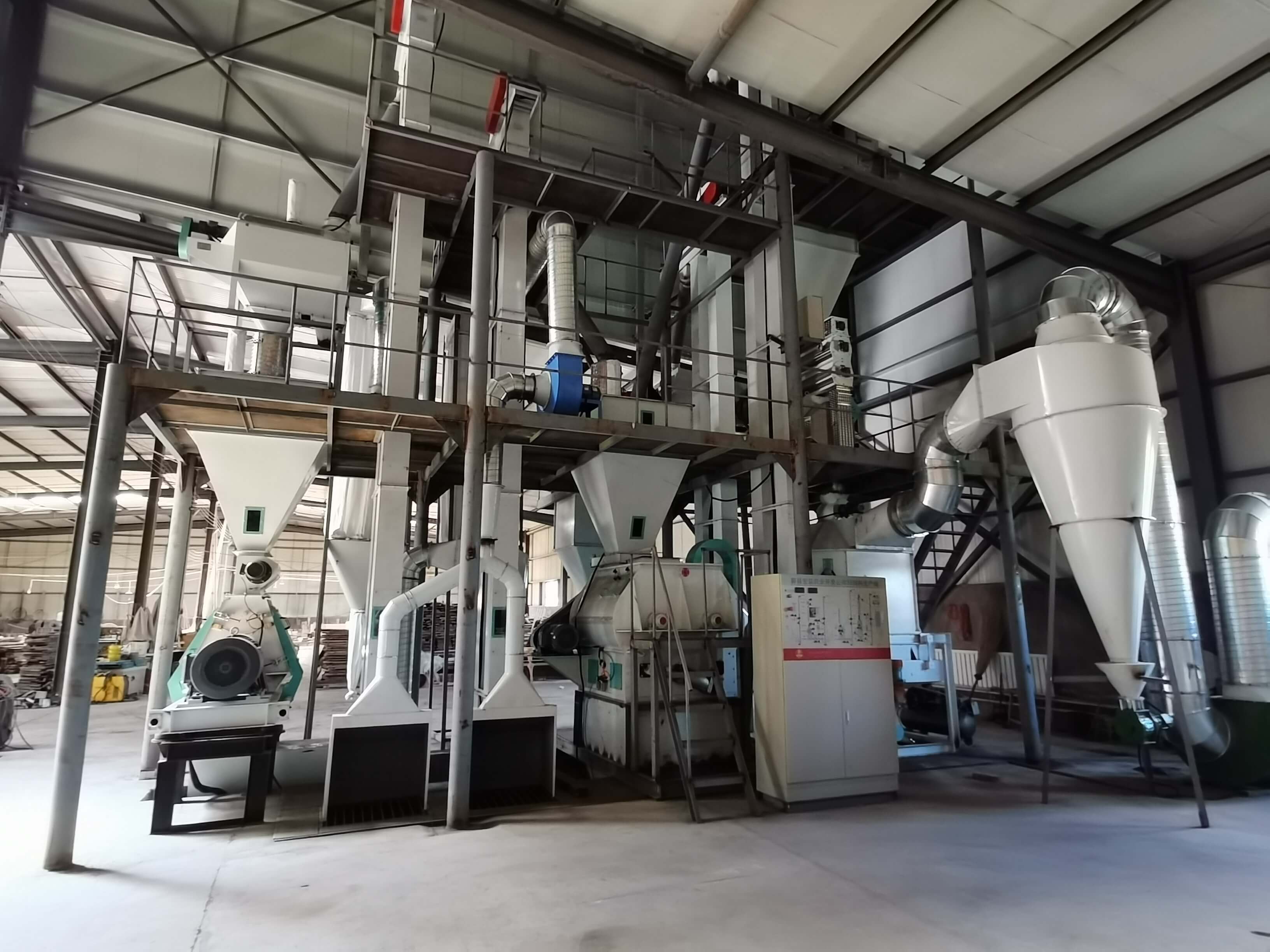
A complete livestock feed production line integrates multiple processing stages to transform raw materials into high-quality finished feed pellets. The core processing flow typically includes:
- Raw Material Reception: Storage silos and conveying systems for corn, soybean meal, wheat bran, and other ingredients
- Grinding Stage: Hammer mills or pulverizers to achieve uniform particle size (typically 200-600 microns)
- Batching & Mixing: Precision weighing systems combined with double-shaft paddle mixers for homogeneous blending
- Pelleting Process: Ring die pellet mills with steam conditioning to produce durable 2-12mm diameter pellets
- Cooling & Screening:
- Packaging System:
Counter-flow coolers to reduce pellet temperature and vibrating screens for size grading
Automatic bagging machines with weight checking and palletizing capabilities
Modern feed production lines incorporate advanced automation controls, dust collection systems, and energy-saving technologies to ensure optimal production efficiency. The integration of Industry 4.0 concepts enables real-time monitoring of key parameters like temperature, moisture, and production capacity through centralized control panels.
Key Selection Criteria for Feed Production Lines
When evaluating complete feed production solutions, several critical factors determine system performance and long-term value:
1. Production Capacity Requirements
Production lines are categorized by hourly output capacity, typically ranging from 1-30 tons per hour. Small-scale farms may require 1-5 TPH systems, while commercial feed mills often need 10-30 TPH configurations. Jiangsu Huamu’s modular design allows easy capacity expansion as business grows.
2. Equipment Quality & Durability
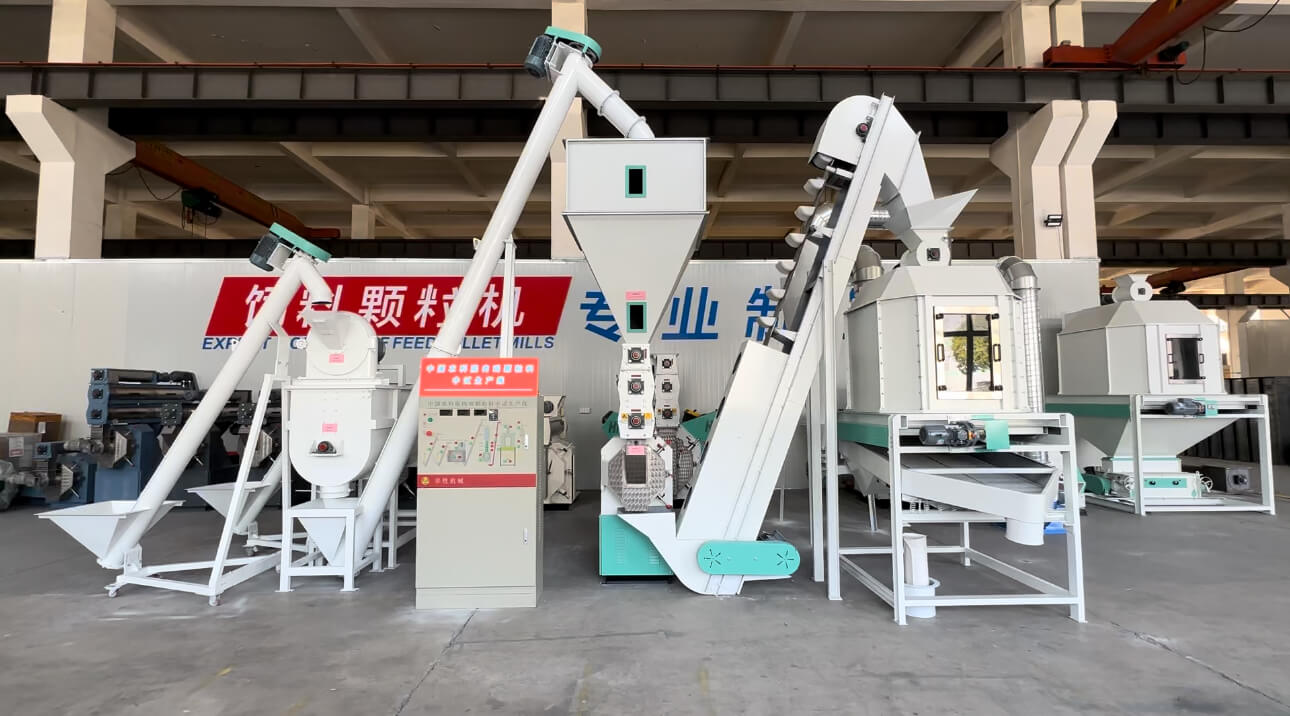
The core components’ material quality determines equipment lifespan and maintenance frequency. For example, our ring die pellet mills use high-grade alloy steel with special heat treatment, achieving 800-1,000 working hours between die replacements – 30% longer than industry average.
3. Process Flexibility
The ability to process multiple feed formulas is essential for modern feed mills. Our double-shaft paddle mixers achieve CV≤5% uniformity across batches, while the waterdrop hammer mills enable coarse to fine grinding (80-800 microns) with quick screen changes.
4. Energy Efficiency
Power consumption directly impacts production costs. Our systems incorporate energy-saving motors, optimized transmission designs, and heat recovery systems. The belt-driven pellet mills consume 15-20% less power than gear-driven alternatives at similar capacities.
5. After-Sales Support
Comprehensive service includes installation commissioning, operator training, spare parts supply, and technical support. Jiangsu Huamu maintains a global service network with 24/7 technical assistance and maintains a 2,000+ SKU spare parts inventory for immediate dispatch.
Core Equipment in Feed Production Lines
The performance of individual machines determines the entire system’s efficiency. Let’s examine the critical components in detail:
1. Pellet Mill Selection Guide
As the line’s heart, the pellet mill must balance capacity, pellet quality, and energy efficiency. Our best-selling HM-420 model features:
- Dual-motor belt drive system for smooth operation
- 2-12mm adjustable die specifications
- 8-12 TPH capacity (depending on formula)
- Automatic lubrication system
- Soundproof enclosure reducing noise to ≤85dB
The patented die design extends service life while producing pellets with 95%+ durability – critical for long-distance transportation without breakage.
2. Hammer Mill Technical Specifications
Our waterdrop hammer mill series offers unmatched versatility:
| Model | Capacity (T/H) | Power (kW) | Screen Size (mm) |
|---|---|---|---|
| SFSP56×36 | 3-5 | 37-45 | Φ2-10 |
| SFSP66×60 | 8-12 | 75-90 | Φ2-12 |
| SFSP112×30 | 15-25 | 132-160 | Φ2-15 |
The “mountain-shaped” secondary crushing structure increases output by 25% compared to traditional designs while maintaining consistent particle size distribution.
3. Mixer Performance Comparison
Our double-shaft paddle mixers outperform single-shaft alternatives in several ways:
- 30-90 seconds mixing cycle vs. 3-5 minutes for ribbon mixers
- CV≤5% uniformity guarantee vs. industry standard CV≤7-10%
- No material segregation during discharge
- Optional liquid addition system with 0.5% accuracy
The U-shaped trough with optimized paddle angles ensures complete material turnover, critical for premix and micro-ingredient blending.
Industry Applications & Case Studies
Jiangsu Huamu’s complete feed production lines serve diverse markets with customized solutions:
1. Poultry Feed Production
For broiler and layer feed production, our systems incorporate:
- Fine grinding (400-600 microns) for optimal nutrient absorption
- 3-4mm diameter pellets with 98%+ durability
- Steam conditioning at 80-85°C for gelatinization
- Cooling to ≤8°C above ambient temperature
A recent 10 TPH poultry feed project in Nigeria achieved 98.5% production efficiency with 0.3% fines rate during the first six months of operation.
2. Aquatic Feed Specialization
Aquafeed production requires unique specifications:
- 200-400 micron fine grinding for floating feed
- 1.5-3mm diameter pellets with 1.2:1 length-to-diameter ratio
- Double-layer conditioning for starches gelatinization
- Special die design for 95%+ water stability
Our 5 TPH shrimp feed line in Vietnam produces feed with 96% water stability after 2 hours immersion, exceeding market requirements.
3. Ruminant Feed Solutions
Cattle and sheep feed production focuses on:
- Coarse grinding (600-800 microns) for rumen health
- 6-12mm diameter pellets for easy chewing
- High-fiber formula processing capabilities
- Dust control systems for worker safety
A 15 TPH dairy cow feed plant in Pakistan reduced feed waste by 18% through optimized pellet quality and size.
FAQ
What capacity range do your complete feed production lines offer?
Our standard configurations range from 1-30 tons per hour, with modular designs allowing easy capacity expansion. For example, our smallest 1 TPH system suits small farms, while our 30 TPH turnkey projects serve large commercial feed mills.
How long does installation and commissioning take?
Typical installation requires 30-60 days depending on project complexity. Our 15-member installation team handles everything from equipment positioning to electrical wiring and PLC programming. Commissioning usually takes 7-10 days to fine-tune all parameters.
What maintenance is required for the pellet mill?
Daily maintenance includes die and roller inspection, lubrication system check, and belt tension adjustment. The ring die requires replacement every 800-1,000 working hours, while rollers last 1,500-2,000 hours. We provide comprehensive spare parts packages and training.
Can your systems process both animal and aquatic feed?
Absolutely. Our equipment features quick-change components for different feed types. For example, the hammer mill can switch screens in 15 minutes, while the pellet mill accepts different die specifications in 30 minutes. Many clients use the same line for multiple feed formulas.
What quality certifications do your products have?
All our equipment meets ISO9001:2015 quality management standards and CE safety requirements. We also comply with OIE animal welfare guidelines and local regulations in export markets. Our quality control system includes 136 inspection points throughout production.
Summary
Selecting the right complete livestock feed production line requires careful evaluation of capacity needs, equipment quality, process flexibility, and after-sales support. Jiangsu Huamu Machinery Co., Ltd. offers turnkey solutions that combine German engineering precision with Chinese manufacturing efficiency, backed by 15+ years of industry experience and 500+ successful projects worldwide.
Our competitive advantages include:
- 30% higher output than industry average for core equipment
- 15-20% lower energy consumption through optimized designs
- 98%+ on-time delivery rate for international projects
- 24/7 technical support with 2-hour response guarantee
- 5-year warranty on main transmission components
Whether you’re establishing a new feed mill or upgrading existing facilities, our engineering team provides free consultation to design the optimal production solution tailored to your specific requirements and budget.