
Choosing an aquatic feed pellet machine is one of the most consequential purchasing decisions in any fish or shrimp feed operation. The pellet mill determines pellet durability, water stability, size consistency, output per hour and how much downtime your plant will face over the next decade. Yet many buyers compare only price per machine and capacity on a nameplate, then discover after installation that the pellets do not hold together in water, the die wears out in weeks instead of months, or the mill simply cannot keep up with the rest of the line. This guide explains how to choose an aquatic feed pellet machine in a structured, engineering-driven way — from raw material characteristics and die specification to drive type, line matching and supplier verification — using practical experience from feed machinery manufacturing in Wuxi, Jiangsu, one of China’s most concentrated feed equipment production regions.
Jiangsu Huamu Machinery Co., Ltd. is a feed machinery manufacturer located in Xibei Town, Wuxi City, specializing in the design, manufacturing, installation and commissioning of complete feed production lines. The company builds ring die pellet machines, waterdrop hammer mills, double shaft mixers, coolers and a full range of auxiliary equipment, and designs turnkey powder, premix, pellet and special aquatic feed projects from 1 to 30 tons per hour. Its belt-driven pellet mills are produced at a volume of roughly 500 units per year, which gives buyers a useful reference point when evaluating whether a supplier has real serial production experience in aquatic feed applications.
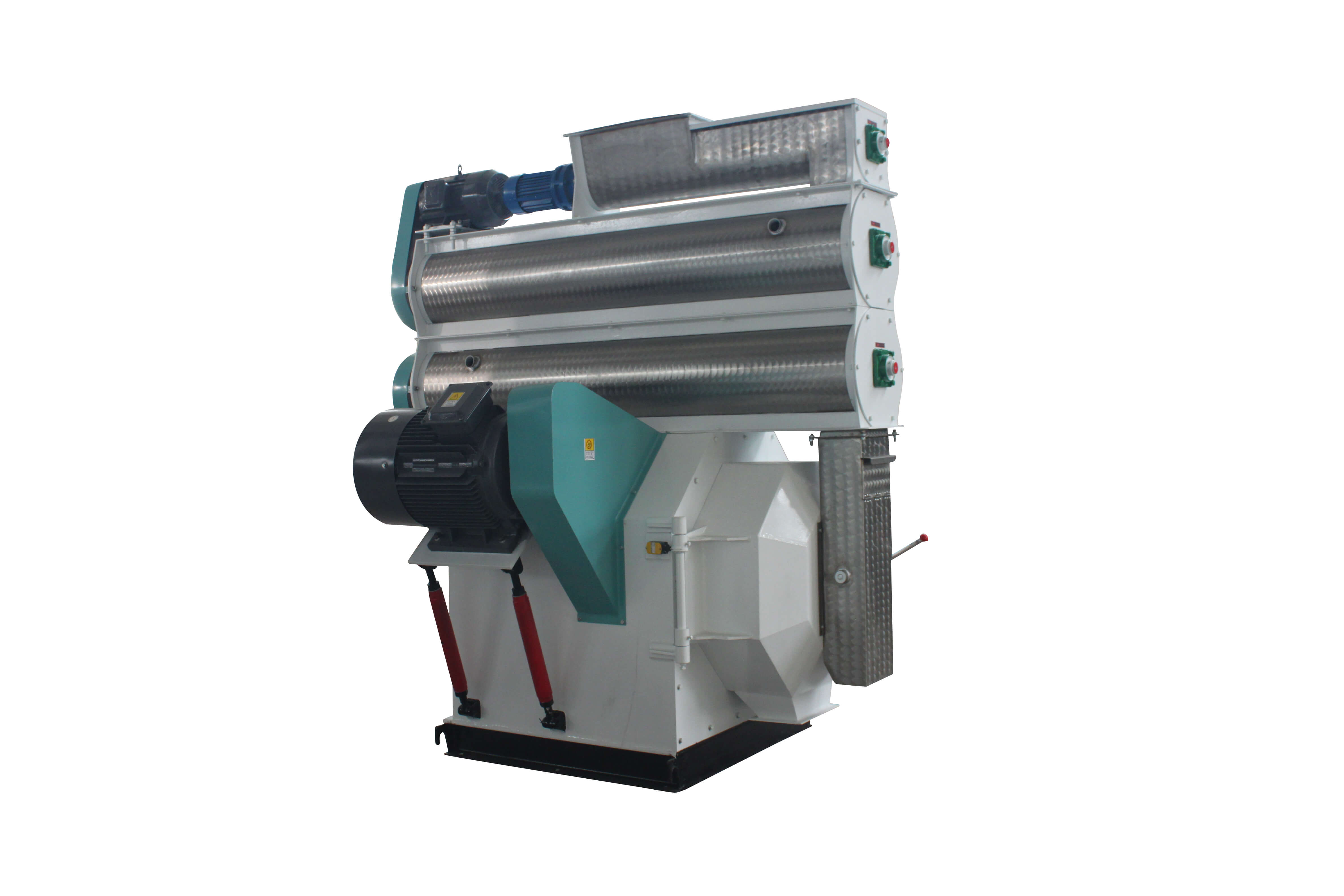
What an Aquatic Feed Pellet Machine Actually Has to Do
Aquatic feed is not simply poultry feed pressed into a different shape. Fish and shrimp feed is formulated with high protein content, significant oil inclusion, fine grinding requirements and often a need for specific water stability — the pellet must stay intact in water long enough for the animal to consume it, without disintegrating and polluting the pond. That combination places different demands on the pellet mill: the die must handle abrasive, oily, high-protein mash; the roller assembly must maintain consistent pressure across the die face; and the conditioner must deliver adequate heat and moisture so the starch and protein bind properly.
An aquatic feed pellet machine therefore has to be evaluated on four outputs rather than one. The first is capacity in tons per hour at a defined pellet diameter. The second is pellet quality: surface finish, length uniformity, durability index and water stability. The third is operating stability: vibration, noise, die and roller wear rate, and power consumption per ton. The fourth is flexibility: whether the same machine can produce different diameters and different formulations for different species without a rebuild.
Species and Feed Type Drive the Specification
Sinking pellet feed for carp, tilapia and shrimp typically requires high density and strong water stability, which pushes toward fine grinding, high conditioning temperature and careful die compression ratio. Floating feed for species that feed at the surface requires expansion, which usually means the pellet mill is paired with an extruder rather than working alone. Juvenile feed requires smaller diameters with tight length tolerances. Buyers who define their species, feed type and diameter range before requesting a quotation consistently get more accurate proposals than buyers who ask for “a fish feed pellet machine” without specification.
How to Choose an Aquatic Feed Pellet Machine: Seven Decision Points
Instead of comparing catalogues page by page, work through the decision points below in order. Each one narrows the machine specification and reduces the risk of an expensive mismatch.
1. Define required capacity at the pellet diameter you will actually run
Capacity is not a single number. A pellet mill rated at a certain hourly output at a large die diameter will produce noticeably less at a small diameter, because the open area of the die and the resistance to flow both change. Always ask a supplier for capacity at your target diameter, and ask how that figure was verified — test data from a comparable customer line is far more credible than a theoretical calculation.
2. Select die compression ratio and hole pattern for the formulation
The compression ratio, expressed as the effective hole length divided by hole diameter, controls how much resistance the mash meets as it passes through the die. Higher ratios produce denser, harder pellets with better water stability but consume more energy and reduce output; lower ratios produce softer pellets more easily. Aquatic feed usually sits in a mid-to-high range, and the correct value depends on protein level, fat content and required water stability. A supplier who cannot discuss compression ratio in technical terms is unlikely to help you solve pellet quality problems later.
3. Decide between belt drive and gear drive
Belt-driven pellet mills use a strong narrow-belt transmission with dual motors, which runs smoothly, dampens shock loads and is simpler and cheaper to maintain. Gear-driven mills are more compact and can transmit higher torque in very large capacities. For small and medium aquatic feed plants, belt-driven ring die machines are the practical default because the transmission absorbs the load spikes that come from variable mash moisture, and belt replacement is a low-cost maintenance task. Jiangsu Huamu’s core pellet mill range is built around this dual-motor narrow-belt principle, with the stated aims of stable operation, high output and low noise.
4. Check conditioner design and steam control
Conditioning is where pellet quality is often won or lost. Adequate retention time, correct steam quality and accurate moisture control determine whether the starch gelatinises sufficiently and whether the pellet survives the die and the cooler. Ask about conditioner shaft configuration, retention time at your required output and how moisture is measured and controlled. Poor conditioning cannot be compensated for by increasing die compression ratio.
5. Match the mill to the upstream grind and mixing stages
An aquatic feed pellet machine cannot produce fine, uniform pellets from coarse, poorly mixed mash. Aquatic formulations generally require fine grinding, which is exactly where a waterdrop hammer mill with a secondary impact structure earns its place. Jiangsu Huamu’s waterdrop chamber design with the “mountain” shaped secondary impact structure is described by the company as delivering around 25% higher output than comparable configurations, and it supports coarse, fine and micro-fine grinding in one machine — useful when a plant needs both aquafeed and other product lines. Downstream of grinding, a double shaft paddle mixer with a 30–90 second cycle and a coefficient of variation of 5% or below delivers the uniformity that the pellet mill needs, and an optional atomizing spray system helps distribute molasses and oil evenly.
6. Plan cooling, crumbling and grading together with pelleting
Hot, soft pellets straight from the die deform in the bin. A counterflow cooler sized to the mill’s output, followed by a crumbler where small sizes are required and a grader to remove fines, completes the pellet quality chain. Buying a pellet mill without matching the cooler is one of the most common causes of disappointing durability results after commissioning.
7. Confirm the electrical, steam and layout envelope
Total connected power, steam boiler capacity, compressed air, floor space and maintenance access all constrain the machine choice. A mill that fits the budget but not the building is not a bargain. Request a general arrangement drawing with the quotation and check lifting points, die removal clearance and roller access.
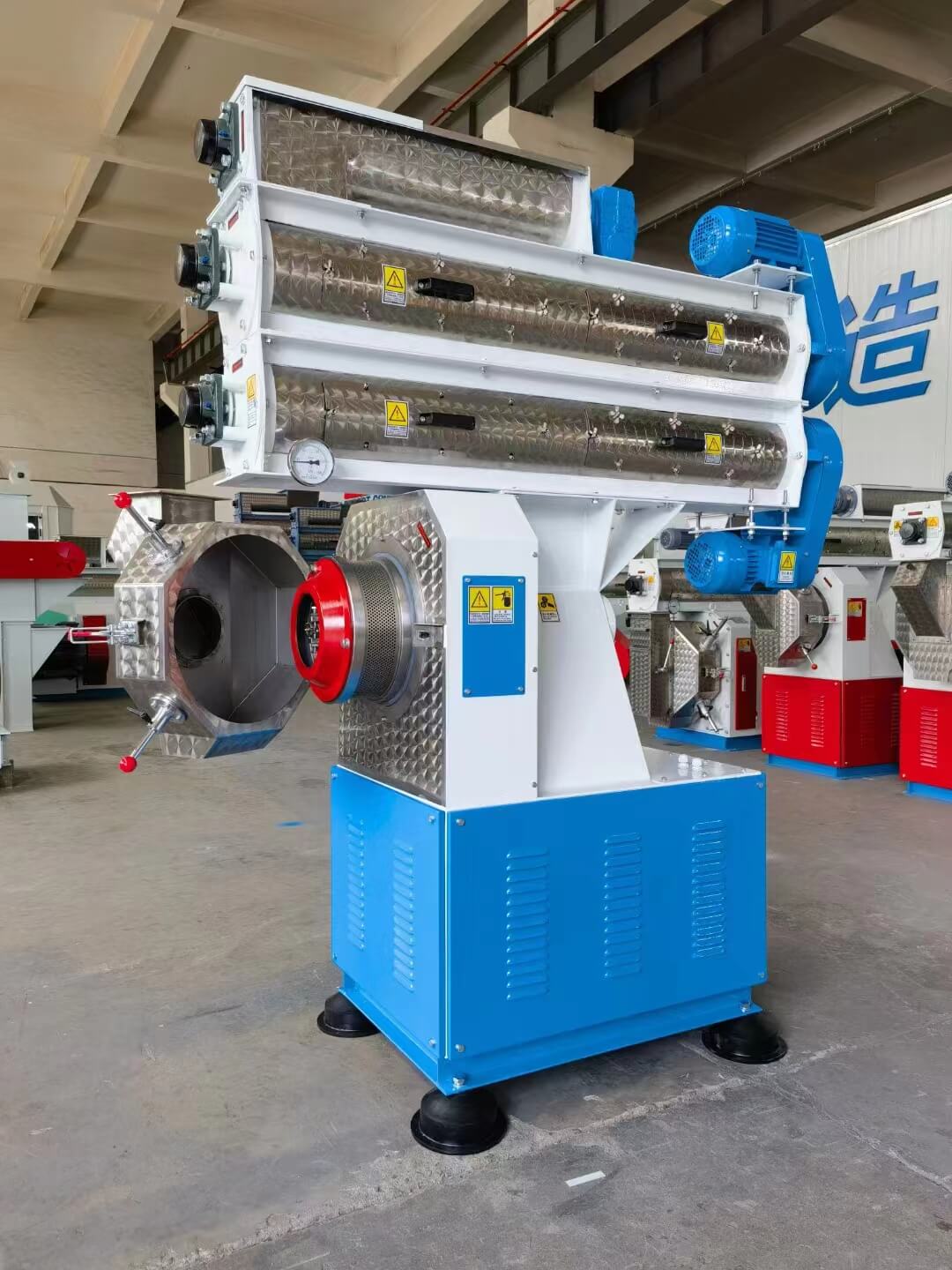
Comparison Table: What Each Specification Changes
The table below summarises how each main specification influences aquatic feed results. Use it as a checklist during technical discussions with any aquatic feed pellet mill manufacturer.
| Specification | What It Controls | Practical Guidance |
|---|---|---|
| Die inner diameter and working width | Capacity and die open area | Match to required tons per hour at your smallest pellet diameter |
| Compression ratio (hole length / hole diameter) | Pellet hardness, density and water stability | Higher ratio for sinking shrimp feed, lower for softer diets; confirm by trial |
| Drive configuration | Load absorption, noise, maintenance cost | Dual-motor narrow-belt drive suits small and medium aquatic plants |
| Conditioner retention time | Starch gelatinisation, binding, die wear | Size the conditioner to output, not to the mill body alone |
| Roller and die material | Service life, pellet surface quality | Ask for wear-part specification and typical replacement interval in writing |
| Cooler and crumbler matching | Durability, fines ratio, final product size | Specify as one package with the pellet mill, not as an afterthought |
Choosing Capacity: From 1 t/h Pilot Plants to 30 t/h Commercial Lines
Aquatic feed plants rarely sit at a single capacity point, because species mix, batch sizes and seasonality all vary. A practical approach is to size the pellet mill at the peak of your expected product mix rather than at the average, then accept that the mill will run below rating on small-diameter products. New commercial plants in growth markets often start in the 3–10 t/h range, while established operations with multiple species lines commonly move to 15–30 t/h configurations with parallel pellet mills so that one unit can be maintained while production continues.
When a plant intends to produce both aquatic feed and poultry or ruminant feed on the same site, capacity planning becomes a scheduling exercise. Sharing the hammer mill, mixer and packing line across product families reduces capital cost, but shared equipment must be cleanable to prevent cross-contamination between high-protein aquatic formulations and other feeds. This is one reason a turnkey design review before ordering matters: the layout, not just the machine list, determines whether the plant runs efficiently.
Turnkey Line Scope from a Single Supplier
Jiangsu Huamu designs, manufactures, installs and commissions complete lines covering crushing, mixing, pelleting, cooling, crumbling, stabilising, drying, conveying, dust collection and finished product packing, at capacities from 1 to 30 tons per hour, for poultry and livestock feed, ruminant feed, aquatic feed, high-grade pig feed and premix. Buying the whole line from one engineering team shortens the commissioning period because interfaces between machines — chute angles, buffer bins, control interlocks — are designed together rather than negotiated between vendors.
Common Buying Mistakes in Aquatic Feed Pelleting
The most frequent error is specifying capacity only at a large die diameter, then discovering that output drops sharply at the 1.5–2.0 mm sizes required for juvenile fish and shrimp. The second is choosing a mill whose conditioner is too small for the required throughput, which forces operators to run hot and wet to compensate and shortens die life. The third is underestimating the importance of fine grinding upstream; oversized particles cause uneven die loading, higher energy consumption and rough pellet surfaces.
Another recurring problem is buying wear parts on price alone. A cheap die that fails early stops the line, and the resulting downtime almost always costs more than the saving. Finally, buyers often overlook documentation and training. Operating staff who understand how to adjust steam, moisture, die clearance and feed rate will produce consistent quality within days; staff who were never trained will chase quality problems for months.
Maintenance Practices That Extend Die and Roller Life
Pellet mill maintenance is mostly about consistency. Keep the feed rate stable rather than surging, because load swings are what crack dies and accelerate roller wear. Check roller-to-die clearance at defined intervals and adjust evenly, since a single loose roller produces uneven pressure across the die face. Monitor finished pellet quality as an early warning signal — a sudden change in surface finish or an increase in fines usually precedes a mechanical issue.
Conditioning discipline matters as much as mechanical maintenance. Correct steam quality, stable moisture and adequate retention time reduce friction and heat inside the die. Clean, well-magnetised mash protects the die from tramp metal damage. Keep a wear-part log recording die hours, product type and output so that replacement intervals become predictable, and maintain a spare die and roller set for each high-volume product diameter rather than a single generic spare.
How to Evaluate an Aquatic Feed Pellet Mill Manufacturer
Supplier evaluation should go beyond the quotation. Ask for the factory’s manufacturing scope and whether the machines are serial-produced or assembled ad hoc. Jiangsu Huamu operates from a 10,000 square metre facility with a registered capital of 10 million RMB, was recognised as a Jiangsu specialised and innovative SME in 2024, holds ISO 9001 certification, and exports to more than 50 countries and regions — all verifiable points that indicate a structured production and quality system rather than a trading operation.
Then examine engineering capability. A supplier that designs the line, manufactures the machines, and sends its own installation and commissioning team is accountable for the result. Ask who performs installation supervision, who trains operators, how spare parts are stocked and shipped, and what documentation accompanies the equipment. Finally, ask for reference installations producing the same feed type and pellet diameter you intend to make. A machine demonstration is useful, but a comparable plant run is more persuasive.
FAQ
How do I choose the right aquatic feed pellet machine for my plant?
Start from the product, not the machine. Define your species, required pellet diameters, target water stability and required tons per hour at the smallest diameter you will run. Then select die compression ratio and hole pattern for your formulation, decide between belt-driven and gear-driven transmission based on capacity and maintenance capability, and match the conditioner, cooler and crumbler to the same output. Finally, confirm the electrical and steam envelope and request a layout drawing with the quotation.
Can one aquatic feed pellet machine produce both floating and sinking fish feed?
A ring die pellet mill produces dense, sinking-type pellets. Floating feed normally requires an extruder, because buoyancy comes from expansion created under extrusion conditions. If your product range includes both floating and sinking feed, plan the line with an extruder for floating products and a pellet mill for sinking and shrimp feed, and share the grinding, mixing, drying and packing stages where the formulations allow.
What capacity should I order for a new fish feed plant?
Size for the peak of your expected product mix rather than the average, and always state capacities at the pellet diameter you will actually run. New commercial plants commonly start between 3 and 10 tons per hour, while larger operations use 15 to 30 tons per hour lines with parallel pellet mills for maintenance flexibility. Turnkey projects in the 1–30 tons per hour range can be engineered around your actual product list.
Why do my pellets break up quickly in water?
Poor water stability usually comes from insufficient grinding fineness, inadequate conditioning, the wrong die compression ratio, or pellets that were not properly cooled before packing. Fine grinding and correct steam conditioning allow the protein and starch to bind properly, while a suitable compression ratio increases density. Check the grinding particle size, conditioner retention time, moisture control and cooler performance before changing the die.
What is the difference between belt-driven and gear-driven pellet mills?
Belt-driven mills use a narrow-belt transmission with dual motors, which absorbs load shocks, runs with lower noise and is inexpensive to maintain because belt replacement is simple. Gear-driven mills are more compact and suit very high torque, large-capacity duties but require more specialised maintenance. For small and medium aquatic feed lines, belt drive is usually the more practical choice.
How much does an aquatic feed pellet machine cost?
Price depends on capacity, die diameter, drive configuration, conditioner size, wear-part material and whether the machine is supplied alone or as part of a complete line including grinder, mixer, cooler, crumbler, conveying and packing. A quotation without a specified capacity at a specified pellet diameter cannot be compared fairly, so always request itemised technical data and scope before comparing prices from different suppliers.
How often do ring dies and rollers need replacement?
Replacement intervals depend on formulation abrasiveness, compression ratio, grinding fineness, conditioning quality and operating discipline, so no supplier should quote a fixed number of hours. Keep a wear log recording running hours, product type and output per die, and hold spare dies for each high-volume diameter. Uneven pellet surface finish and rising fines are usually the first signs that a die or roller needs attention.
Summary
Choosing an aquatic feed pellet machine is a specification exercise before it is a purchasing decision. Define the feed type and pellet diameter, select the die compression ratio for your formulation, size the conditioner and cooler to the same output, choose a transmission that your maintenance team can support, and confirm that the upstream grinding and mixing stages can deliver the fine, uniform mash the mill needs. Then evaluate suppliers on manufacturing scope, engineering capability, installation and training support, and verifiable experience in comparable aquatic feed installations.
Jiangsu Huamu Machinery designs, manufactures, installs and commissions feed machinery and complete lines from its base in Xibei Town, Wuxi City, covering ring die pellet machines, waterdrop hammer mills, double shaft mixers, coolers, stabilisers, crumblers, extruders, dryers, packing machines, conveyors and dust collectors, with turnkey capacity from 1 to 30 tons per hour across poultry, ruminant, aquatic, pig and premix feed. Buyers who approach the selection process with clear specifications and a structured supplier checklist are far more likely to end up with a line that produces durable, water-stable pellets at the rated output — and to avoid the costly revisions that follow a rushed purchase.