
In any pellet feed production line, the pellet mill is only half the story. Once hot, moist pellets leave the die, they must be cooled quickly and evenly before storage, bagging or transport. If pellet temperature and moisture are not controlled properly, pellets can crack, crumble, develop mold, or lose durability during handling. This is exactly where a well-designed counterflow feed cooler earns its place in the process. As an experienced counterflow feed cooler manufacturer based in Wuxi, Jiangsu, Jiangsu Huamu Machinery Co., Ltd. designs, builds and installs cooling equipment as part of complete feed production lines for poultry, livestock, aquatic and premix feed plants.
This guide explains how counterflow cooling works, which parameters matter most during selection, how to match cooler capacity to your pellet mill output, and what to check before you request a quotation from a counterflow feed cooler supplier. It is written for feed mill owners, project engineers and procurement teams who need practical, technical answers rather than marketing claims.
What Is a Counterflow Feed Cooler and Why Does It Matter?
A counterflow feed cooler is a cooling device in which ambient air flows upward through a descending bed of hot pellets. Because the air and the pellets move in opposite directions, the hottest pellets meet the warmest, most humid air at the top of the cooling chamber, while the coolest, freshest air contacts the already-cooled pellets near the discharge outlet. This counterflow principle produces a gentle, gradual temperature drop instead of a sudden shock, which helps protect pellet integrity and reduces surface cracking.
The cooling stage sits directly after the pellet mill and usually before the crumbler, screener and packing section. It has three jobs: reduce pellet temperature to within roughly 3–5 °C of ambient temperature, bring moisture down to a safe storage level (typically below 12–13% depending on formulation and climate), and stabilize pellet durability so that fines generation during conveying and bagging stays low.
Skipping or undersizing the cooling stage creates a chain of problems. Hot pellets going into a silo cause condensation on silo walls, which leads to caking and mold growth. Moist pellets reduce pellet durability index and increase fines returned to the mill, which raises energy consumption and lowers effective output. A properly sized counterflow cooler therefore protects product quality and protects the economics of the whole plant.
How the Counterflow Cooling Process Works Step by Step
Understanding the internal process helps buyers ask the right questions. In a typical counterflow cooler, pellets enter through a rotary distributor or feeding hopper at the top and form a moving bed inside the cooling chamber. A fan or set of fans pushes air through the bed from bottom to top. The cooling chamber walls are usually perforated or fitted with louvers so that air can pass through the pellet mass evenly across the full cross-section.
Discharge is controlled by a reciprocating grid, swing gate or motorized discharge mechanism that moves at a rate matched to the incoming pellet flow. This keeps the bed depth relatively constant, which in turn keeps retention time and cooling performance stable even when the pellet mill output fluctuates slightly. Many designs also include a cyclone or dust collection connection to handle the fine particles carried out with the exhaust air.
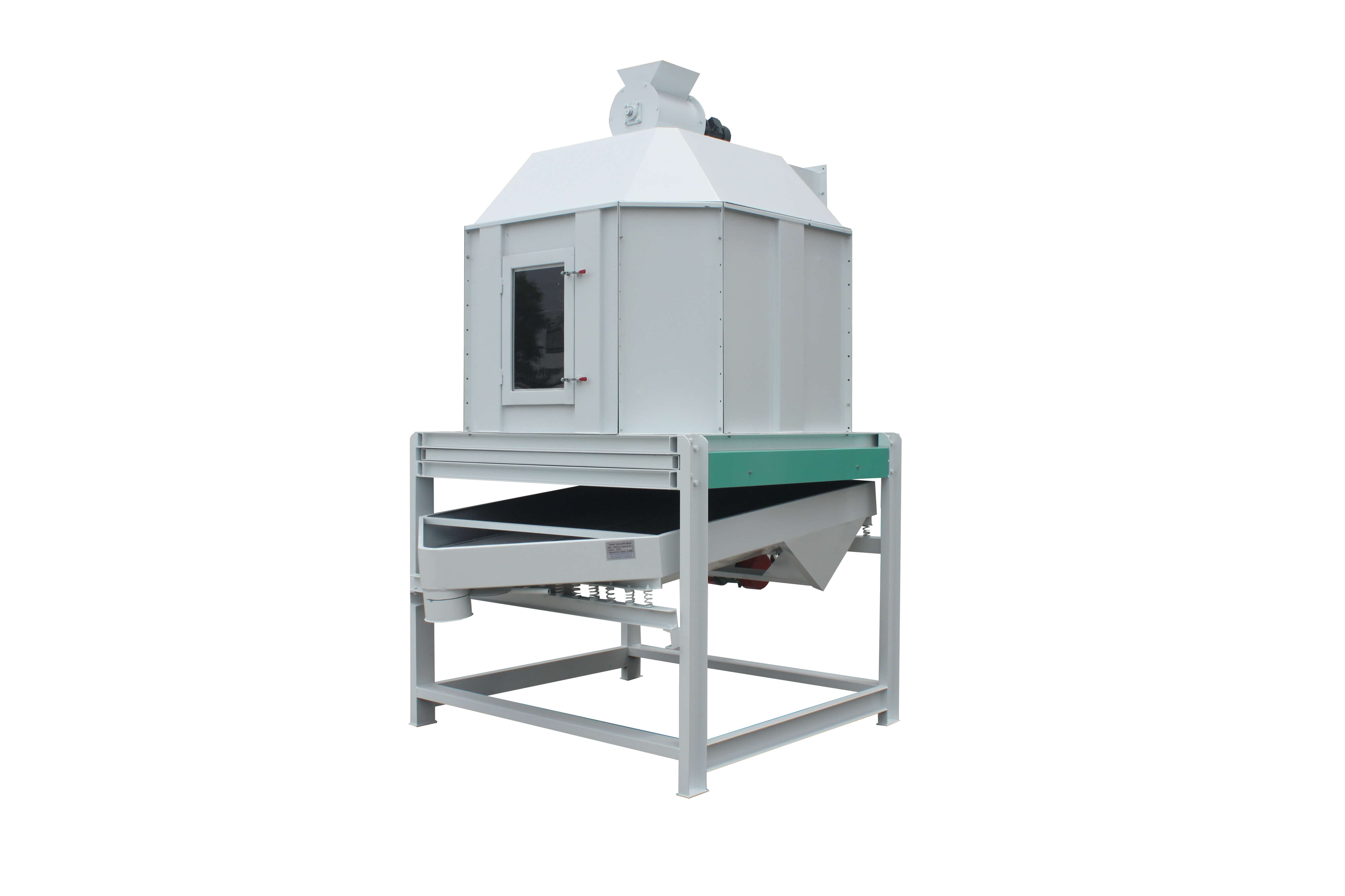
Retention time is the single most important process variable. For most poultry and livestock pellets, a retention time of roughly 6–10 minutes is enough to reach the target temperature, while larger diameter pellets or high-moisture formulations may need a longer residence time. Aquatic feed pellets, especially sinking pellets with high starch content, often require more careful control because they are denser and more sensitive to moisture gradients.
Airflow, Bed Depth and Pellet Diameter
Air volume must match the heat load. If airflow is too low, the top layer of pellets stays hot and the discharge temperature rises. If airflow is excessive, you waste fan power and may over-dry the outer surface of the pellet, which can increase breakage. Bed depth interacts with airflow: a deeper bed increases resistance and improves air distribution uniformity, but requires more fan pressure. Pellet diameter changes the surface-area-to-volume ratio, so a cooler configured for 4 mm pellets may behave differently with 8 mm or 10 mm pellets.
Why Counterflow Beats Simple Cross-Flow Designs
In a cross-flow cooler, air passes horizontally through the falling pellet curtain. The pellets nearest the air inlet cool quickly while pellets on the far side stay warmer, which creates uneven cooling and moisture variation between bags from the same batch. The counterflow arrangement spreads the temperature gradient along the vertical axis instead, so every pellet experiences a similar cooling curve. The result is a more uniform final product and better consistency in downstream storage and transport.
Counterflow Feed Cooler Selection Guide: Key Parameters to Check
Before contacting a counterflow feed cooler manufacturer, prepare your process data. A supplier cannot size a cooler correctly from plant capacity alone; the pellet mill die diameter, formulation, fat and molasses inclusion, ambient conditions and target final moisture all affect the required cooling area. The table below summarizes the parameters that most directly influence selection.
| Parameter | Why It Matters |
|---|---|
| Cooling capacity (t/h) | Must be matched to the pellet mill output, usually with a 10–20% margin for peak production. |
| Pellet diameter and type | Crumble pellets, large ruminant pellets and dense aquatic pellets need different retention times. |
| Inlet pellet temperature | Pellets leaving the die typically range from 70–90 °C; the heat load drives required airflow. |
| Moisture content | High-moisture formulations require longer retention and stronger exhaust capacity. |
| Ambient temperature and humidity | Hot, humid climates reduce cooling efficiency and often require larger cooling area. |
| Discharge control system | Reciprocating or motorized discharge keeps bed depth stable and prevents uneven outflow. |
| Dust and exhaust handling | Cyclone or dust collector connections reduce fines emissions and keep the plant clean. |
Capacity Matching: Cooler Size vs Pellet Mill Output
A common mistake is specifying a cooler exactly equal to the pellet mill nameplate output. In practice, pellet mills run at different efficiencies depending on die condition, formulation and operator skill, and plants often add a second shift during peak season. A cooler sized 10–20% above normal output provides buffer capacity and keeps discharge temperature stable during short production surges. Oversizing by a very large margin, on the other hand, can shorten effective bed depth and cause uneven airflow, so the target is a balanced match rather than the biggest possible unit.
Construction, Materials and Energy Use
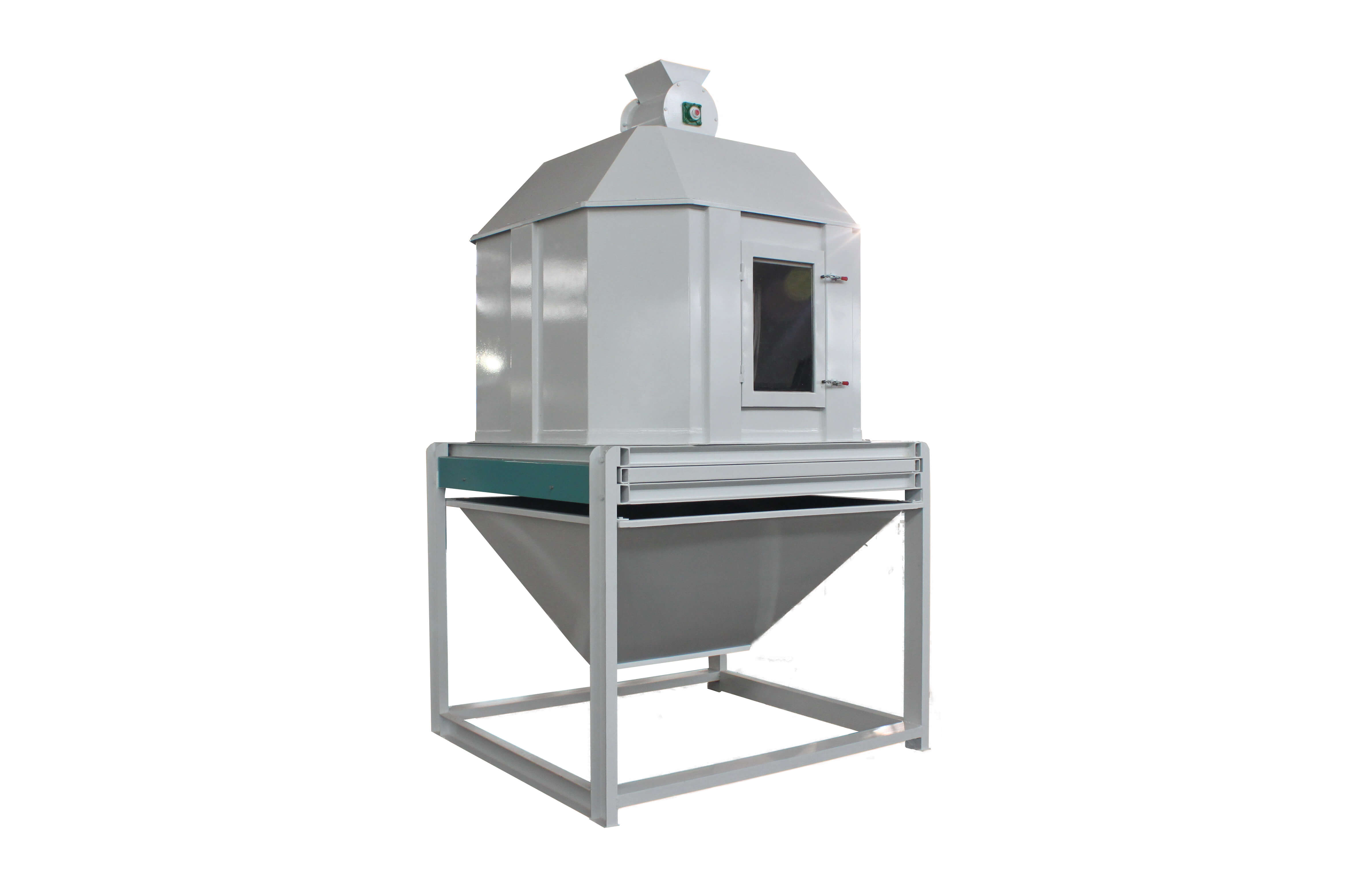
Cooler bodies are normally fabricated from mild steel with anti-corrosion treatment, and food-contact or high-humidity areas may use stainless steel. Look at plate thickness, louver design, fan motor efficiency and the quality of the discharge mechanism, because these determine service life and maintenance cost. Fan power is the main operating cost of the cooling section, so an efficient fan and well-designed air path reduce electricity consumption over years of operation. Insulation and a tight structure also help prevent condensation inside the chamber during seasonal temperature swings.
Why Work With Jiangsu Huamu as Your Counterflow Feed Cooler Manufacturer
Jiangsu Huamu Machinery Co., Ltd. is located in Xibei Town, Wuxi City, Jiangsu Province, an area with convenient transport links and a strong manufacturing base. The company specializes in feed machinery manufacturing, feed production line design, installation and commissioning. Its product range includes ring die pellet machines, waterdrop hammer mills, double shaft mixers, coolers, and premix additive complete units, as well as complete units for pellet animal and poultry feed and aquatic product feed.
Huamu holds ISO9001 quality management certification, is registered with a capital of 10 million RMB, operates a 10,000 square meter production site, and was recognized as a Jiangsu Province specialized, refined, distinctive and innovative (SRDI) small and medium enterprise in 2024. Products have been exported to more than 50 countries and regions. For buyers comparing counterflow feed cooler suppliers, these are concrete indicators of production capability and quality control rather than marketing language.
The company’s engineering team can design, manufacture and install complete projects from 1 to 30 tons per hour, covering powder material, premix material, pellet material and special aquatic product material. Because the cooler is supplied as part of an integrated line, it is configured together with the pellet mill, crumbler, screener, conveyors and dust collection system instead of being treated as an isolated piece of equipment. That coordination matters: air balance, elevation and discharge height, and automation signals all have to line up for the cooling section to perform as designed.
Custom Engineering for Different Feed Types
Different feed categories place different demands on cooling. Poultry layer and broiler feed usually prioritizes pellet durability and throughput, so the cooler is configured for stable retention time and low fines generation. Ruminant feed with large diameter pellets needs a slower discharge rate and a deeper bed. Aquatic feed, which is denser and more sensitive to moisture migration, often requires tighter control of airflow and discharge speed to avoid surface cracking and internal moisture gradients. Premix and concentrate lines may use smaller cooling sections coordinated with weighing and batching equipment.
Custom Counterflow Feed Cooler Solutions for 1–30 T/H Feed Plants
Whether you are building a new feed mill or upgrading an existing cooling section, the right approach starts with the process layout, not the equipment list. Huamu’s design process typically reviews raw material types, formulation, target capacity, pellet diameters, available building height, ambient climate and automation level, then proposes a cooler configuration and matching auxiliary equipment.
- New feed plant projects: complete line design from receiving and grinding through mixing, pelleting, cooling, crumbling, screening and packing, with equipment sized for the target hourly output.
- Cooling section upgrades: replacing an undersized or aging cooler with a properly matched counterflow unit while retaining existing conveyors and structural supports where possible.
- Multi-line plants: separate cooling sections for poultry, ruminant and aquatic lines so that retention time can be optimized for each product family.
- Turnkey installation: mechanical installation, electrical connection, commissioning and operator training, with performance verified on actual production runs.
Customization also covers practical details such as discharge height relative to the bucket elevator, access platforms for cleaning, inspection doors, and the interface between the cooler and the plant’s central control system. These details are easy to overlook at the quotation stage and expensive to fix after installation.
Where a Counterflow Cooler Fits in a Complete Line
In a typical pellet line, material moves from the hammer mill to the mixer, then to the conditioner and pellet mill, then into the counterflow cooler, then to the crumbler (for crumble feed), the screener, and finally the packing scale or bulk silo. The cooler discharge must be positioned to feed the elevator without excessive drop height, because high drop heights increase pellet breakage and fines. When Huamu designs a line, this elevation planning is done together with the cooler selection so that the whole flow is coherent.
What Affects Counterflow Feed Cooler Price
Buyers often ask for a counterflow feed cooler price early in the conversation, but price depends on several variables: cooling capacity and chamber dimensions, fan quantity and motor power, construction material and plate thickness, discharge mechanism type, dust collection arrangement, automation level, and whether the unit is a standalone supply or part of a complete line with installation and commissioning. A smaller unit for a 1–2 t/h line and a large unit for a 20–30 t/h line are not comparable in cost, and a stainless-steel or high-humidity configuration costs more than a standard carbon steel build. Providing accurate process data at the inquiry stage is the fastest way to get a meaningful quotation instead of a rough range.
Installation, Operation and Maintenance Tips
Correct installation and disciplined maintenance determine whether a counterflow cooler delivers its rated performance for a decade or becomes a bottleneck within a year. The following practices are used on Huamu projects and are worth applying to any brand of cooler.
Installation Checks
Verify that the supporting structure is level and capable of carrying the loaded weight of the cooler plus pellets. Check that the cooler is plumb, because a tilted chamber causes the pellet bed to migrate to one side and creates uneven airflow. Confirm that fan inlets are clear, ductwork is sealed, and the exhaust route to the cyclone or dust collector is unobstructed. Electrical connections should include proper motor protection, and any level sensors or discharge controllers must be calibrated before the first production run.
Daily Operation
Start the fan before pellets enter the chamber, and keep the discharge rate matched to the incoming flow so the bed depth stays within the design range. Monitor outlet pellet temperature regularly rather than relying on a single daily reading, because small drifts indicate a developing problem such as blocked louvers or a worn discharge mechanism. Watch for excess fines at the discharge and around the cooler, since this can signal over-drying or mechanical abrasion.
Preventive Maintenance Schedule
- Inspect the cooling chamber and louvers weekly for dust buildup, broken perforations and material bridging.
- Clean fan impellers and check belt tension and bearing condition monthly; unbalanced fans lose airflow and increase noise.
- Lubricate bearings according to the manufacturer’s interval and record the date and grease type used.
- Check the discharge mechanism for wear, alignment and consistent stroke length; replace worn parts before they affect bed stability.
- Inspect ductwork, seals and the dust collection connection quarterly for leaks that reduce effective airflow.
- Review outlet temperature and moisture data against the baseline after each major formulation change.
Common Problems and Practical Fixes
If pellets leave the cooler too hot, check airflow first: blocked louvers, a slipping fan belt or a closed damper are frequent causes. If outlet moisture is too high, look at retention time, ambient humidity, and whether the pellet mill is adding excessive steam. If fines increase sharply, examine pellet quality at the mill as well as cooler airflow, since over-drying makes pellets brittle. Uneven cooling between batches usually points to unstable bed depth, which comes back to discharge control and feed rate consistency.
FAQ
What is a counterflow feed cooler used for?
A counterflow feed cooler cools hot, moist pellets coming from the pellet mill to within a few degrees of ambient temperature and to a safe storage moisture level. It uses upward-flowing air against a downward-moving pellet bed, which produces gradual, even cooling, protects pellet durability and prevents condensation and mold during storage.
How do I choose the right capacity for my feed mill?
Match the cooler to your actual pellet mill output rather than to the plant’s nominal capacity, and add roughly 10–20% margin for peak production. Also consider pellet diameter, formulation, inlet pellet temperature, ambient humidity and whether you run multiple shifts. Sharing this data with the manufacturer allows proper sizing of cooling area and airflow.
Can Jiangsu Huamu build a custom counterflow cooler for a 1–30 T/H line?
Yes. Jiangsu Huamu designs, manufactures and installs complete feed production lines from 1 to 30 tons per hour, covering powder, premix, pellet and special aquatic feed projects. The cooler is configured together with the pellet mill, crumbler, screener, conveyors and dust collection system, and customized to the available building height and automation requirements of the plant.
How do I contact a counterflow feed cooler manufacturer for a quotation?
Prepare your target hourly output, pellet diameters, feed types, inlet temperature, available installation height and any automation requirements. Then contact the manufacturer directly through their official website or sales team. Providing complete process data at the first inquiry shortens the engineering review and results in a more accurate quotation for the cooling section or the complete line.
What is the difference between a counterflow cooler and a cross-flow cooler?
In a cross-flow cooler, air passes horizontally through falling pellets, so pellets near the air inlet cool faster than those on the opposite side, producing uneven temperature and moisture. In a counterflow cooler, air moves vertically against the pellet bed, so cooling is gradual and uniform across the whole batch, which generally improves pellet quality and consistency.
How long does it take to cool pellets in a counterflow cooler?
Typical retention time is around 6–10 minutes for standard poultry and livestock pellets. Large diameter pellets, high-moisture formulations and dense aquatic pellets may require longer residence times. Retention time is controlled by bed depth and discharge rate, so the correct setting depends on the specific product being produced.
Does the cooler need a dust collector?
The exhaust air from a counterflow cooler carries fine particles and moisture, so a cyclone or dust collection connection is normally recommended. This keeps the working environment clean, reduces material loss, and prevents dust from settling on nearby equipment. The connection should be planned during line design rather than added later.
What maintenance does a counterflow feed cooler require?
Weekly inspection of the chamber and louvers, monthly cleaning of fan impellers and belt checks, regular bearing lubrication, and periodic inspection of the discharge mechanism and ductwork. Keeping records of outlet temperature and moisture helps detect performance drift early, before it affects pellet quality.
Summary
The counterflow feed cooler is a small part of the capital cost of a feed mill but a large part of product quality and operating stability. Getting the cooling stage right means matching capacity to real pellet mill output, understanding how airflow, bed depth and retention time interact, and choosing a manufacturer who can design the cooler as part of a complete, coordinated production line. Jiangsu Huamu Machinery, based in Wuxi, Jiangsu, manufactures pellet machines, hammer mills, mixers, coolers and complete feed production lines from 1 to 30 tons per hour, backed by ISO9001 certification and project experience in more than 50 countries and regions. If you are planning a new feed plant, upgrading a cooling section, or comparing counterflow feed cooler suppliers for a custom project, share your process data with the Huamu team and start the engineering discussion early.