
For any livestock, poultry, or aquaculture operation that is scaling up production, the decision to invest in in-house feed manufacturing usually starts with one question: what does a feed pellet machine price actually look like, and what drives that number up or down? The answer is rarely a single figure on a quotation sheet. The price of a feed pellet machine is influenced by capacity, drive design, die configuration, material quality, automation level, and whether the machine is delivered as a standalone unit or as part of a complete feed production line.
This guide breaks down the real cost structure behind feed pellet machine price decisions, explains how to match pellet mill capacity to your farm or commercial plant, outlines the equipment needed to start a feed mill, and shows how to evaluate a feed pellet mill manufacturer before you commit capital. It is written for international buyers, farm owners, feed mill operators, and project investors who want a practical, technical, and commercially grounded perspective rather than marketing slogans.
Jiangsu Huamu Machinery Co., Ltd. (江苏华牧机械有限公司) is a feed machinery manufacturer based in Xibei Town, Wuxi City, Jiangsu Province, China. Founded as a specialized developer of feed machinery, the company designs, manufactures, installs, and commissions complete feed production lines covering powder feed, premix feed, pellet feed, and special aquatic feed projects with capacities from 1 to 30 tons per hour. Its portfolio includes ring die pellet machines, waterdrop hammer mills, double shaft mixers, coolers, stabilizers, crumbler, extruders, dryers, packing machines, bucket elevators, conveyors, and dust collectors.
What Really Determines the Feed Pellet Machine Price?
Buyers who compare quotations often find a wide spread between the lowest and highest offers for what appears to be the same machine. That gap is usually explained by a handful of structural factors. Understanding these factors is the fastest way to compare feed pellet machine price offers fairly instead of comparing only the headline number.
The first factor is output capacity. A pellet mill rated at 1 ton per hour and a pellet mill rated at 10 tons per hour are not simply scaled versions of the same product — they use different die diameters, different roller assemblies, different main shaft diameters, and often completely different drive systems. Capacity directly drives steel weight, motor power, gearbox sizing, and bearing grade, and therefore drives cost.
The second factor is the drive and transmission design. Belt-driven pellet mills are widely used in small and medium-sized feed plants because they absorb shock loads, run smoothly, and are easier to maintain. Gear-driven pellet mills cost more but offer higher torque density and better performance under continuous heavy load. A manufacturer that uses a double-motor, strong narrow-belt transmission design, for example, is solving for smooth operation, low noise, and stable output — engineering choices that are reflected in both performance and price.
The third factor is the die and roller configuration. Ring die assemblies are precision components. The number of holes, the compression ratio, the die material, and the surface treatment all influence both the purchase cost and the running cost per ton of pellets. Conditional feed pellet mill prices should always be evaluated against expected die life and pellet quality, not in isolation.
The fourth factor is the automation and control level. Manual feeding and manual lubrication machines are cheaper; machines with centralized lubrication, frequency conversion, current monitoring, and PLC-based control cost more up front but reduce labor cost and unplanned downtime. For a commercial feed plant running two or three shifts, the total cost of ownership almost always favors the higher-specification option.
The fifth factor is scope of supply. A feed pellet machine price quoted as a bare machine is not comparable to a price that includes the feeder, conditioner, steam system, Die and Roller spares, electrical cabinet, installation supervision, and commissioning. Buyers should always ask for a clearly itemized scope of supply before comparing suppliers.
Feed Pellet Machine Price Ranges by Capacity: What Buyers Should Expect
Rather than presenting fixed numbers, which change with steel prices, exchange rates, and configuration, it is more useful to understand how price scales with capacity. The table below summarizes the general relationship between capacity band, typical application, and cost structure. Use it as a budgeting framework, then request a formal quotation for exact figures.
| Capacity Band | Typical User | Main Cost Drivers | Cost Positioning |
|---|---|---|---|
| 1–3 t/h | Family farms, cooperatives, small commercial mills | Small ring die, single or double motor belt drive, manual or semi-automatic control | Entry-level investment, fastest payback |
| 5–10 t/h | Regional feed mills, poultry and swine integrators | Larger die diameter, steam conditioning, frequency control, spare die set | Mid-range investment, balanced automation |
| 15–30 t/h | Large commercial feed plants, aquatic feed specialists | Heavy-duty gear drive, full automation, complete line integration, silos and conveying | Capital project level, engineered turnkey solution |
A common mistake is to buy a pellet mill sized for today’s demand and then discover that the surrounding line — hammer mill, mixer, cooler, crumbler, packing — cannot keep up. Feed production is a chain, and the weakest link sets the output. When budgeting, allocate roughly the pellet mill cost plus the auxiliary equipment cost, because the auxiliary equipment needed to start a feed mill often accounts for a significant share of total project investment.
Equipment Needed to Start a Feed Mill: A Complete Line Checklist
The question of what equipment is needed to build a feed mill appears in almost every serious buyer inquiry. The short answer is that a functional feed production line requires four functional blocks: raw material handling and grinding, batching and mixing, conditioning and pelleting, and cooling, sizing, and packing. Each block contains several machines, and the correct combination depends on the feed type and capacity.
For the grinding block, a waterdrop hammer mill is the industry standard for grain and meal size reduction. Compared with conventional round-chamber designs, the waterdrop chamber combined with a secondary impact structure improves throughput. Jiangsu Huamu’s waterdrop hammer mill uses this geometry and reports approximately 25% higher output at comparable motor power, with the ability to switch between coarse, fine, and micro-fine grinding — one machine covering several feed specifications, including high-grade livestock and poultry feed and aquatic feed, as well as raw material grinding in alcohol and citric acid plants.
For the mixing block, a double shaft paddle mixer is the mainstream choice for medium and large lines. Mixing cycles of 30 to 90 seconds per batch, combined with a coefficient of variation (CV) of 5% or below and no segregation after discharge, give operators the consistency that pellet quality later depends on. A customizable atomizing spray system allows molasses and oil to be distributed evenly, which matters for high-energy rations and aquatic feeds.
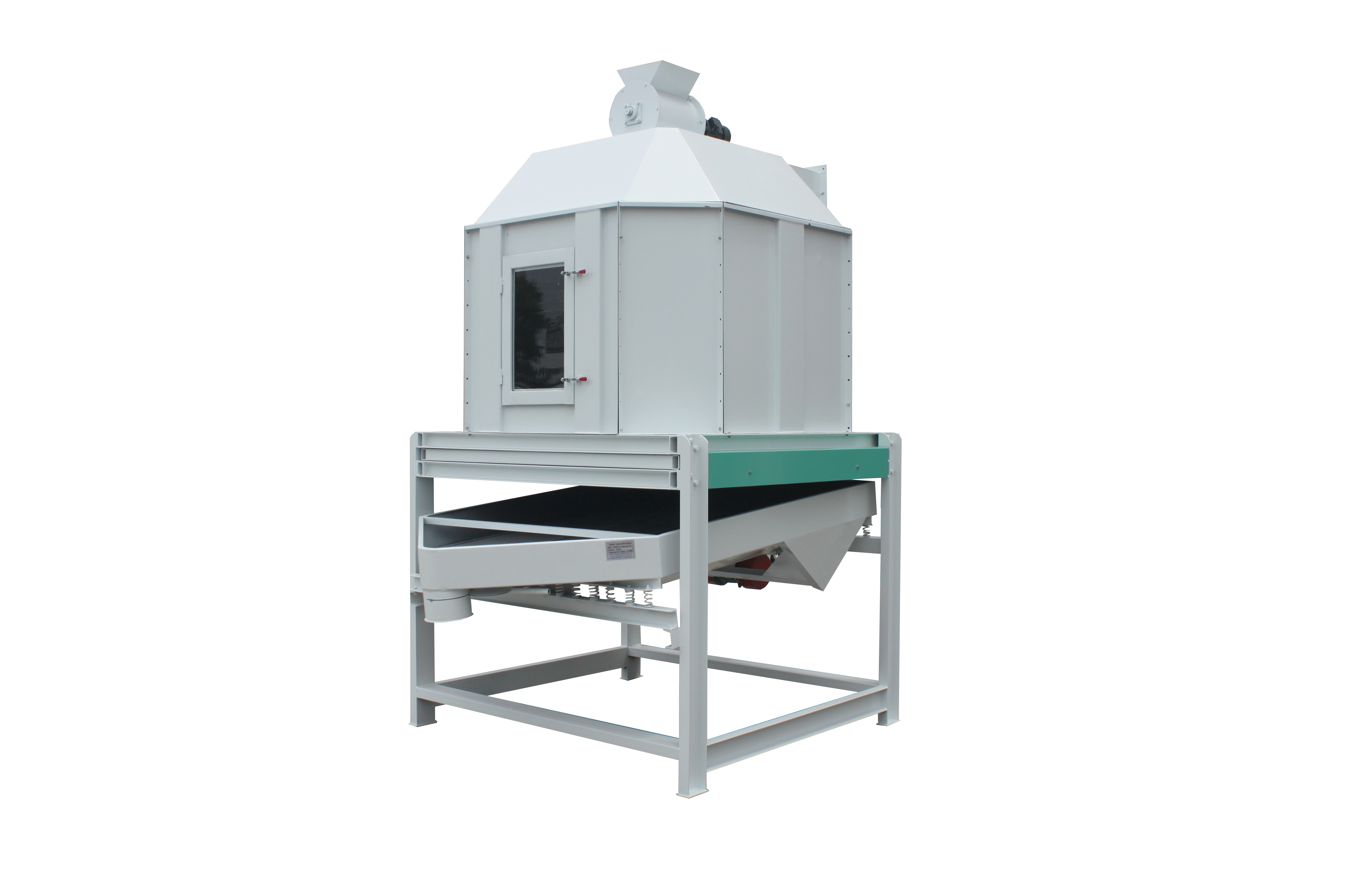
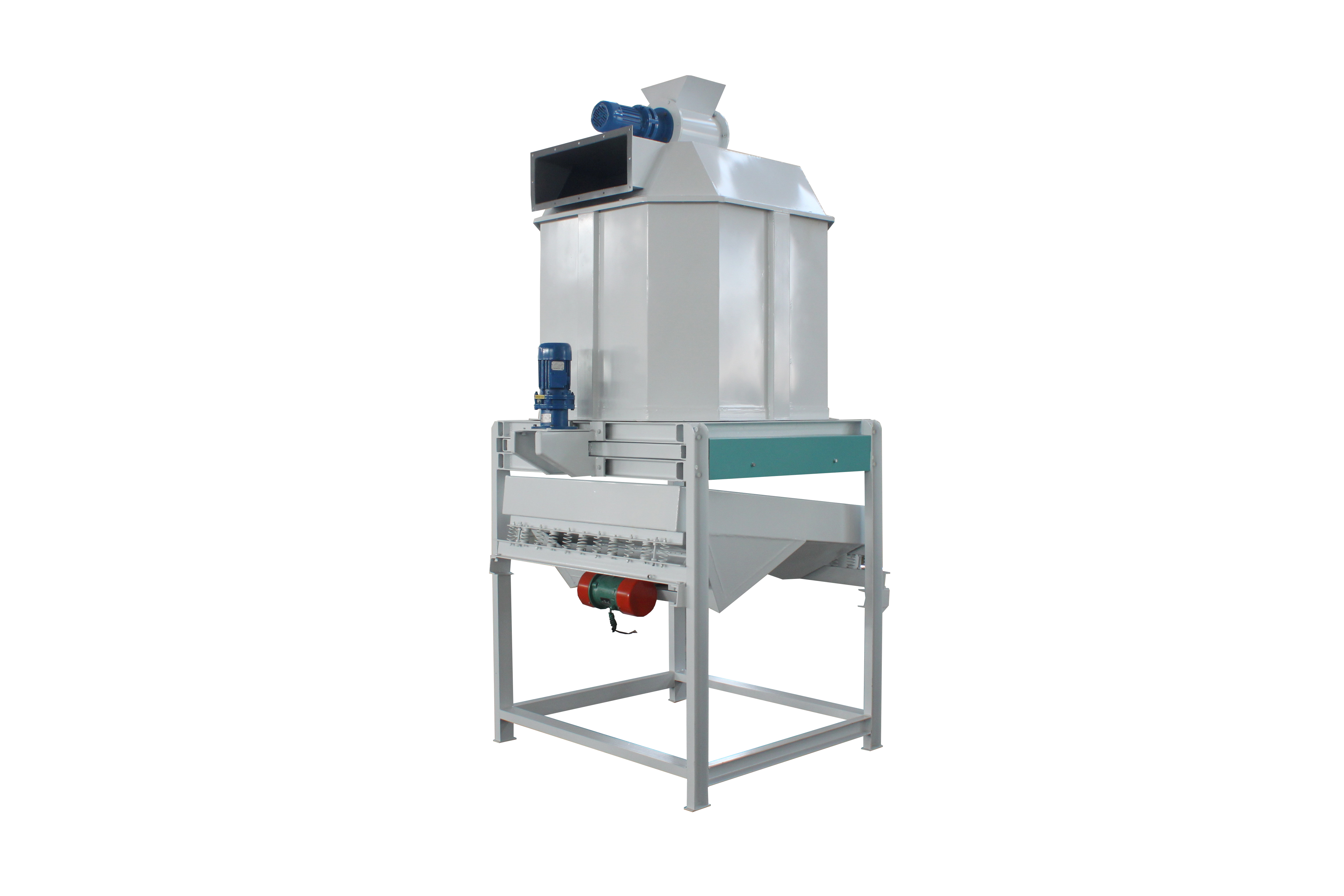
For the pelleting block, the ring die pellet machine is the core of the line, supported by a conditioner, feeder, and steam system. For aquatic feed, an extruder is typically added, followed by a dryer. For the post-pelleting block, a counter-flow cooler reduces pellet temperature and moisture, a stabilizer improves starch gelatinization and durability for aquatic pellets, a crumbler produces granular feed for young poultry, and a packing machine handles finished bags.
Core Equipment Checklist for a Standard Feed Production Line
- Raw material receiving and cleaning: receiving hopper, elevator, cleaner, magnetic separator
- Grinding: waterdrop hammer mill with aspiration system and pulse dust collector
- Batching: multi-ingredient batching scale with PLC control
- Mixing: double shaft paddle mixer with optional molasses/oil spray system
- Pelleting: ring die pellet machine with conditioner and feeder
- Cooling and sizing: counter-flow cooler, crumbler, pellet sieve
- Conveying: bucket elevator, screw conveyor, belt conveyor
- Environment control: dust collectors and aspiration ducts across grinding and pelleting points
- Packing: automatic or semi-automatic weighing and bagging machine
For premix and additive plants, the configuration changes: batching accuracy, cross-contamination prevention, and sealed conveying become the primary design criteria rather than pelleting capacity. This is why a capable feed pellet mill manufacturer should also be able to design the full process flow, not just supply a single machine.
Why Choose Jiangsu Huamu Machinery as Your Feed Machinery Supplier
Jiangsu Huamu Machinery Co., Ltd. is located in Xibei Town, Wuxi City, Jiangsu Province, a region with convenient transportation and a mature manufacturing base. The company specializes in manufacturing feed machinery, designing feed production lines, and providing installation and commissioning services. With a registered capital of 10 million RMB and a 10,000 square meter production site, it combines engineering capability with industrial-scale fabrication capacity.
In 2024, the company was recognized as a Jiangsu Province specialized and sophisticated (专精特新) small and medium-sized enterprise, and it operates under the ISO9001 international quality management system. Products are exported to more than 50 countries and regions, which means the equipment has been proven across different climates, power standards, and raw material conditions.
The company’s pellet machine line focuses on small and medium belt-driven machines. The double-motor strong narrow-belt transmission produces stable running, high output, and low noise, and annual production and sales reach around 500 units — a volume that indicates market acceptance in the small and medium segment. Beyond pellet mills, the product range includes waterdrop hammer mills, double shaft mixers, coolers, stabilizers, crumblers, extruders, dryers, packing machines, elevators, conveyors, and dust collectors.
Perhaps the most practical advantage for overseas buyers is engineering support across the whole project: Jiangsu Huamu designs and manufactures complete projects for powdered feed, premix feed, pellet feed, and special aquatic feed from 1 to 30 tons per hour, and provides installation and commissioning teams with experienced design, production, and on-site personnel. Whether you are building a new plant or upgrading an existing one, the configuration is engineered around your formula, capacity target, and local site conditions.
How to Compare Feed Pellet Machine Price Offers Without Getting Burned
Once you have two or three quotations in hand, use a structured comparison rather than a simple lowest-price ranking. The following evaluation framework protects buyers from hidden costs and specification gaps.
| Evaluation Item | What to Check | Why It Matters |
|---|---|---|
| Rated capacity | Capacity at stated die hole diameter and feed formula | Capacity claims vary widely with pellet size |
| Scope of supply | Feeder, conditioner, steam fittings, spares, control cabinet, installation | Exclusions become surprise costs later |
| Spare parts cost | Die and roller price, availability, delivery lead time | Consumables dominate long-term operating cost |
| Reference projects | Similar capacity and similar feed type installations | Proven process design reduces commissioning risk |
| Service response | Installation support, remote guidance, spare part packing | Downtime cost often exceeds the price difference |
Also consider the operating cost side of the equation. A machine with a slightly higher purchase price but lower energy consumption per ton, longer die life, and fewer unplanned stops can recover the difference within one or two production seasons. Buyers should therefore request energy consumption per ton and expected die life from the feed pellet mill manufacturer before signing.
Installation, Commissioning, and Maintaining Pellet Quality
Correct installation and commissioning is where the theoretical value of a feed production line becomes real. Foundation flatness, alignment of drive components, belt tension, steam piping layout, and aspiration balance all influence the final performance. A manufacturer that provides installation and commissioning teams — rather than shipping machines and leaving integration to the buyer — removes a large share of project risk.
During commissioning, the die needs a proper running-in period. Feeding rate, steam addition, and moisture should be increased gradually so the die holes are polished without overloading the main motor. Operators should record main motor current, pellet temperature, and pellet durability during this stage; these baselines are the reference for later troubleshooting.
Daily maintenance follows a simple discipline: check belt tension and pulley alignment, verify lubrication of roller bearings and main shaft bearings, inspect the die and roller clearance, monitor the conditioner steam pressure, and clean the cooling and aspiration systems. Rotating spares such as dies and rollers should be stocked according to consumption rate so that a worn die does not stop the whole line.
For mixed feed, remember that pellet quality begins before the pellet mill. Uniform particle size from the hammer mill, correct mixing cycle, accurate batching, and stable steam quality all affect durability. A well-designed line treats these upstream steps as part of the pelleting system rather than as separate concerns.
FAQ
What determines the feed pellet machine price for a small to medium feed plant?
Price is mainly determined by rated capacity, drive and transmission design (belt versus gear), ring die diameter and material, conditioning and steam system configuration, automation level, and the scope of supply. A quotation that includes feeder, conditioner, control cabinet, spare die, and installation supervision is not directly comparable to a bare-machine price. Buyers should ask for an itemized scope before comparing numbers.
How much does it cost to set up a complete feed production line of 5 tons per hour?
There is no single figure because the line composition changes with feed type. A 5 t/h line typically includes a hammer mill, batching system, double shaft mixer, ring die pellet machine, cooler, crumbler, conveying equipment, dust collectors, and packing machine. The pellet mill is the core cost, but auxiliary equipment often accounts for a substantial share. The reliable approach is to provide the manufacturer with your formula, pellet size, capacity target, and site layout so a full turnkey quotation can be prepared.
What equipment do I need to start a feed mill from scratch?
At minimum you need receiving and cleaning equipment, a grinding mill, a batching scale, a mixer, a pellet machine with conditioner, a cooler, conveying equipment, dust collection, and a packing machine. Premix and additive plants require a different configuration focused on weighing accuracy and cross-contamination control. For aquatic feed, an extruder and dryer are usually added. A turnkey designer can sequence these blocks according to your building layout and labor plan.
Which feed pellet machine brand is reliable for a commercial livestock farm?
Look beyond brand names and evaluate engineering substance: transmission design, die and roller quality, spare part availability, installation support, and whether the supplier can design the whole process flow. Jiangsu Huamu Machinery has focused on feed machinery for years, produces around 500 pellet machines annually, holds ISO9001 certification, was recognized as a Jiangsu Province specialized and sophisticated SME in 2024, and exports to more than 50 countries — all practical indicators of production discipline and international service experience.
Should I buy a ring die pellet machine or a flat die pellet machine?
Flat die machines are generally suited to very small capacities and on-farm use, while ring die machines are the standard for commercial feed production because of higher capacity, better pellet quality consistency, and longer continuous running capability. For farms producing several tons per hour or supplying external customers, a ring die pellet machine is normally the correct choice.
How long does installation and commissioning take?
It depends on line capacity, the number of machines, site preparation quality, and local labor availability. A single pellet mill can often be installed and commissioned within days, while a complete 1–30 t/h turnkey project requires a longer schedule covering mechanical installation, electrical wiring, water and steam piping, trial running, and operator training. A detailed schedule should be agreed before shipment.
Can the production line be customized for aquatic feed or premix feed?
Yes. Jiangsu Huamu designs and manufactures projects for powdered feed, premix feed, pellet feed, and special aquatic feed from 1 to 30 tons per hour. Aquatic feed typically requires fine grinding, extrusion, drying, and stabilizing, while premix production emphasizes weighing accuracy and sealed material handling. Customization is based on formula characteristics, target capacity, and site conditions.
What is the typical delivery lead time for a feed pellet machine?
Lead time varies with capacity, configuration, and current production schedule. Standard models are usually faster to deliver than fully customized lines with non-standard voltage, layout, or automation requirements. Buyers planning a new plant should confirm the delivery schedule together with the installation window so that site work and equipment arrival are synchronized.
Summary
Understanding feed pellet machine price is really a matter of understanding the production system around the machine. Capacity, drive design, die configuration, automation, spare parts, and scope of supply determine both the purchase price and the long-term cost per ton of feed. Buyers who evaluate quotations against a structured checklist — and who work with a manufacturer capable of designing, manufacturing, installing, and commissioning the complete line — consistently achieve better payback than buyers who select on headline price alone.
Jiangsu Huamu Machinery Co., Ltd. serves exactly this need: a feed machinery manufacturer in Wuxi, Jiangsu, with ISO9001 certification, Jiangsu Province specialized and sophisticated SME recognition in 2024, an annual output of around 500 pellet machines, and complete 1–30 t/h turnkey capability for livestock, poultry, ruminant, swine, aquatic, and premix feed projects. For buyers comparing feed pellet machine prices for a farm upgrade or a new feed plant, the most productive next step is to share your capacity target, feed type, and site conditions, and request an engineered quotation rather than a bare machine price.