
Choosing a complete feed production line is one of the highest-investment decisions a feed mill owner will ever make. The wrong configuration can lock a plant into low output, unstable pellet quality, high energy costs and years of expensive retrofits. The right configuration, on the other hand, can be installed quickly, run for more than a decade with predictable maintenance, and scale with your market as demand grows.
This guide is written for feed mill investors, project managers and procurement teams who are comparing complete feed production line options from suppliers. It walks through what a complete line actually contains, how to match capacity to your real market, which machine specifications genuinely matter, and how to evaluate whether a feed pellet production line manufacturer can deliver design, manufacturing, installation and commissioning as one accountable package. Jiangsu Huamu Machinery Co., Ltd., a feed, biomass and organic fertilizer machinery manufacturer based in Wuxi, Jiangsu, has designed and delivered complete projects from 1 t/h to 30 t/h, and the considerations below reflect the questions buyers most often need answered before signing.
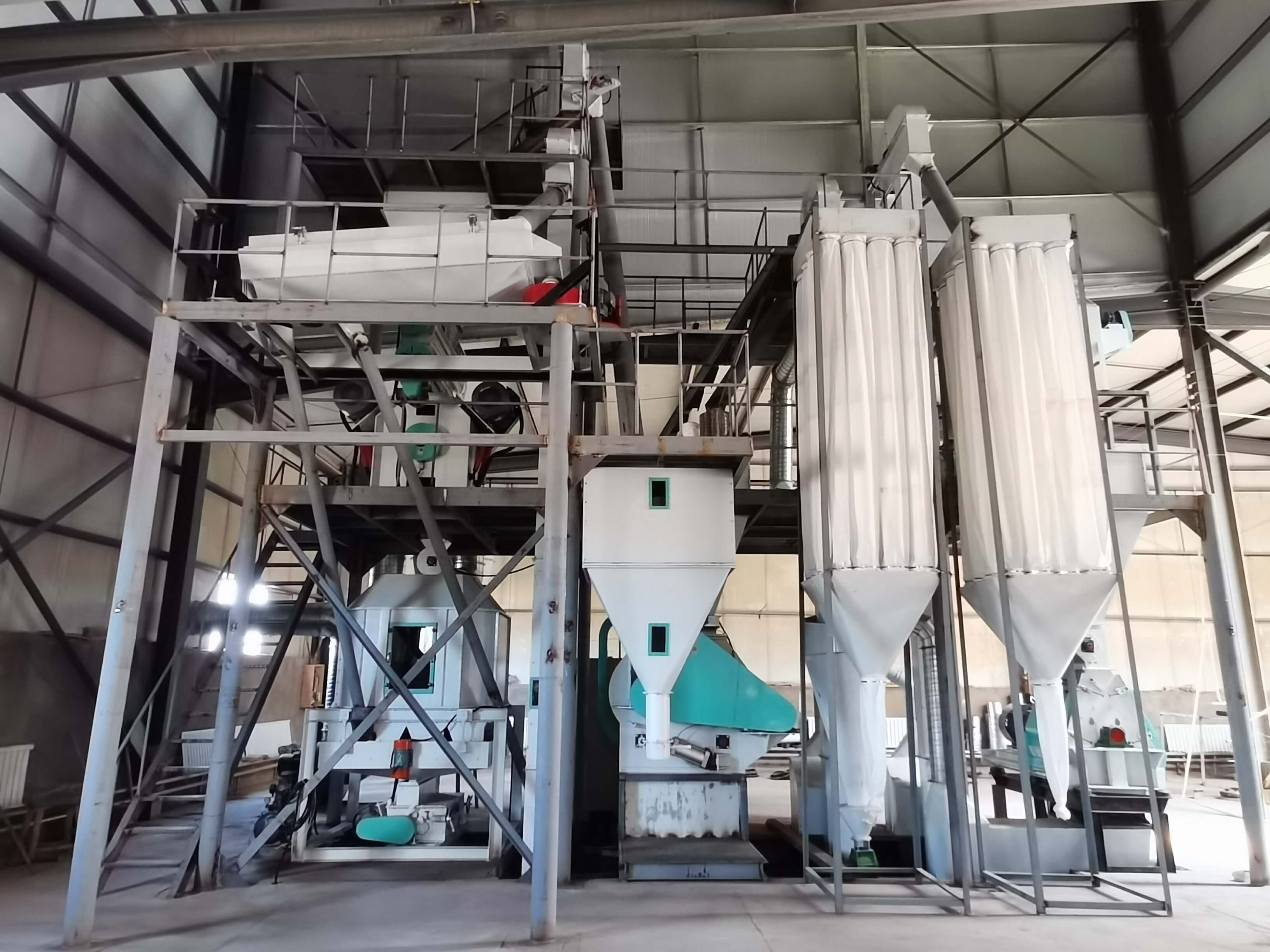
What Does a Complete Feed Production Line Actually Include?
A complete feed production line is not a single machine — it is a connected process flow in which every stage depends on the performance of the stage before it. A typical line covers raw material receiving and cleaning, grinding, batching and mixing, conditioning and pelleting, cooling, crumbling, screening, finished product storage and packing, plus the conveying, dust collection and electrical control systems that hold the whole plant together.
Grinding is handled by a hammer mill, which determines the particle size distribution of the mash and therefore how well the pellet binds. Batching and mixing follow, and this is where feed uniformity and additive accuracy are decided. The mixer is often underestimated: a mixer that blends in 60 seconds with a low coefficient of variation protects pellet quality and prevents nutrient segregation, while a slow or poorly designed mixer creates variability that no pellet mill can correct afterwards.
Pelleting is the core of the line. Mixed mash is conditioned with steam and molasses or oil where the formula requires it, then pressed through a ring die to form durable pellets. Immediately after the pellet mill, the product must be cooled to within a few degrees of ambient temperature, and for some formulas it passes through a crumbler and a stabilizer before screening and bagging. Each of these steps has a defined capacity and retention time, and the whole line must be balanced so that no single machine becomes a bottleneck.
This is why a complete feed production line should be purchased as an engineered system rather than a shopping list of machines. A supplier that only quotes individual units cannot guarantee throughput, and the buyer carries all the integration risk.
How to Choose a Complete Feed Production Line: Seven Decision Points
Buyers searching for guidance on how to choose a complete feed production line usually want a checklist they can bring to a supplier meeting. The seven points below are the ones that most often change the final equipment list — and the final invoice.
1. Define your raw materials and formula first
Start with what you will actually grind: maize, soybean meal, wheat bran, cassava, fish meal, meat and bone meal, or fibrous by-products. Hard and fibrous materials require more grinding power and a different hammer mill screen strategy, while high-oil and high-moisture formulas change the conditioning and cooling load. The species mix matters just as much. A poultry feed production line for broiler and layer feed runs differently from an aquatic feed production line, where fine grinding, higher conditioning temperature and tighter durability targets are standard.
2. Size the line to real market demand, not to a brochure
Capacity should be calculated from daily shift hours, working days per month and the seasonal peak you expect in three to five years. A plant rated 10 t/h does not produce 10 tonnes every hour of the year — changeover, cleaning and maintenance reduce effective output. Buyers who plan a 5 t/h requirement often select a slightly larger line so the plant can run one shift instead of two, cutting labor and energy cost per tonne.
3. Choose the pellet mill drive type deliberately
For small and medium capacities, a belt-driven ring die pellet mill with dual-motor narrow-belt transmission is a practical choice: it runs smoothly, produces low noise, and is easier and cheaper to service than a gearbox unit. Belt drives also absorb shock loads when difficult formulas pass through the die. For very high capacities or abrasive formulas, gear-driven units become more attractive. Jiangsu Huamu focuses on small and medium belt-type pellet mills, with annual sales of around 500 units and sets, and this is one of the reasons the company can offer well-proven configurations rather than experimental ones.
4. Match the grinding stage to your target fineness
Ask for the required fineness (screen size) and the expected throughput at that fineness, not just the maximum headline capacity. A waterdrop-shaped grinding chamber combined with a secondary impact structure improves output at a given motor power — Huamu’s hammer mills report roughly 25% higher output at comparable specifications — and allows one machine to handle coarse, fine and micro-fine grinding by changing screens. For aquatic feed and high-grade poultry feed this flexibility is worth paying for.
5. Specify mixing accuracy and liquid addition
Uniformity is expressed as the coefficient of variation (CV). A CV of 5% or lower is generally acceptable for complete feed, and a double-shaft paddle mixer with a 30-90 second cycle can reach that while avoiding segregation of minerals and premix. If your formula uses molasses or fat, specify an atomized spraying system at the quotation stage; retrofitting liquid addition later is far more expensive than including it in the original design.
6. Plan layout, utilities and future expansion
Steel structure height, silo arrangement, truck access, steam boiler capacity, compressed air and total connected electrical load all constrain the equipment list. A supplier that designs the line should ask for a site drawing and a utility specification before quoting. It is also wise to reserve space for one additional pellet mill or a second packing line so that expansion does not require demolishing the building.
7. Check automation level and spare parts availability
PLC-based batching control, centralized motor control cabinets and interlocking are the difference between a plant that needs constant manual intervention and one that runs with a small shift team. Equally important is spare part availability: dies, rollers, screens, bearings and belts are consumables, and a supplier that cannot ship them quickly will slow your plant down for weeks.
Typical Equipment Configuration of a Complete Feed Production Line
The table below shows how the equipment list changes with capacity and product type. It is a configuration framework, not a fixed catalogue — every project should be confirmed against actual formulas, site conditions and local regulations.
| Process Stage | Typical Equipment | What It Determines |
|---|---|---|
| Intake & cleaning | Receiving hopper, bucket elevator, screener, magnet | Raw material hygiene and equipment protection |
| Grinding | Waterdrop hammer mill, screens, pulse filter | Fineness, pellet durability, energy per tonne |
| Batching & mixing | Batching scale, double-shaft paddle mixer, atomized liquid system | Formula accuracy, mixing uniformity (CV ≤ 5%) |
| Conditioning & pelleting | Conditioner, ring die pellet mill, steam system | Output, pellet hardness, starch gelatinization |
| Cooling & finishing | Counterflow cooler, crumbler, stabilizer, screener | Moisture, durability, crumb size distribution |
| Packing & auxiliaries | Packing machine, conveyors, dust collectors, control cabinets | Labor cost, dust level, plant-wide automation |
Matching Capacity: How 1-30 t/h Lines Differ
Capacity is the single most common source of quotation misunderstanding. A 1-2 t/h line is usually a compact, single-mill setup suitable for regional supply, contract feed production or a farm-scale operation. It typically combines a small hammer mill, a batch mixer, one pellet mill, a counterflow cooler and manual or semi-automatic packing, and it can be installed in a modest building without heavy civil works.
At 5-10 t/h the plant becomes a true industrial line: multiple ingredient bins, automatic batching, larger conditioning volume, a bigger ring die, automatic packing, and a properly designed dust collection network. At 15-30 t/h, engineering detail dominates — the steam system, cooler retention time, conveying capacity and electrical load profile all need simulation rather than estimation, and the layout usually needs a multi-level steel structure.
Because the same product type can be produced on very different configurations, buyers should always request a capacity guarantee at a defined formula and fineness, and check whether the quoted rate refers to mash or finished pellets. The difference between those two numbers can be 10-20%, which is significant when you compare supplier quotations side by side.
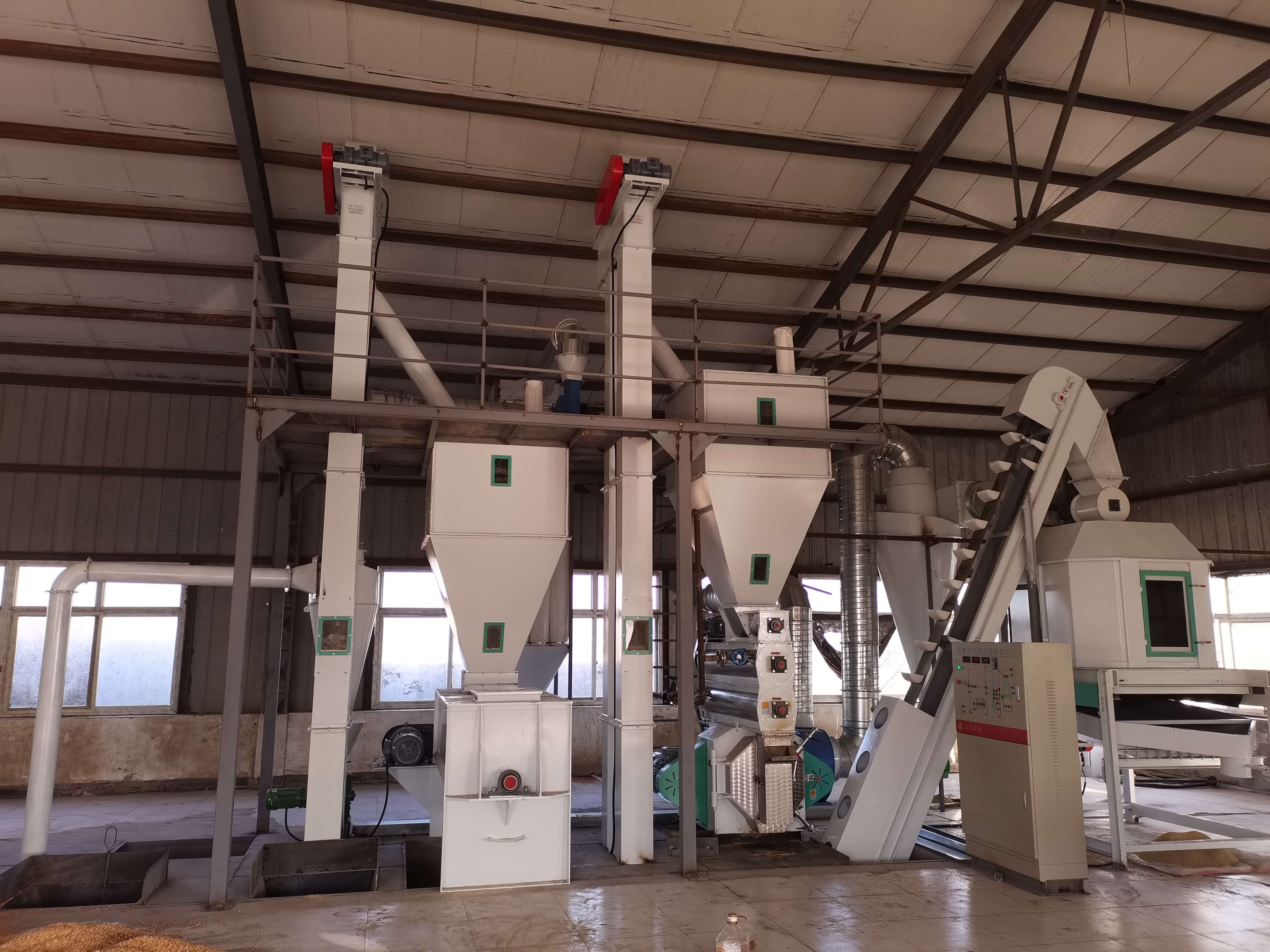
Evaluating a Complete Feed Production Line Supplier
Once the technical scope is clear, the decision shifts to who can deliver it. A supplier of a complete feed production line must be able to do four things well: design the process around your formulas, manufacture the core equipment to consistent tolerances, install and commission on site, and support the plant after start-up.
Ask for the following before you compare prices on a like-for-like basis:
- Process design capability: a flow diagram, equipment list with rated capacities, utility consumption figures and a layout drawing tailored to your site.
- Core equipment manufacturing: confirmation that the pellet mill, hammer mill and mixer are built in-house rather than sourced and rebadged, which affects lead time and spare part consistency.
- Project experience at your capacity and species: reference projects in poultry, ruminant, swine or aquatic feed, ideally with contactable plant operators.
- Installation and commissioning team: an in-house team that performs mechanical installation, electrical hook-up, trial production and operator training, rather than a subcontracted crew.
- Quality system and credentials: ISO 9001 certification, clear inspection records, and recognition such as provincial specialized and sophisticated SME status, which reflects manufacturing discipline.
- Export and documentation support: export experience, packing for sea freight, voltage and frequency customization, and manuals in your working language.
Jiangsu Huamu Machinery Co., Ltd. operates a 10,000 m² manufacturing base in Xibei Town, Wuxi, with registered capital of RMB 10 million, ISO 9001 certification and provincial specialized and sophisticated SME recognition in 2024. The company designs and manufactures complete lines for powder feed, premix, pellet feed and special aquatic feed from 1 t/h to 30 t/h, and its products are exported to more than 50 countries and regions. Equipment supplied includes ring die pellet mills, waterdrop hammer mills, double-shaft mixers, coolers, stabilizers, crumblers, extruders, dryers, packing machines, elevators, conveyors and dust collectors — a scope that lets one team take responsibility for the whole process instead of dividing it between vendors.
Installation, Commissioning and Operating Cost
The purchase price of a complete feed production line is only the first number on the balance sheet. Operating cost is driven by electrical power per tonne, die and roller life, steam consumption, labor per shift and downtime. A line with slightly higher capital cost but a better-matched motor package, effective conditioning and reliable cooling usually produces cheaper feed over five years than a cheaper line running at unstable moisture and high breakage rates.
Commissioning is where most of that value is either captured or lost. A structured start-up should include mechanical and electrical inspection, no-load running tests, gradual load-up on real formulas, die and roller gap adjustment, steam quality tuning, and operator training on changeover, lubrication and daily inspection. Buyers should insist on a written commissioning report with measured outputs and pellet durability results, because those numbers become the baseline for every later performance discussion.
For maintenance planning, keep a consumable stock of dies, rollers, hammer mill screens, bearings, belts and filters on site. Most unplanned stoppages in feed plants are not catastrophic failures — they are small parts that were not on the shelf. A supplier that provides a recommended spare parts list at handover, and can ship within days rather than months, protects your production more than any single machine upgrade.
Frequently Asked Questions
How do I choose the right capacity for a complete feed production line?
Calculate your required daily output from expected sales, then divide by realistic working hours per shift and the number of shifts you plan to run. Add a 20-30% margin for seasonal peaks and future growth, and confirm with the supplier whether the quoted capacity refers to mash or finished pellets at your specific formula and fineness. Most new plants between 5 and 15 t/h find that one well-sized line running one or two shifts covers their market without over-investing.
What is included in a turnkey feed production line project?
A turnkey project normally covers process design and flow diagram, equipment manufacturing, steel structure or building layout coordination, mechanical and electrical installation, trial production, commissioning and operator training. Conveying, dust collection and control systems should be included in the scope from the beginning, since they are frequently underestimated in budget quotations and are essential to a plant that runs cleanly and safely.
How long does it take to install and commission a complete feed production line?
Installation time depends mainly on capacity, structure complexity and site readiness. A compact 1-5 t/h line can often be installed and commissioned within weeks once the building, power supply and foundation work are ready, while larger 15-30 t/h plants with multi-level structures and extensive conveying require a longer schedule. The critical factor is site preparation: civil works, electrical supply and steam capacity should be completed before the installation team arrives.
Can one production line make poultry, ruminant and aquatic feed?
Yes, within limits. The same grinding, mixing, pelleting and cooling equipment can produce poultry, ruminant and swine feed by changing screens, dies and conditioning parameters. Aquatic feed, however, usually requires finer grinding, higher conditioning temperature and tighter durability control, and shrimp or specialty feed may need extruders and dryers. If aquatic products are part of your plan, tell the supplier at the design stage so the grinding and conditioning stages are specified accordingly.
How much does a complete feed production line cost?
Price is driven by capacity, equipment configuration, automation level, structure type and the extent of auxiliary systems such as dust collection and packing. Two quotations for the same nominal capacity can differ significantly because one excludes conveying, control cabinets or installation. Always request a detailed equipment list with capacities, motor power and scope boundaries, so you are comparing identical packages rather than headline numbers.
How can I contact a feed machinery manufacturer for a project quotation?
Prepare four pieces of information before you contact a supplier: target capacity in t/h, the main species and formulas, available raw materials, and site conditions including building dimensions and power supply. With these details a manufacturer can propose a process flow, equipment list and preliminary layout, and give a realistic quotation. Jiangsu Huamu welcomes enquiries for new plants and for upgrades of existing lines, and can review existing layouts to identify bottlenecks before recommending equipment changes.
Summary
Choosing a complete feed production line comes down to matching the process to your raw materials, formulas and market, then selecting a supplier who can design, manufacture, install and commission the whole system. Define capacity honestly, specify grinding fineness, mixing uniformity and pellet mill drive type deliberately, reserve space for expansion, and compare quotations on an identical equipment scope. A manufacturer with in-house core equipment production, turnkey installation teams and proven experience across 1-30 t/h projects will reduce integration risk and give you a plant that performs predictably from the first production shift.