
Feed particle size has a direct effect on feed intake, mixing uniformity, pellet quality, and production cost. For feed mills producing poultry feed, livestock feed, aquatic feed, or premixed feed, the grinding section is one of the most energy-intensive and quality-sensitive parts of the process. This is why choosing the right livestock feed hammer mill is not simply a matter of matching a motor to a production capacity. The grinding chamber design, screen configuration, hammer arrangement, feeding method, and dust control all influence output, particle size consistency, and long-term operating cost.
Jiangsu Huamu Machinery Co., Ltd. is a feed machinery manufacturer based in Xibei Town, Wuxi City, Jiangsu Province, China. The company specializes in feed machinery manufacturing, feed production line design, installation, and debugging. Its product range includes ring die pellet machines, waterdrop hammer mills, double-shaft mixers, coolers, and premix additive complete units, as well as complete units for pellet animal and poultry feed and aquatic product feed. For buyers planning a new feed plant or upgrading an existing grinding line, understanding how to evaluate a grain feed hammer mill can reduce commissioning problems and improve long-term productivity.
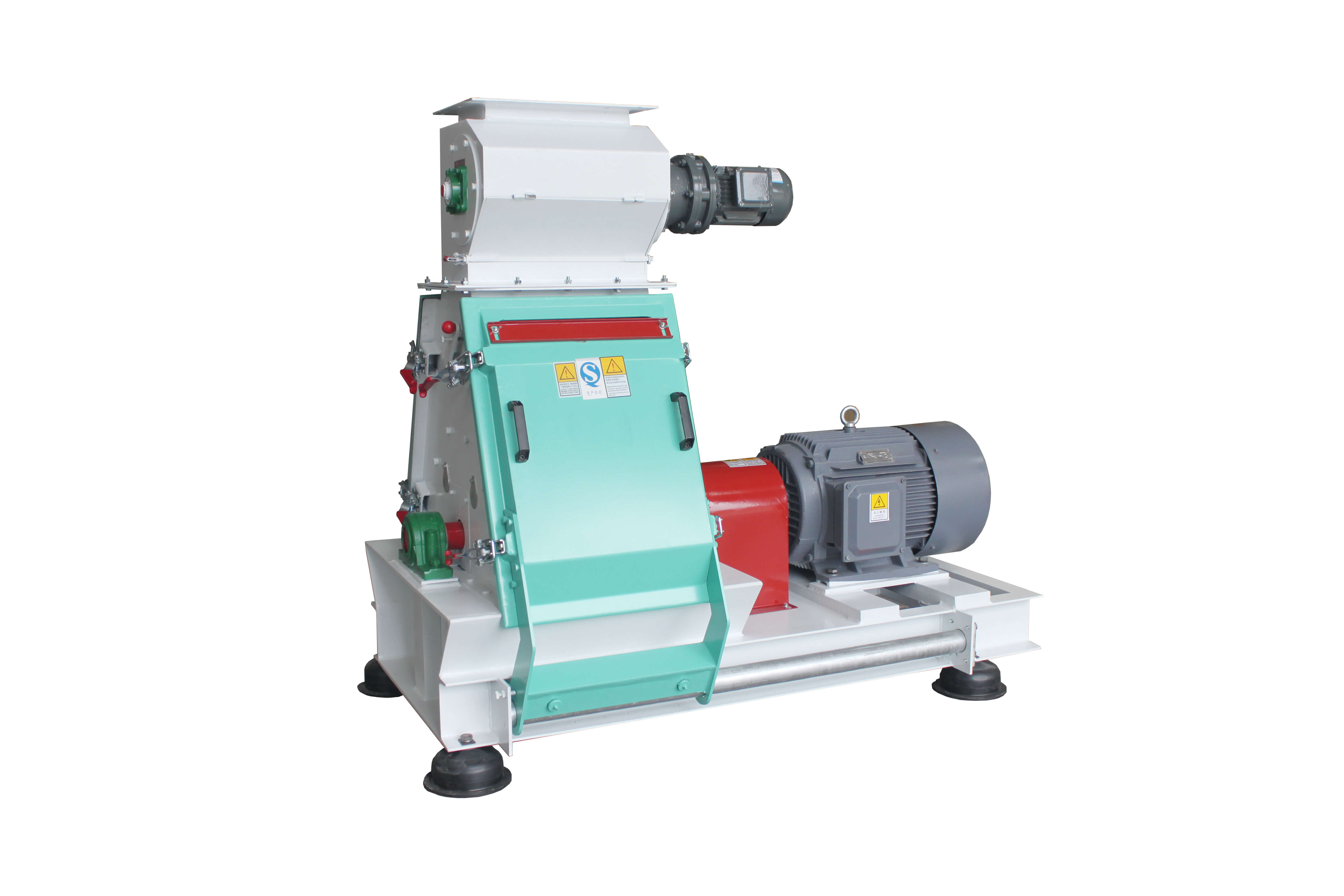
Why Hammer Mill Selection Matters in Livestock Feed Production
A hammer mill reduces raw grains, oilseed meals, and other ingredients into a controlled particle size before mixing, conditioning, and pelleting. If the grinding result is too coarse, pellets may have poor durability and uneven texture. If the grind is too fine, energy consumption increases, capacity drops, and dust control becomes more difficult. In poultry feed, particle size affects pecking behavior and digestion. In ruminant feed, a different grind profile may be required. In aquatic feed, fine grinding is often necessary to support stable pellet formation and water stability.
The challenge is that no single hammer mill setting is ideal for every formula. A feed mill that produces several product lines needs a grain feed grinder that can be adjusted for different raw materials and target particle sizes. This is especially true when the same line handles corn, wheat, soybean meal, bran, fish meal, or mineral premix ingredients. The selection process should therefore consider the full product mix, not only the highest-capacity formula.
Another important factor is the relationship between grinding and downstream equipment. A hammer mill that produces an inconsistent particle size distribution can create mixing segregation, unstable conditioning, and variable pellet quality. In a complete feed production line, the grinding section should be matched with the mixer, pellet mill, cooler, and conveying system. Jiangsu Huamu approaches feed machinery as part of an integrated production system, which is why its hammer mills are offered alongside complete line design and installation support.
Key Factors When Choosing a Livestock Feed Hammer Mill
Buyers often begin with capacity requirements, but capacity alone is not enough. A feed hammer mill selection guide should cover raw material properties, target particle size, screen area, hammer tip speed, motor configuration, feeding uniformity, and maintenance access. The following factors are among the most important for livestock and poultry feed applications.
Raw Material Characteristics and Moisture
Different raw materials behave differently during grinding. Corn and wheat are relatively easy to grind, while fibrous ingredients, high-oil materials, and high-moisture grains can reduce capacity and increase screen blockage. Moisture content is especially important. Grain that is too wet may smear inside the grinding chamber, reduce screen open area, and cause overheating. Buyers should define the typical moisture range of incoming raw materials and discuss it with the grain feed hammer mill manufacturer before selecting a model.
Material bulk density and oil content also affect performance. Soybean meal, bran, and certain by-products can be lighter and more dusty, requiring attention to aspiration and dust collection. For feed mills that use multiple raw materials, a flexible hammer mill configuration with interchangeable screens and suitable hammer arrangements is often more practical than a single fixed setup.
Target Particle Size and Screen Configuration
Target particle size determines the screen aperture, hammer arrangement, and rotor speed. Coarse grinding for ruminant feed may use a larger screen, while fine grinding for poultry feed or aquatic feed requires a smaller aperture. Screen selection should be based on the desired particle size distribution, not only the smallest particle size. A narrow distribution is usually preferred because it supports consistent mixing and pelleting.
Screen wear is also a practical consideration. Screens should be easy to inspect and replace, and the mill should provide adequate access to the grinding chamber. If a feed mill changes formulas frequently, quick screen changes can reduce downtime. In this respect, a well-designed poultry feed grinding machine should support routine maintenance without requiring excessive disassembly.
Capacity and Motor Matching
Capacity is usually expressed in tonnes per hour, but actual output depends on raw material, moisture, screen size, and desired fineness. A hammer mill rated at a certain capacity with corn at a coarse grind may not achieve the same output with a finer screen or a lighter, more fibrous material. Buyers should ask for capacity data based on their specific raw materials and target particle size, rather than relying on a single headline figure.
Motor power should be matched to the grinding chamber, rotor mass, and intended workload. Undersized motors may cause overload trips, while oversized motors do not necessarily improve efficiency if the chamber and screen area are not matched. Jiangsu Huamu designs feed production lines from 1 to 30 tonnes per hour and can help match hammer mill capacity with the overall line requirement.
Grinding Chamber Design and Rotor Structure
The grinding chamber shape influences material flow and residence time. A waterdrop-shaped chamber is designed to reduce dead zones and improve material circulation, which can support higher grinding efficiency. The rotor structure, hammer layout, and secondary impact design also affect how material is broken down. Jiangsu Huamu’s waterdrop hammer mill uses a waterdrop-shaped grinding chamber and a “mountain-shaped” secondary impact structure. According to the company’s product information, this design supports a 25% output improvement compared with previous configurations and allows coarse, fine, and micro grinding in one machine.
Rotor balance and bearing quality are important for stable operation. A well-balanced rotor reduces vibration, noise, and bearing load. Buyers should also consider the hammer changing method, because hammer wear is normal in daily operation. Easy access to the rotor and screens helps maintain consistent grinding performance over time.
Dust Control, Noise, and Maintenance Access
Grinding generates dust, heat, and noise. A hammer mill should be integrated with proper aspiration, dust collection, and explosion protection measures where required by the local installation environment. Noise levels should be considered in plant layout, especially when the mill is installed near operator areas. Maintenance access is equally important. Daily checks may include screen condition, hammer wear, belt tension, bearing temperature, and vibration.
For feed mills in continuous operation, the difference between a convenient and a difficult maintenance design can be measured in hours of downtime. A hammer mill should allow operators to inspect the grinding chamber, replace screens, and check hammers safely and efficiently. This is a key point when comparing livestock feed grinding equipment from different suppliers.
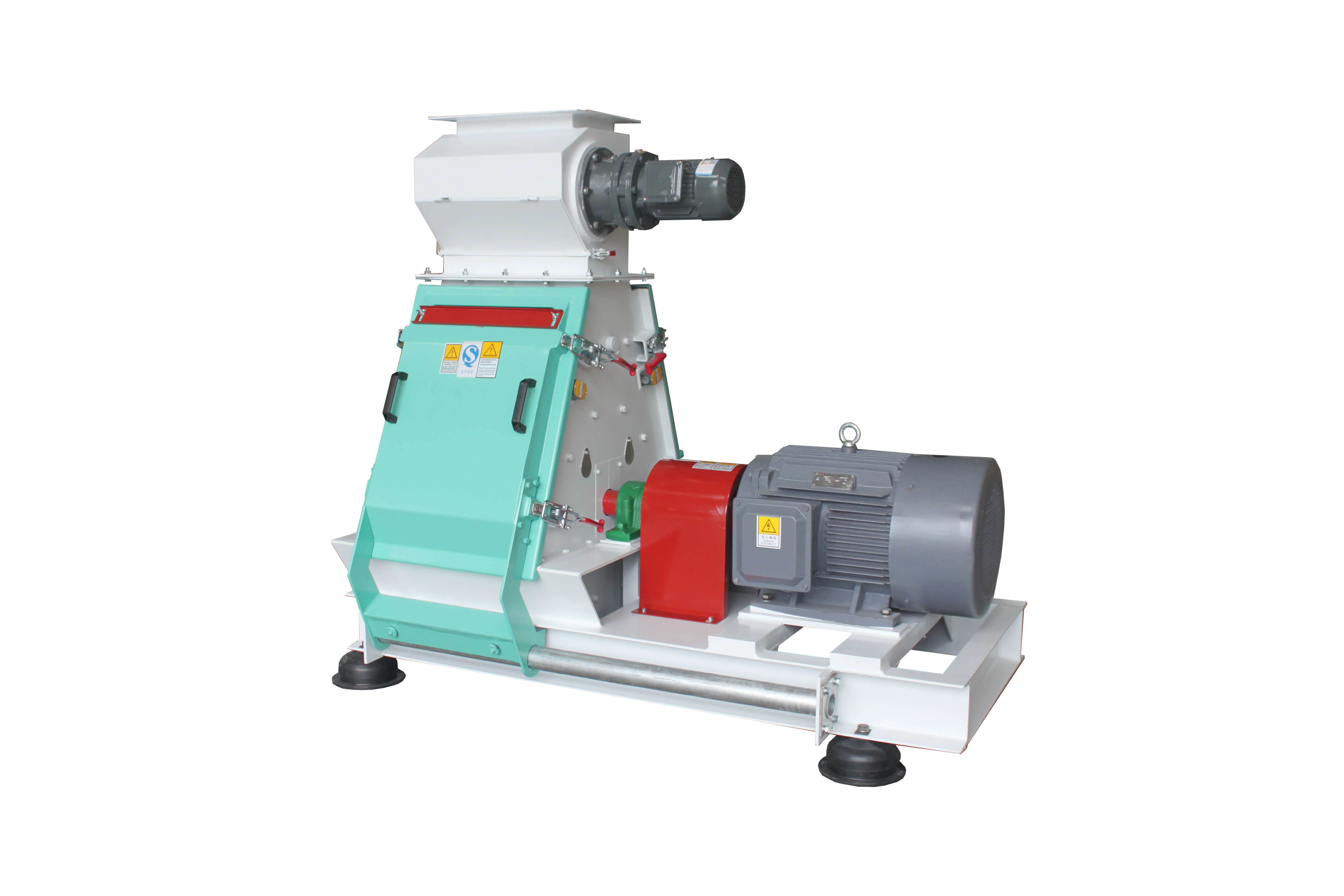
Hammer Mill Selection Checklist for Feed Mill Buyers
A structured comparison helps buyers avoid decisions based only on price or nominal capacity. The table below summarizes the main evaluation points for a livestock feed hammer mill used in poultry, livestock, and aquatic feed production.
| Selection Factor | What to Evaluate | Practical Guidance |
|---|---|---|
| Raw material mix | Grain type, bulk density, oil content, fiber content, moisture range | Provide the producer with real formula data and typical moisture levels. |
| Target particle size | Coarse, fine, or micro grinding; screen aperture; desired distribution | Match screen and hammer configuration to the final feed product, not only the raw grain. |
| Capacity and motor | Tonnes per hour at the required fineness; motor power; starting method | Confirm capacity with the actual raw material and screen size to be used. |
| Grinding chamber design | Chamber shape, rotor structure, secondary impact design, material flow | Look for designs that reduce dead zones and support stable, efficient grinding. |
| Maintenance access | Screen replacement, hammer inspection, bearing access, safety interlocks | Choose equipment that allows safe and efficient routine maintenance. |
| Auxiliary systems | Feeding, conveying, aspiration, dust collection, automation | Integrate the hammer mill with the complete line design rather than treating it as a standalone machine. |
How Jiangsu Huamu’s Waterdrop Hammer Mill Supports Grain Feed Grinding
Jiangsu Huamu Machinery manufactures waterdrop hammer mills for feed industry applications. The design uses a waterdrop-shaped grinding chamber and a “mountain-shaped” secondary impact structure. This configuration is intended to improve material flow inside the chamber and increase grinding efficiency. The company states that the design offers a 25% output improvement compared with previous structures and supports coarse, fine, and micro grinding in one machine.
This flexibility is useful for feed mills that produce more than one product type. A plant may need coarse grinding for certain ruminant feeds, fine grinding for poultry feed, and finer grinding for aquatic feed or special formulas. Instead of installing separate machines for each particle size range, a waterdrop hammer mill can be adjusted through screen changes and operating settings. This can simplify equipment layout and spare parts planning, although the actual configuration should always be confirmed with the manufacturer based on the product mix.
The hammer mill is also part of Jiangsu Huamu’s broader feed machinery range. The company supplies ring die pellet machines, double-shaft mixers, coolers, and complete units for pellet animal and poultry feed and aquatic product feed. For buyers seeking a feed mill machinery supplier that can coordinate grinding, mixing, pelleting, cooling, and conveying, this integrated approach can reduce interface problems during installation and commissioning.
Coarse, Fine, and Micro Grinding: One Machine, Multiple Applications
The ability to perform different grinding duties in one machine is valuable for small and medium-sized feed plants that need production flexibility. Coarse grinding may be used for ingredients that require a more open structure, while fine grinding supports pellet quality and uniform mixing. Micro grinding is relevant for aquatic feed and special formulations where a finer particle size is needed. The key is to select the correct screen, hammer arrangement, and feed rate for each application.
Jiangsu Huamu’s waterdrop hammer mill is described as suitable for high-grade livestock and poultry feed, aquatic feed, and raw material grinding in alcohol plants and citric acid plants. This reflects the broader use of hammer mills beyond finished feed production. In alcohol and citric acid production, raw material grinding also affects downstream processing efficiency, so particle size control and stable operation are important.
For feed mills, the practical benefit is not simply “one machine for everything.” It is the ability to change over between product runs with less equipment duplication. However, buyers should still evaluate changeover time, screen inventory, and operator training. A flexible hammer mill is most effective when the production plan and maintenance schedule are organized around the required particle size ranges.
Matching a Hammer Mill to Complete Feed Production Lines
A hammer mill does not operate in isolation. It receives material from a feeding system, discharges to a conveyor or elevator, and works alongside mixing, batching, conditioning, pelleting, cooling, and bagging equipment. If the grinding capacity is not matched to the downstream process, bottlenecks can appear even if the hammer mill itself performs well in a standalone test.
Jiangsu Huamu can design and manufacture complete powder material, premix material, pellet material, and special aquatic product material projects from 1 to 30 tonnes per hour. This range covers small starter plants, regional feed mills, and larger integrated lines. For a new feed mill, the design should consider the number of formulas, daily operating hours, raw material receiving, storage, grinding, batching, mixing, pelleting, and finished product handling. For an existing plant, the focus may be on replacing an older grinder, improving dust control, or increasing capacity without rebuilding the entire line.
In a complete line, the hammer mill should be selected with the mixer and pellet mill in mind. If the pellet mill requires a fine grind for durable pellets, the hammer mill must be able to deliver that particle size at the required capacity. If the mixer operates in short cycles, the grinding section must supply material consistently to avoid waiting time. These system-level considerations are part of the reason a 1-30 t/h feed production line should be designed as an integrated project rather than assembled from unrelated machines.
How to Evaluate a Grain Feed Hammer Mill Manufacturer or Supplier
When comparing suppliers, buyers should look beyond the quotation sheet. A reliable grain feed hammer mill manufacturer should be able to explain how the machine will perform with the buyer’s raw materials, provide drawings and layout support, and offer installation and commissioning guidance. The supplier’s experience with complete feed production lines is also relevant, because it affects how well the hammer mill integrates with the rest of the plant.
Jiangsu Huamu Machinery is located in Wuxi City, Jiangsu Province, an area with convenient transportation and a strong manufacturing base. The company has registered capital of 10 million RMB, covers an area of 10,000 square meters, and was recognized as a Jiangsu Province specialized and sophisticated SME in 2024. It has passed ISO9001 international quality system certification, and its products are exported to more than 50 countries and regions. These facts are useful starting points for buyers evaluating a grain feed hammer mill manufacturer for international projects.
Buyers should also ask about documentation, spare parts availability, operator training, and after-sales support. A clear spare parts list for screens, hammers, bearings, and belts helps reduce future downtime. If the project includes a complete line, the supplier should provide layout drawings, process flow information, and commissioning support. It is also reasonable to request references or visit similar installations where available, while respecting the supplier’s confidentiality commitments.
Installation, Operation, and Maintenance Tips
Correct installation improves hammer mill performance. The machine should be placed on a suitable foundation with proper isolation to reduce vibration. Feeding should be uniform, and the aspiration system should be balanced to avoid negative pressure problems or dust accumulation. Before commissioning, the rotor should be checked for free rotation, the screen should be properly seated, and all safety guards should be in place.
During operation, operators should monitor motor current, bearing temperature, vibration, noise, and discharge quality. A sudden increase in current may indicate overfeeding, screen blockage, or excessive moisture. A change in particle size may indicate screen wear or hammer wear. These signs should be investigated promptly rather than waiting for a breakdown.
Routine maintenance should include checking hammer wear, screen condition, belt tension, bearing lubrication, and fastening bolts. Screens should be replaced when holes or excessive wear affect particle size. Hammers should be inspected as a set, and the rotor should be balanced after major replacement work. Keeping maintenance records helps identify recurring issues and supports planned downtime. For a poultry feed grinding machine running multiple shifts, a preventive maintenance schedule is usually more economical than reactive repairs.
FAQ
What is the difference between a livestock feed hammer mill and a grain feed grinder?
A livestock feed hammer mill and a grain feed grinder are often used to describe similar equipment. A hammer mill uses rotating hammers to impact and break material through a screen, while a grain feed grinder may refer more broadly to machines that reduce grain size. In feed production, the term livestock feed hammer mill usually emphasizes the application and the grinding chamber design used for feed ingredients.
How do I choose the right screen size for poultry feed grinding?
Screen size should be selected according to the target particle size for the specific poultry feed product. A smaller screen produces finer grinding but may reduce capacity and increase energy use. Buyers should test with representative raw materials and confirm the desired particle size distribution with the equipment supplier.
What capacity ranges can Jiangsu Huamu supply for feed hammer mills and complete lines?
Jiangsu Huamu designs and manufactures complete feed production lines from 1 to 30 tonnes per hour. Hammer mill capacity should be matched to the raw material, target fineness, and overall line requirement. Buyers should provide their product mix and expected operating hours for an accurate recommendation.
Can a waterdrop hammer mill handle both coarse and fine grinding?
Jiangsu Huamu’s waterdrop hammer mill is designed for coarse, fine, and micro grinding in one machine. The actual result depends on the screen configuration, hammer arrangement, and raw material. For feed mills with multiple product lines, this flexibility can reduce the need for separate grinding equipment.
What should I check before buying a grain feed hammer mill from a manufacturer?
Check the manufacturer’s experience with similar raw materials, the proposed capacity at the required fineness, maintenance access, spare parts availability, and support for installation and commissioning. If the hammer mill will be part of a complete feed line, also review the supplier’s line design capability and integration experience.
How often should hammer mill screens and hammers be inspected?
Inspection frequency depends on operating hours, raw material abrasiveness, and production intensity. In many feed mills, screens and hammers are checked during routine maintenance and whenever particle size or capacity changes. A preventive maintenance schedule should be established based on actual wear patterns.
Summary
Choosing a livestock feed hammer mill requires a balanced evaluation of raw materials, target particle size, capacity, grinding chamber design, maintenance access, and supplier support. A machine that looks suitable on a specification sheet may not perform well if it is poorly matched to the actual feed formula or complete production line. For poultry, livestock, and aquatic feed producers, the grinding section should be treated as part of an integrated process that connects receiving, batching, mixing, pelleting, cooling, and packaging.
Jiangsu Huamu Machinery Co., Ltd. manufactures waterdrop hammer mills and other feed machinery from its base in Wuxi City, Jiangsu Province, China. The company designs feed production lines from 1 to 30 tonnes per hour, provides installation and debugging support, and serves customers in more than 50 countries and regions. Its waterdrop hammer mill uses a waterdrop-shaped grinding chamber and a “mountain-shaped” secondary impact structure, supporting coarse, fine, and micro grinding in one machine. For buyers comparing grain feed hammer mill manufacturers, the next step is to define the raw material mix, required particle size, and line capacity, then request a configuration that matches those conditions.