
Choosing the right mixing equipment is one of the most consequential decisions a feed mill, livestock farm, or feed trading business will make. A feed mixer determines how consistent every batch of feed will be, how much labor the mixing stage consumes, and how quickly a production line can respond to changing feed formulas. For buyers sourcing equipment internationally, the challenge is not simply finding a livestock feed mixer wholesale supplier — it is finding a manufacturer that understands formulation, particle size, moisture, and the practical realities of daily farm operation.
This guide walks through the technical and commercial factors that separate a dependable poultry feed mixer machine manufacturer from a supplier who only sells catalog hardware. It covers mixing principles, cycle time, uniformity targets, drive configurations, additive dosing, maintenance planning, and the questions to ask before you request a quotation for a feed mixing machine for farm use or a complete turnkey feed production line.
What a Feed Mixer Actually Does in a Modern Feed Line
Mixing is the stage where nutritional value is either preserved or lost. Every ingredient in a formula — maize, soybean meal, bran, fish meal, limestone, salt, vitamins, trace minerals, molasses, and oils — enters the mixer at a different bulk density and particle size. If the mixer cannot homogenize these materials within a short cycle, heavier particles settle, micro-ingredients concentrate in one corner of the batch, and animals receive inconsistent nutrition from the same formulation. That inconsistency shows up later as uneven growth, poor feed conversion, and complaints from downstream customers.
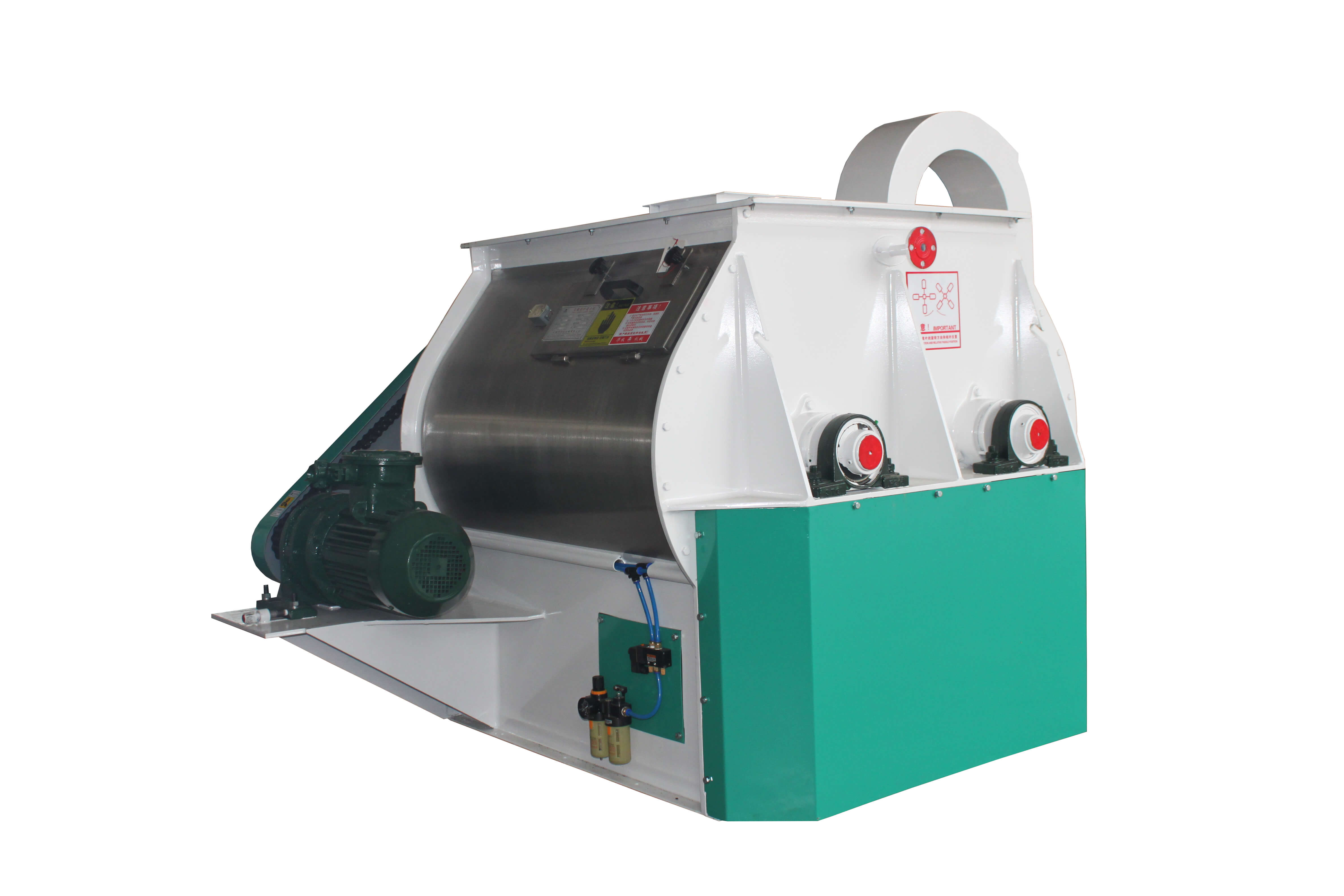
A properly designed animal feed mixer solves this by combining three capabilities: a mixing chamber geometry that keeps the entire batch in motion, a drive system strong enough to handle dense and abrasive formulas without stalling, and a discharge mechanism that empties the chamber fully so batches do not contaminate each other. On a well-built machine, the coefficient of variation (CV) between sampled points in a batch stays below 5 percent, which is the practical threshold most feed quality standards accept.
Mixing is also the point in the process where liquid additives are introduced. Molasses, vegetable oil, fat, and liquid enzymes are far harder to disperse evenly than dry powders. If the mixer lacks a proper spray system, these liquids create sticky clusters that later clog pellet dies and reduce pellet quality. Buyers evaluating a double shaft paddle feed mixer should therefore look at the liquid addition design as carefully as they look at the mixing shaft itself.
Key Features to Evaluate in a Farm Feed Mixing Machine
Not every mixer is built for the same duty. A machine intended for premix and concentrated additives faces very different demands from one handling high-fiber cattle rations or high-fat poultry formulas. The specifications below are the ones that determine whether a mixer will still perform to specification after several years of two- or three-shift operation.
Mixing uniformity and cycle time
Uniformity and cycle time are linked, and both should be confirmed with documented test data rather than a brochure claim. A double shaft paddle mixer with a 30 to 90 second mixing cycle per batch and a CV of 5 percent or lower represents good performance for dry powder and granular feed materials. Short cycles matter commercially: a mixer that completes a batch in 60 seconds supports far more throughput per shift than one that needs three minutes for the same volume, and it reduces the total connected load required for the same output target.
Equally important is the claim that the design does not produce segregation after mixing. Paddle-based designs that keep material in a fluidized zone avoid the classic problem where vibration and gravity re-separate particles of different density during discharge. Ask the manufacturer to explain the discharge sequence, because a fast, complete discharge preserves whatever uniformity the mixing cycle achieved.
Drive system and structural durability
The drive is where cheap mixers fail first. On pellet machines and mixers alike, belt and chain configurations determine how smoothly the machine runs under load. A double-motor narrow-belt transmission, as used on Jiangsu Huamu’s belt-type pellet machines, is chosen specifically for stable operation, high output, and low noise — the same engineering logic applies to mixer drives. Look for generously sized shafts, replaceable wear liners on the trough and paddle tips, and bearings specified for continuous duty rather than intermittent farm use.
Structural checks are equally practical: verify plate thickness on the mixing chamber, confirm the discharge door seals properly, and ask whether the frame is designed to sit on an anti-vibration mount. A mixer that shakes will crack welds, loosen fasteners, and contaminate batches through leaking seals within a few seasons.
Additive and liquid dosing options
Fat, molasses, and oil additions are standard in poultry and ruminant feed. A mixer with a customizable atomizing spray system disperses these liquids as fine droplets rather than pouring them into one point of the batch, which prevents the sticky agglomerates that damage pellet dies and cause uneven energy content. If your formula includes more than 2 percent liquid addition, confirm the number of nozzles, the pump capacity, and whether the spray timing is interlocked with the mixing cycle.
Comparing Feed Mixer Types for Livestock Operations
Buyers commonly compare three mixer families: horizontal ribbon mixers, vertical screw mixers, and double shaft paddle mixers. Each has a legitimate place in the market, but they behave very differently once batch size, cycle time, and formulation complexity enter the picture. The comparison below summarizes the practical differences rather than abstract specifications.
| Mixer type | Typical batch time | Best suited to | Points to verify |
|---|---|---|---|
| Vertical screw mixer | Longer cycles | Small farms, on-site blending of a few ingredients | Risk of segregation, limited liquid addition |
| Horizontal ribbon mixer | Moderate | General powder blending, premix plants | Dead zones at the ends, wear on ribbon edges |
| Double shaft paddle mixer | 30–90 seconds per batch | Poultry, cattle, aquatic feed, premix, chemical powders | CV value, spray system, discharge door seal |
For commercial feed production where formulas change several times a day and liquid additives are routine, the double shaft paddle design usually wins on cycle time and uniformity. A machine that achieves CV ≤ 5 percent with a 30 to 90 second cycle and no segregation is a meaningful productivity advantage at scale. For very small operations blending one or two ingredients on site, a simpler machine may still be economically justified.
How to Choose a Livestock Feed Mixer Wholesale Supplier
Once the technical specification is settled, supplier selection becomes the dominant risk factor. Feed equipment is a long-service asset, and the difference between a responsive manufacturer and a trading intermediary appears in year two and year three, when spare parts, technical guidance, and process adjustments are needed. The following checks are practical and can be completed before any purchase order is issued.
- Verify the factory, not just the catalog. Confirm where the machines are manufactured, request workshop photographs or a live video walkthrough, and check that the company designs and installs lines rather than only reselling equipment.
- Ask for the process design capability. A real manufacturer can propose a full flow — receiving, grinding, mixing, pelleting, cooling, crumbling, and packing — sized to your target output in tons per hour, not just quote a single mixer.
- Confirm quality system certification. An ISO 9001 certified quality system indicates documented production and inspection processes, which matters for buyers who need consistency across repeat orders.
- Check export experience. Equipment shipped to more than 50 countries has usually been adapted for different voltages, ambient temperatures, and local installation conditions.
- Ask about installation and commissioning. A supplier with its own installation and debugging team can supervise erection, train operators, and hand over a line that actually reaches nameplate output.
- Confirm spare parts availability. Paddle tips, liners, bearings, belts, and seals are consumables. Ask for a recommended spare parts list and typical lead times.
When requesting an animal feed mixer price, provide the supplier with your required batch size, target hourly output, formula types, liquid addition percentage, available power supply, and site layout. Quotations based on this information are comparable; quotations based on a generic model number are not. It is also worth asking for references in your region or in a similar production segment, since installation conditions often reveal more than a specification sheet.
To contact a manufacturer directly, use the official website contact form, email, or phone number rather than relying only on marketplace listings, and ask specific technical questions in the first message. The quality of the reply — whether it addresses your formula, throughput, and site constraints — is itself a useful indicator of the support you will receive after shipment.
Single Mixer Purchase vs. a Turnkey Feed Production Line
Many buyers begin with one machine and later discover that mixing capacity is constrained by the grinder upstream or the cooler and packer downstream. A feed line is a chain, and the slowest stage sets the output. Before committing capital, it is worth mapping the intended process end to end.
A complete line for poultry and livestock feed typically includes a hammer mill for grinding, a mixer for blending, a pellet machine for forming pellets, a cooler for reducing pellet temperature and moisture, a crumbler where finer pellet sizes are required, and a packing machine, connected by elevators, conveyors, and a dust collection system. For aquatic feed, extruders and dryers are added. Sizing these stages consistently is what allows a plant to reach its stated capacity in tons per hour rather than only on paper.
A manufacturer capable of designing and building 1 to 30 tons per hour powder, premix, pellet, and specialty aquatic feed projects can size the whole chain from a single set of process assumptions. That avoids the common problem of mismatched equipment from multiple vendors, where each supplier optimizes only its own unit. For a farm expanding from on-site blending into commercial feed sales, a phased turnkey approach — installing the mixing and grinding stage first with structure and power sized for later pelleting — is a practical way to control capital exposure.
Maintenance Practices That Protect Mixing Accuracy
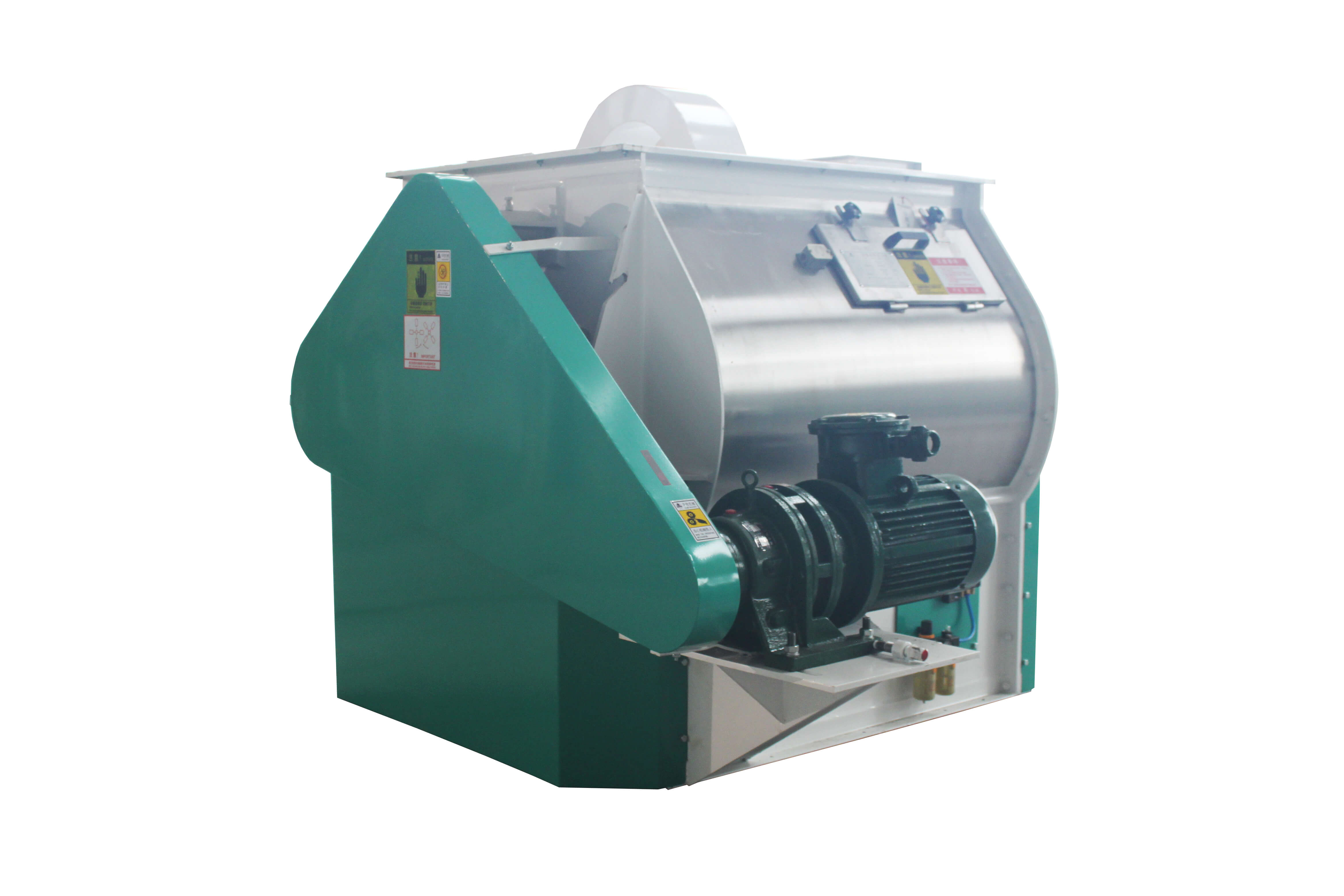
A mixer holds its uniformity only while its internals remain in tolerance. Paddle tips wear, liners thin, and discharge seals harden. These are gradual changes, so performance drifts silently until a batch fails a quality check. A simple preventive routine prevents most of this.
Daily and weekly checks
At the start of each shift, confirm the discharge door closes fully and the limit switch engages, listen for abnormal noise from the drive, and check that no material remains in the chamber from the previous batch. Weekly, inspect the spray nozzles for clogging if liquids are dosed, verify belt tension, and check lubrication points against the manual. Cleaning between formula changes should be systematic, particularly when moving from a medicated or highly concentrated premix batch to a standard feed batch.
Seasonal and annual servicing
Measure paddle tip clearance and liner thickness on a scheduled basis, replace worn components as a set rather than individually, and inspect shaft bearings for play. Re-torque structural fasteners and check anti-vibration mounts. If the mixer feeds a pellet machine, keep the mixing stage consistent — variability introduced at mixing often appears downstream as fluctuating pellet durability and die wear.
FAQ
What should I look for in a livestock feed mixer wholesale supplier?
Look for a manufacturer that designs and installs complete feed lines, not only a reseller of individual machines. Confirm factory location, quality certification such as ISO 9001, export experience, availability of installation and commissioning support, and a clear spare parts list. Ask technical questions about your formula and target output — a supplier who answers specifically is likely to support you after delivery.
How do I choose a poultry feed mixer machine manufacturer for a new feed plant?
Start from your production target in tons per hour, then confirm the mixer batch size and cycle time that support it. Verify mixing uniformity with documented test data, check the liquid addition design if you use molasses or oil, and ask whether the manufacturer can size the grinder, pellet machine, cooler, and packing stage to match. A single supplier for the whole chain reduces interface risk.
What mixing uniformity can a double shaft paddle feed mixer achieve?
A well-built double shaft paddle mixer typically reaches a coefficient of variation of 5 percent or lower between sampled points, with a mixing cycle of roughly 30 to 90 seconds per batch, and it is designed to avoid segregation after mixing. Ask for the tested CV value and the sampling method used, since uniformity claims should be supported by measurement rather than assumption.
How much does an animal feed mixer cost?
Price depends on batch volume, construction materials, drive configuration, whether a liquid spray system is included, and the level of automation. A quotation is only meaningful when it is based on your required batch size, hourly output, formula types, and local power supply. Request a configuration-specific offer rather than comparing headline prices for different machine classes.
Can one supplier provide a complete turnkey feed production line?
Yes, provided the manufacturer has in-house design, production, and installation teams. Jiangsu Huamu designs and builds 1 to 30 tons per hour powder, premix, pellet, and specialty aquatic feed projects, supplying mixers, hammer mills, ring die pellet machines, coolers, crumblers, extruders, dryers, packers, conveyors, and dust collectors as an integrated line with installation and commissioning support.
Is a double shaft paddle mixer suitable for premix and concentrated additives?
It is well suited to premix and additive blending because short cycles and full-chamber motion reduce the risk of segregation and dead zones, and an atomizing spray option helps disperse small liquid additions evenly. For very small batches of highly concentrated micro-ingredients, discuss the specific formula with the manufacturer so the mixer size and discharge design are matched to the duty.
How do I contact a feed mixer factory directly for a quotation?
Use the manufacturer’s official contact channels — website inquiry form, email, or telephone — and include your required output, batch size, formula types, liquid addition percentage, power supply, and site conditions. Direct contact with the technical team usually produces a faster and more accurate configuration proposal than a marketplace message.
What maintenance keeps a farm feed mixing machine accurate?
Check discharge door sealing and drive noise every shift, clean between formula changes, inspect spray nozzles weekly, and measure paddle tip clearance and liner thickness on a scheduled basis. Replace wear parts as sets, check bearing play annually, and re-torque structural fasteners. Consistent maintenance is what keeps uniformity within specification over the life of the machine.
Summary
Selecting a feed mixer is a process decision, not a catalog decision. The right machine delivers short batch cycles, verified uniformity of CV ≤ 5 percent, reliable liquid additive dispersion, and a drive and structure built for continuous duty. The right supplier delivers something more: process design that sizes the mixer against the grinder, pellet machine, cooler, and packing stage so the whole line reaches its rated output, plus installation, commissioning, and spare parts support after handover.
For buyers comparing a livestock feed mixer wholesale supplier, the practical path is to define output and formula requirements first, request configuration-specific quotations with technical detail, verify the manufacturing base and quality system, and confirm installation and service capability. Jiangsu Huamu Machinery, based in Wuxi, Jiangsu, manufactures feed machinery and designs turnkey feed production lines from 1 to 30 tons per hour, covering hammer mills, double shaft paddle mixers, ring die pellet machines, coolers, and complete auxiliary equipment for poultry, ruminant, swine, aquatic, and premix applications. Sharing your production targets and site conditions at the inquiry stage is the fastest way to obtain an accurate proposal and a realistic project timeline.