
Selecting a counterflow feed cooler is one of the most underestimated decisions in feed mill projects. Pellet mills, hammer mills and mixers usually attract most of the attention, yet the cooler directly controls final pellet temperature, surface moisture, fines generation and storage stability. A poorly matched counterflow feed cooler can turn well-formed pellets into cracked, damp or mold-prone product within days, no matter how good the pellet press is. This guide explains how a counterflow cooler works, what parameters actually matter, how to match capacity to your pellet line, and how to evaluate whether a counterflow feed cooler manufacturer is professional, reliable and suitable for your project.
Jiangsu Huamu Machinery Co., Ltd. is a feed machinery manufacturer based in Xibei Town, Wuxi City, Jiangsu Province, China. The company designs, manufactures, installs and commissions complete feed production lines, including ring die pellet machines, waterdrop hammer mills, double shaft mixers, coolers, stabilizers, crumbles, extruders, dryers, packing machines and conveying equipment. With ISO9001 certification, recognition as a Jiangsu Provincial Specialized and Refined SME in 2024, a 10,000 square meter production base and equipment running in more than 50 countries, Huamu supplies turnkey projects from 1 to 30 tons per hour covering poultry feed, ruminant feed, aquatic feed, high-grade pig feed and premix. This article draws on that engineering experience to help buyers ask the right questions before placing an order.
What Is a Counterflow Feed Cooler and Why It Matters in a Feed Mill
A counterflow feed cooler is a post-pellet conditioning device in which hot, moist pellets from the pellet mill move downward while cooling air moves upward through the pellet column. Because the airflow travels in the opposite direction to the product, the coldest air contacts the coolest pellets at the discharge end, and the warmest air meets the hottest pellets at the top. This counterflow logic produces a gentle, even cooling curve instead of a thermal shock, which is why counterflow designs are widely preferred for compound feed, poultry feed and aquatic feed pellets.
The cooling stage has three jobs that are easy to state and hard to achieve simultaneously. First, it must reduce pellet temperature close to ambient, typically within about 5°C above room temperature as an accepted industry target. Second, it must remove surface moisture gained during conditioning and pelleting so pellets reach a moisture level safe for storage and transport, commonly in the region of 12–13% depending on the formulation and climate. Third, it must do all this without creating cracks, shrinkage or excessive fines. Rushing any of the three creates downstream losses in bagging, weighing accuracy, customer complaints and shelf life.
In practice, a cooler that is too small for the pellet mill forces operators to slow production, which wastes the capacity they paid for. A cooler that is oversized with poorly controlled retention time can over-dry pellets, making them brittle and increasing breakage during conveying. The correct answer is not simply “bigger” — it is a cooler matched to throughput, pellet diameter, formulation and climate, with adjustable retention time and airflow.
How a Counterflow Cooler Works: Structure and Airflow Logic
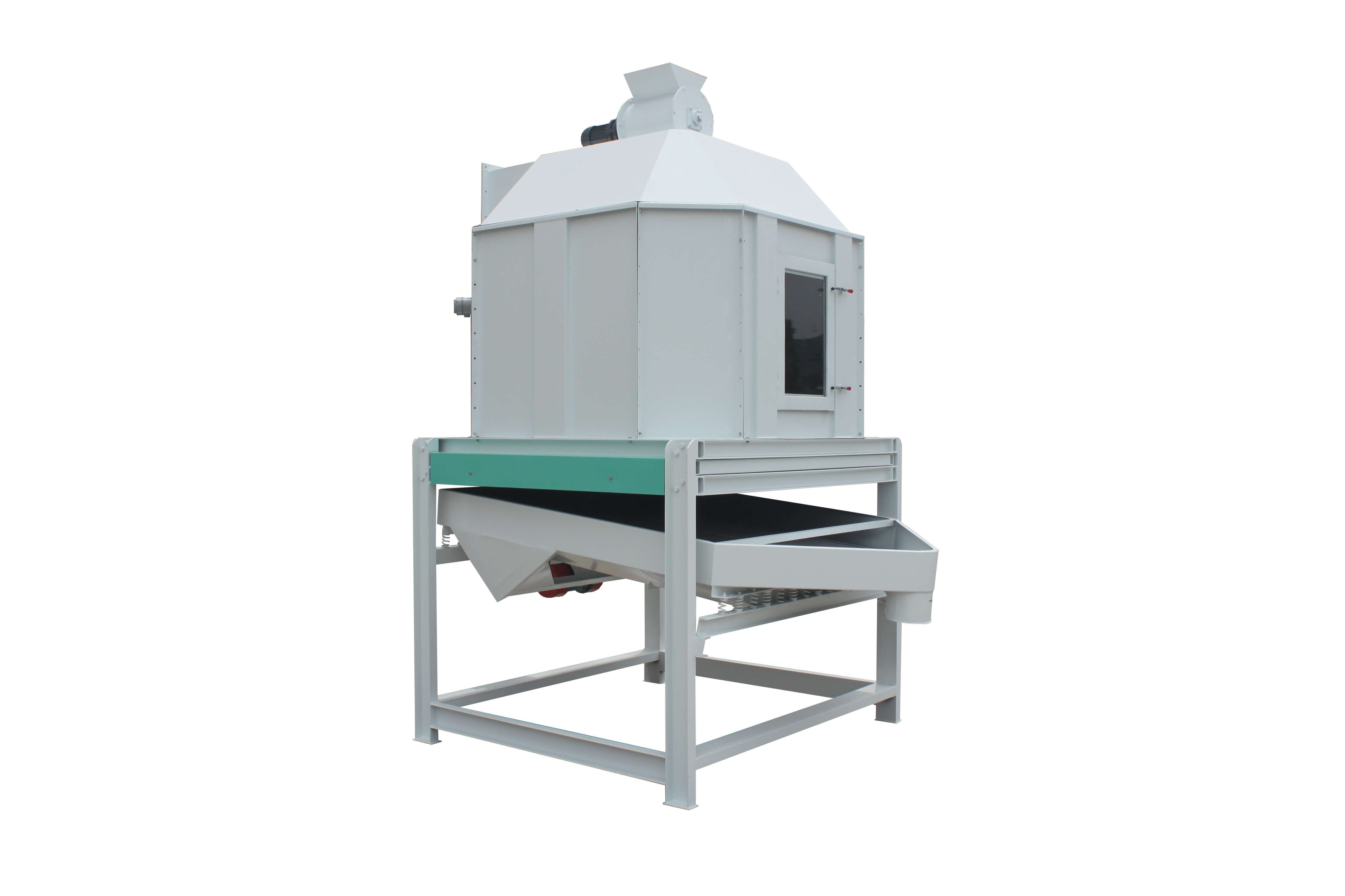
The typical machine consists of a vertical cooling chamber, a distributing mechanism at the top that spreads pellets evenly across the cross-section, a discharge gate or swing-type discharge at the bottom, one or more centrifugal fans with ducting, and a control system that manages retention time and air volume. Even distribution at the top is critical: if pellets pile unevenly, air will always choose the path of least resistance, leaving some zones under-cooled and others over-dried. That is why the internal distributor and the discharge uniformity of a counterflow pellet cooler deserve close inspection during factory acceptance.
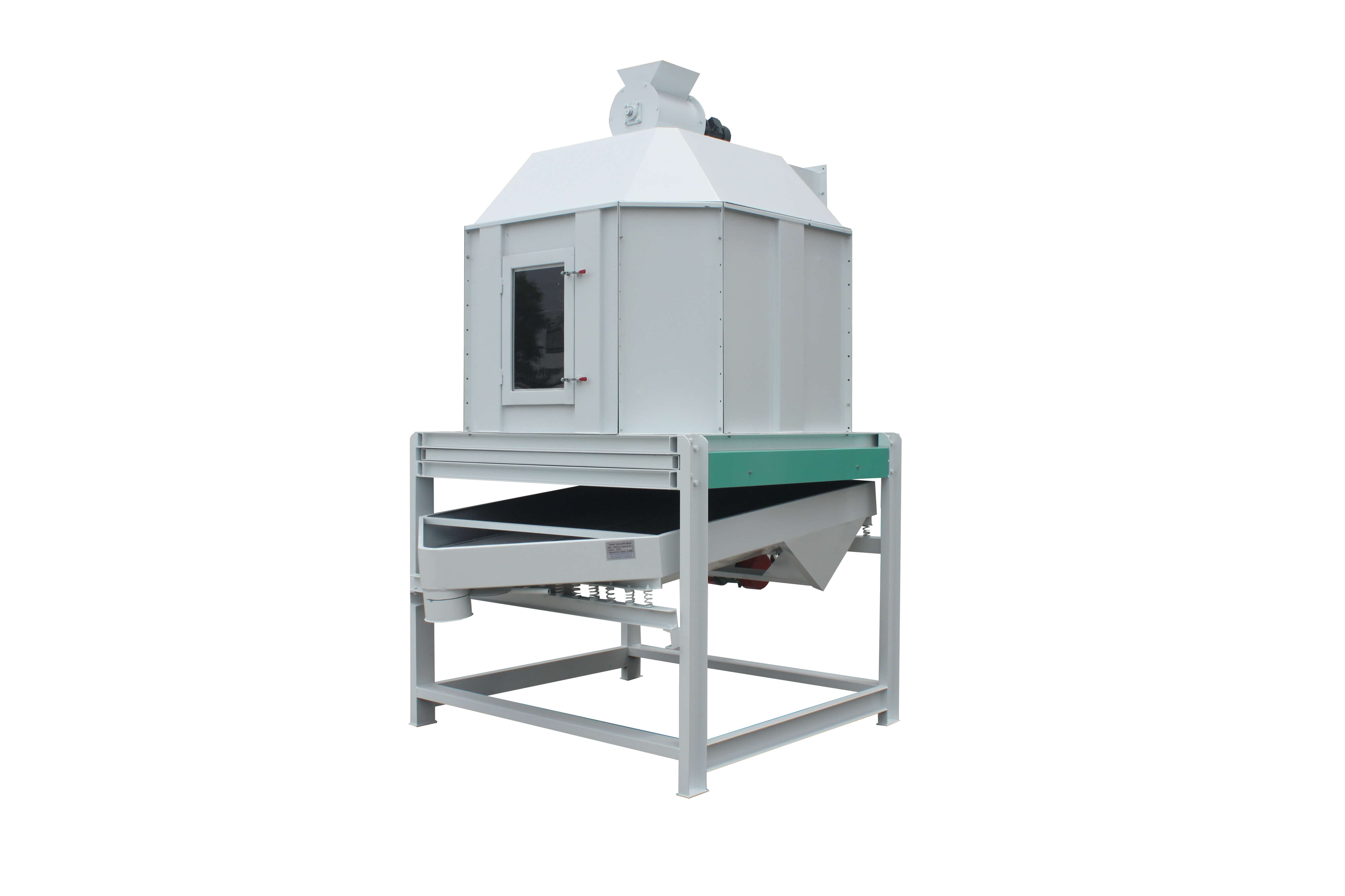
Retention time is regulated either by a mechanical discharge system driven by a variable-speed motor or by level and temperature feedback from sensors. In well-designed installations, the cooler holds a full pellet column so that every pellet passes through the same cooling history, instead of short-circuiting from top to bottom. The fan arrangement usually allows part of the air to be recirculated in cold climates or exhausted directly in hot, humid climates, and a cyclone or dust collector recovers the fines carried out with the air stream so they can be returned to the process rather than lost.
Two operating details separate a calm cooler from a problematic one. The first is air-to-product balance: airflow that is too low leaves pellets hot and soft, while excessive airflow dries the surface too fast and promotes cracking. The second is discharge consistency. A discharge that opens and closes abruptly dumps slugs of pellets, disturbs the column and causes temperature spikes; a smooth, adjustable discharge keeps the column stable. During commissioning, both should be tuned against actual measurements rather than assumed from a nameplate.
Key Selection Criteria: Matching a Counterflow Cooler to Your Pellet Line
Choosing a counterflow feed cooler starts with the pellet mill, not with the cooler catalogue. The cooler must handle the peak output of the press at the smallest pellet diameter you intend to run, because small pellets are produced at lower tonnage but leave the die hotter and with higher surface moisture. If you produce several pellet sizes, size the cooler for the worst case, then confirm that retention time remains adjustable enough for the easiest case.
| Selection Factor | What to Check | Why It Matters |
|---|---|---|
| Throughput match | Cooler capacity versus pellet mill output at your smallest die | Prevents forced slowdown of the press and bottlenecks |
| Retention time control | Variable-speed discharge or adjustable gate with feedback | Allows tuning for pellet size, formulation and climate |
| Airflow and fan configuration | Fan volume, static pressure, damper control, recirculation option | Balances cooling speed against cracking and over-drying |
| Distribution uniformity | Top distributor design, discharge uniformity, dead zones | Avoids mixed hot and cold pellets in the same batch |
| Fines handling | Cyclone or dust collector, return path to process | Reduces product loss and keeps the plant clean |
| Construction and hygiene | Material thickness, access doors, cleanout design, surface finish | Supports sanitation, serviceability and long service life |
| Site conditions | Ambient temperature, humidity, altitude, available height | Defines realistic cooling targets and layout options |
Height is often the forgotten constraint. Vertical counterflow coolers need elevation, and retrofits into existing buildings sometimes require a compact layout or a different arrangement to fit under existing roof steel. Sharing a dimensioned layout drawing and section view of the building early prevents expensive surprises later. It is also worth deciding in advance whether the cooler will discharge to a crumbler, a packing line or a bulk silo, because the discharge chute, bypass and fines return must be designed around that flow.
Finally, climate should be part of the specification. In hot, humid regions the cooler is asked to remove moisture from air that is already close to saturation, so airflow, retention time and sometimes post-cooling ventilation need more margin. In cold regions, air that is too cold can thermally shock pellets, and partial air recirculation or pre-conditioning of the cooling air becomes valuable. A supplier who asks about your climate, formulation and pellet sizes before quoting is usually a supplier who has commissioned machines in the field.
How to Identify a Professional and Reliable Counterflow Feed Cooler Manufacturer
Buyers searching for a reliable counterflow feed cooler factory are usually comparing offers that look similar on paper. The differentiators appear in engineering depth and project execution. Start with the questions a manufacturer asks you: a serious supplier wants to know pellet diameter range, formulation (especially fat and molasses levels), required throughput, steam and moisture conditions, ambient climate, building height, and the equipment upstream and downstream. A supplier who quotes a price after only asking “how many tons per hour” is likely selling a box, not a solution.
Second, examine integration capability. The cooler rarely stands alone; it connects to the pellet mill, the crumbler, the bucket elevator, the fines return line and the packing bin. A manufacturer who also builds ring die pellet machines, waterdrop hammer mills and double shaft mixers can verify that the cooler matches the actual output of the press rather than an optimistic catalogue figure. Jiangsu Huamu, for example, produces the pellet mill, hammer mill, mixer and cooler within one production system, which allows the cooling stage to be sized against real measured output from the press.
Third, ask for verifiable facts rather than adjectives: quality management certification, factory area, production capacity, inspection records, and a commissioning procedure with measurable acceptance criteria such as discharge temperature, pellet moisture and fines percentage. Fourth, ask who will supervise installation and how operator training is handled. A cooler is easily under-performed by operators who adjust the discharge gate by feel; documented commissioning and training are part of the product.
- Does the quotation include a dimensioned general arrangement and airflow schematic?
- Are retention time, fan volume and discharge control adjustable after installation?
- Is the cooler sized against your smallest pellet diameter, not just the average?
- What acceptance measurements are taken at commissioning, and who records them?
- Are wear parts, screens, seals and fan components available as spares?
- Can the manufacturer support installation, debugging and operator training on site?
- Can they reference completed projects in similar capacities and feed types?
Integration with Huamu Feed Production Lines from 1 to 30 Tons per Hour
Cooling performance cannot be separated from the rest of the line. In a typical Huamu turnkey configuration, raw materials are ground in a waterdrop hammer mill with a water-drop shaped grinding chamber and a “mountain” shaped secondary impact structure, blended in a double shaft paddle mixer with a 30–90 second mixing cycle and a coefficient of variation of 5% or less, conditioned and pelleted in a ring die pellet machine, then cooled, crumbled where required, screened and packed. Because the mixer can be fitted with an atomizing spray system for molasses and oil, the pellets entering the cooler may carry higher fat and moisture loads, which changes how much cooling air and retention time are needed.
This matters for aquatic feed especially. Sinking and floating fish feed pellets are dense, and shrimp feed is finer and more fragile; both are less tolerant of thermal shock than standard poultry pellets. Retaining a stable column, avoiding abrupt discharge and controlling airflow gently will protect pellet integrity far better than pushing more air through the cooler. For high-grade pig feed and poultry feed, the priority shifts toward consistent moisture and minimal fines so that bagging weights and pellet durability index remain stable across the shift.
Sizing across the 1–30 t/h range should be done line by line. A small 1–3 t/h plant may run a single press with a compact vertical cooler sized to its peak output; a 10–20 t/h plant often needs a cooler with generous retention volume plus a buffer between the press and the cooler to absorb short stops. For projects above that, multiple presses may feed a shared cooling and conveying section, in which case the control philosophy — how discharge rate follows incoming flow — becomes as important as the machine itself. Discussing the whole material flow, not just the cooler, is how a suitable counterflow pellet cooler is actually specified.
Installation, Commissioning and Daily Maintenance Tips
Installation quality determines whether the cooler performs to its design intent. The machine must be level and plumb, the discharge must be free of restriction, ducting should have as few sharp bends as possible, and the fan must be installed so that air is drawn or pushed in the intended direction without leaking at joints. Access doors and inspection points should remain reachable after the surrounding steelwork and bins are erected, which is a layout decision made long before commissioning.
Commissioning should be measurement-driven. Run the line at design throughput with the intended pellet size, then record discharge pellet temperature, pellet moisture, fines content and cooler air conditions at several retention time settings. Adjust the discharge speed and air damper until the pellets are cool and stable without surface cracking, and write the resulting set points into the operating procedure. Operators should know which knob to turn when the weather changes, when the formulation changes, or when the pellet mill output drops.
Daily maintenance is simple but must be consistent. Clean the distributor and discharge area at the end of each production run to prevent buildup that disturbs the column. Inspect the fan impeller for dust accumulation that can cause imbalance and vibration. Check the fines collection system so that carryover does not escape to the atmosphere or clog the return line. Verify that the discharge mechanism moves smoothly through its full range, and lubricate moving parts according to the manual. During scheduled shutdowns, inspect the cooling chamber for wear, corrosion or buildup in humid climates, and confirm that the control sensors still read accurately.
Common Cooling Problems and Practical Solutions
The most frequently reported issue is pellets leaving the cooler too hot, which usually traces back to insufficient retention time, inadequate airflow, or a discharge that opens too far and lets product pass through quickly. Check the column level first, then air volume, then discharge settings, in that order. The second common issue is high fines after cooling, which often indicates over-drying or thermal shock: reduce airflow slightly, extend retention time, and review the conditioning temperature and moisture before the die. If fines appear only in certain pellet sizes, look at distribution uniformity inside the cooler rather than at the fan.
Uneven cooling between the top and bottom of the batch, condensation on the cooler walls, and mold appearing in bags after a few weeks all point to moisture management rather than to the cooler alone. In humid seasons, higher airflow with correct retention time, prompt bagging, and attention to the moisture entering the cooler help. Where the plant adds molasses or oil through a spray system, the additional moisture load should be discussed with the equipment supplier during line design, since cooling capacity and retention time may need adjustment.
FAQ
What is the difference between a counterflow feed cooler and a horizontal cooler?
A counterflow cooler moves pellets downward against upward airflow, so the coolest air meets the coolest pellets and cooling is gradual and even across the column. A horizontal or belt cooler moves pellets along a conveyor while air passes through the bed. Counterflow designs generally offer better uniformity, gentler handling and a smaller footprint, which is why they are common in compound feed, poultry feed and aquatic feed lines. Horizontal designs can suit specific layouts or very fragile products. The right choice depends on pellet type, building height and throughput.
How do I choose the right counterflow feed cooler capacity for my pellet mill?
Size the cooler against the peak output of your pellet press at the smallest pellet diameter you plan to produce, then confirm that retention time and airflow remain adjustable for larger pellet sizes. Allow margin for formulation changes such as higher fat or molasses content, and account for site climate, since hot and humid conditions reduce cooling effectiveness. Share your building height and downstream equipment with the supplier so the layout, discharge and fines return are designed together rather than added later.
How can I judge whether a counterflow feed cooler manufacturer is reliable and suitable?
Look for engineering engagement rather than a fast price: the manufacturer should ask about pellet sizes, formulations, climate and building layout before quoting. Check verifiable credentials such as ISO9001 certification, factory size and production capacity, and ask how commissioning acceptance is measured. Experience across the full line — pellet mill, hammer mill, mixer and cooler — helps ensure the cooler is matched to real press output. Finally, confirm installation supervision, operator training, documentation and spare parts availability.
Can one counterflow cooler handle poultry feed, pig feed and aquatic feed?
Yes, a properly sized and adjustable counterflow cooler can serve multiple feed types, but the settings must change with the product. Aquatic feed pellets are denser and often more sensitive to abrupt temperature change, while poultry and pig pellets usually prioritize consistent moisture and low fines. Adjustable retention time and airflow control are essential, and on multi-product lines the operating procedure should list set points for each product rather than relying on operator judgement alone.
What temperature and moisture should pellets have after cooling?
As a common industry target, cooled pellets should leave the cooler at roughly ambient temperature plus about 5°C, with surface moisture reduced to a level safe for storage and transport — often around 12–13% depending on formulation and local climate. Exact targets should be agreed with your equipment supplier and quality team, and verified by measurement at commissioning rather than assumed from a catalogue.
What maintenance does a counterflow feed cooler require?
Clean the distributor and discharge area after each production run, inspect the fan for dust buildup and imbalance, keep the fines collection and return system clear, and confirm the discharge mechanism moves smoothly through its full range. Lubricate moving parts as specified in the manual, and during scheduled shutdowns inspect the chamber for wear, corrosion or buildup. Accurate sensors and clean internals prevent most cooling complaints before they start.
Summary
Choosing a counterflow feed cooler is a system decision, not a component purchase. The machine must be matched to the pellet mill’s real output at the smallest die, equipped with adjustable retention time and airflow, and designed for even distribution and smooth discharge so that every pellet receives the same cooling history. Climate, formulation, building height and downstream equipment all influence the specification, and commissioning should be validated with measured temperature, moisture and fines data rather than by ear.
When evaluating suppliers, prioritize engineering engagement, verifiable credentials, full-line integration capability and after-sales support over the lowest quotation. Jiangsu Huamu Machinery designs and manufactures pellet mills, waterdrop hammer mills, double shaft mixers, coolers and complete auxiliary equipment, and delivers turnkey feed production lines from 1 to 30 tons per hour with installation, commissioning and operator training. If you are planning a new feed plant or upgrading an existing cooling section, share your pellet sizes, throughput and layout with the Huamu team to receive a counterflow feed cooler configuration matched to your actual production conditions.