
Choosing a complete feed production line is one of the most important investment decisions a feed mill, farming enterprise or agribusiness group will make. The line determines output capacity, pellet quality, energy consumption, labor requirements and how easily the plant can be expanded in the future. For buyers in Asia, Africa, the Middle East, South America and Europe, the challenge is not simply finding equipment — it is finding a reliable complete feed production line manufacturer who can design, build, install and commission a system that actually performs in daily operation.
Jiangsu Huamu Machinery Co., Ltd. is a feed machinery manufacturer based in Xibei Town, Wuxi City, Jiangsu Province, China. The company specializes in manufacturing feed machinery, designing feed production lines, and providing installation and debugging services. With a registered capital of 10 million RMB, a 10,000 square meter production site, ISO9001 quality system certification and recognition as a Jiangsu Provincial Specialized, Refined, Distinctive and Innovative SME in 2024, Huamu supplies complete feed production lines with capacities from 1 to 30 tons per hour to customers in more than 50 countries and regions.
This guide explains what a complete feed production line includes, how to match equipment to your formula and capacity target, which technical questions to ask a supplier, and how to compare quotations without being misled by low headline prices.
What Is a Complete Feed Production Line and What Does It Include?
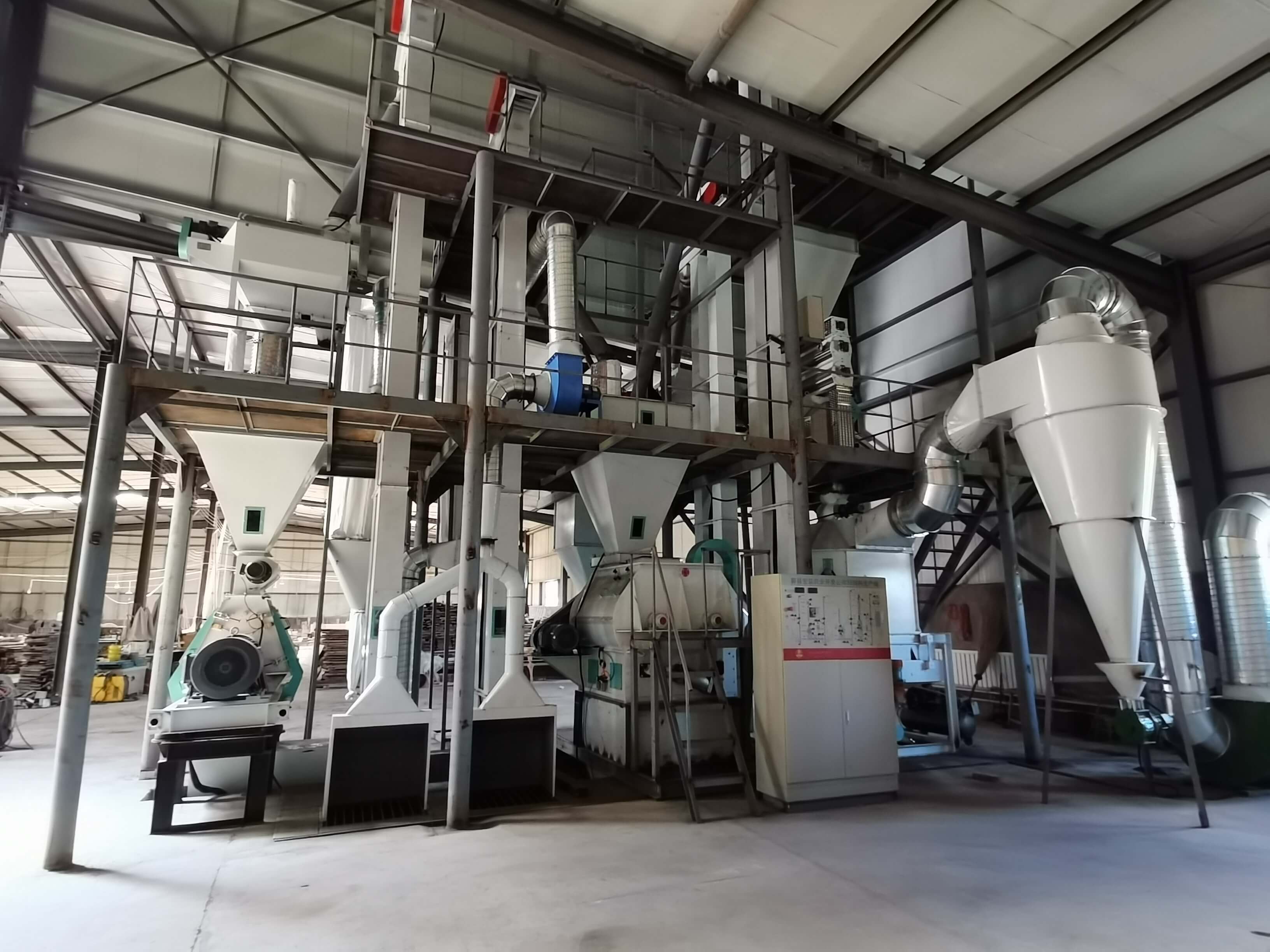
A complete feed production line is an integrated system that receives raw materials such as corn, soybean meal, wheat bran, fish meal and additives, then processes them through grinding, batching, mixing, pelleting, cooling, crumbling, screening and packing to produce finished compound feed. A properly designed line connects each stage with conveying equipment, storage bins, dust collection and control systems so that material flows continuously with minimal manual handling.
In a typical turnkey feed mill project, the scope usually covers the following modules:
- Raw material receiving and cleaning — receiving pits, bucket elevators, pre-cleaners and magnetic separators.
- Grinding section — hammer mills with aspiration and sieving systems to control particle size.
- Batching and mixing section — ingredient bins, weighing systems, double shaft paddle mixers and liquid addition systems.
- Pelleting section — ring die pellet machines, conditioners, feeders and steam systems.
- Post-pelleting section — coolers, crumbles, stabilizers and graders.
- Finished product handling — packing machines, bulk loading, conveyors and dust collectors.
Because the modules are interdependent, the capacity of the whole line is limited by the weakest stage. A professional complete feed production line supplier will balance grinder output, mixer cycle time, pellet mill capacity and cooler retention time so that the plant reaches its rated output rather than only performing well on paper.
Why Manufacturer Selection Matters More Than the Equipment List
Most quotations from different suppliers look similar on paper: a hammer mill, a mixer, a pellet mill, a cooler and a packing machine. The real difference lies in engineering detail, manufacturing tolerance, material selection and the supplier’s ability to support installation and troubleshooting after shipment. A line that is undersized in the conveying section or incorrectly piped for steam will lose capacity every day of its service life.
When evaluating a reliable complete feed production line manufacturer, look beyond the equipment list and examine four capabilities: in-house design and drawing capacity, manufacturing control, installation and commissioning experience, and long-term spare parts support. A supplier that only assembles purchased components will struggle to solve process problems such as unstable pellet durability, high fines return or uneven mixing uniformity.
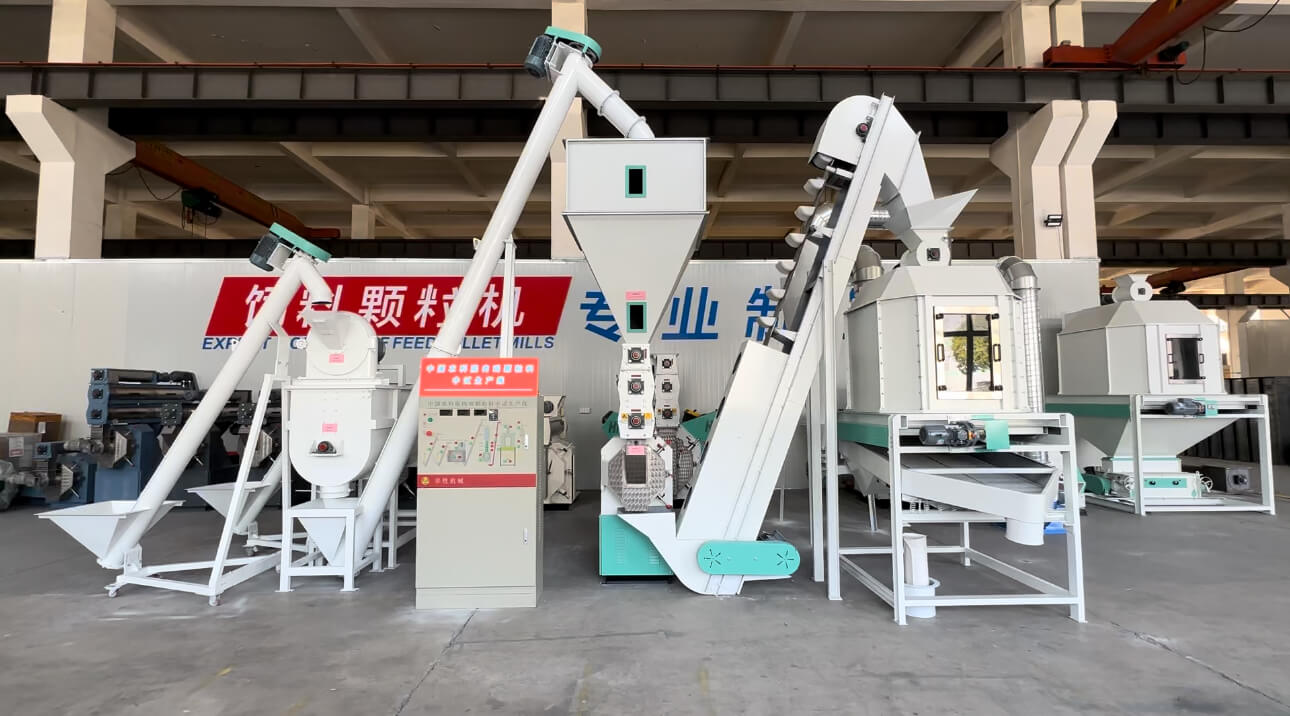
Jiangsu Huamu’s approach reflects this process-oriented view. The company designs and manufactures complete units for powder feed, premix feed, pellet feed and special aquatic feed, and maintains an experienced design, production and installation team. Its product range includes ring die pellet machines, waterdrop hammer mills, double shaft mixers, coolers and premix additive complete units, which allows the process stages to be matched rather than assembled from unrelated sources.
Matching Capacity: From 1 t/h to 30 t/h Complete Feed Production Lines
Capacity planning should start from the market, not from the machine. Define the daily tonnage required, the number of product formulas, the shift pattern and the expected growth over five years. A plant designed for 5 tons per hour with a single pellet mill can often be upgraded by adding a second mill and extending the cooling and conveying sections, but only if the original layout reserved the space.
The table below shows how typical configurations change across capacity bands. Actual configurations depend on formula, bulk density, pellet diameter and required grading accuracy.
| Capacity Band | Typical Equipment Configuration | Suitable Application |
|---|---|---|
| 1–5 t/h | One hammer mill, one double shaft mixer, one pellet mill, cooler, crumbler, packing machine | Family farms, small commercial feed mills, starter projects |
| 5–15 t/h | Parallel grinding, multi-bin batching, one or two pellet mills, counterflow cooler, two-stage crumbling, automatic packing | Poultry and livestock feed plants, regional feed suppliers |
| 15–30 t/h | Multiple grinding lines, batching and mixing with liquid addition, twin pellet mills, stabilizer, high-capacity cooling and bulk loading | Aquatic feed plants, large integrated farms, multi-species feed complexes |
For buyers comparing a 1-30 t/h complete feed production line price, the most useful comparison is cost per ton of installed capacity, not total quotation value. A cheaper line that runs at 70 percent of rated output and requires frequent die changes will cost more over ten years than a correctly sized line with better conditioning and cooling.
Why Aquatic Feed Needs a Different Line Design
Aquatic feed production places higher demands on grinding fineness, conditioning temperature, die compression ratio and post-pellet stabilization. Shrimp and fish feeds usually require micro-grinding, longer conditioning time and a stabilizer after the cooler to control water stability. A supplier with experience in aquatic product complete units will specify different hammer mill screens, conditioner retention time and cooler dwell time compared with a poultry feed line.
Why Premix and Powder Feed Need Separate Attention
Premix and concentrate production focuses on weighing accuracy, mixing uniformity and cross-contamination control rather than pelleting. In these lines, the double shaft paddle mixer, batching scale accuracy and dust collection design become the critical factors. Huamu manufactures premix additive complete units alongside pellet lines, which allows the same project team to handle both powder and pellet sections of a complex plant.
Core Equipment Performance: What Actually Drives Line Output
Three machines largely determine whether a complete feed production line meets its design capacity: the hammer mill, the mixer and the pellet machine. Understanding their working principles helps buyers ask precise technical questions during supplier evaluation.
Waterdrop Hammer Mill: Grinding Efficiency and Versatility
Huamu’s waterdrop hammer mill uses a waterdrop-shaped grinding chamber and a “mountain” type secondary impact structure. Compared with conventional designs, the company reports a 25 percent increase in output for comparable power, and the machine can perform coarse, fine and micro-fine grinding in one unit. This flexibility matters in plants producing both high-grade poultry feed and aquatic feed, where screen changes would otherwise interrupt production.
When specifying a hammer mill, confirm the required particle size, the bulk density of raw materials, the aspiration air volume and the screen change time. Grinding capacity on corn is not the same as capacity on oily or fibrous ingredients, so a supplier should ask for your formula rather than quoting a single headline tonnage.
Double Shaft Paddle Mixer: Uniformity in 30–90 Seconds
The double shaft paddle mixer is designed for fast, gentle mixing. Huamu’s model completes a mixing cycle in 30 to 90 seconds per batch with a coefficient of variation (CV) of 5 percent or less and no segregation after discharge. An optional atomizing spray system allows molasses, oil and other liquids to be distributed evenly, which is essential for high-energy diets and for aquatic feeds with added fish oil.
Mixing uniformity directly affects pellet durability and animal performance. A mixer that needs three minutes to reach acceptable CV limits the whole line’s throughput and increases energy cost per ton.
Ring Die Pellet Machine: Stable Pelleting at Lower Noise
Huamu focuses on small and medium belt-driven pellet machines using a dual-motor strong narrow-belt transmission. The design delivers stable operation, high output and low noise, with annual sales reaching 500 sets — a volume that supports consistent spare parts availability. For buyers comparing configurations, belt drive offers easier maintenance and lower initial cost, while gear drive is often preferred for very high-torque aquatic applications.
How to Evaluate a Complete Feed Production Line Manufacturer: A Practical Checklist
Buyers often ask which complete feed production line manufacturer is reliable, and the honest answer is that reliability can be verified. Use the checklist below during factory visits, video audits and technical clarification meetings.
- Design capability: Can the supplier produce layout drawings, process flow diagrams, load calculations and utility requirements for your building?
- Manufacturing depth: Are key components such as rotors, shafts, dies and mixer paddles made in-house or outsourced without inspection control?
- Quality system: Is there a certified quality management system such as ISO9001 covering design, production and service?
- Reference installations: Can the supplier explain the configuration of similar capacity lines and the process challenges solved?
- Installation and commissioning: Does the quotation include supervision, training and performance testing, or only equipment supply?
- Spare parts and response: Are dies, rollers, screens and bearings available with predictable lead times?
- Documentation: Are operation manuals, electrical drawings and maintenance schedules provided in a usable language and format?
A supplier that answers these questions with documents and calculations, rather than general statements, is usually the safer long-term partner. It is also reasonable to request a factory acceptance test before shipment, especially for pellet mills and mixers.
The Turnkey Process: From Layout Design to Commissioning
A turnkey feed mill project follows a predictable sequence. The supplier collects site information including building dimensions, available power, steam capacity, raw material storage and finished product handling requirements. The process engineer then produces a mass balance and equipment list, followed by a general layout that respects gravity flow wherever possible to reduce conveying energy.
After drawing approval, fabrication begins with quality inspection at each stage. Equipment is tested, packed and shipped with a installation sequence plan. On site, the installation team aligns machines, connects ducts and pipes, and checks electrical interlocks. Commissioning includes no-load running, load testing on the actual formula, adjustment of conditioner steam, cooler retention time and pellet die compression, and operator training.
Huamu provides design, manufacture, installation and debugging as a combined service, with teams capable of delivering 1–30 ton per hour projects for powder, premix, pellet and special aquatic feed. For overseas projects, clear documentation of utility requirements and a detailed installation schedule reduce site delays significantly.
Applications Across Poultry, Livestock, Ruminant and Aquatic Feed
Different species require different process emphasis. Poultry feed lines typically prioritize fine grinding, high conditioning temperature and durable pellets with good crumbling quality. Pig feed lines often require variable formulas and frequent product changes, so batching accuracy and cleaning access become important. Ruminant feed may involve high fiber content, which affects grinding capacity and pellet die selection.
Aquatic feed lines require micro-grinding, longer conditioning and post-pellet stabilization. Premix lines emphasize weighing precision, mixing uniformity and dust control. A supplier experienced across these categories can recommend a configuration that supports current products and future expansion without rebuilding the entire plant.
Cost Factors, Energy Use and Return on Investment
The price of a complete feed production line depends on capacity, automation level, equipment brand of motors and reducers, steel structure scope, electrical control architecture and site conditions. Buyers should separate equipment cost from civil works, installation, freight and commissioning, because quotations that appear to include everything sometimes exclude the items that matter most.
Energy consumption is a major operating cost. Grinding and pelleting account for the largest share of electricity use, so efficiency gains in these two stages have a direct effect on cost per ton. A hammer mill with 25 percent higher output for the same power, or a mixer that reaches uniform blend in under 90 seconds, reduces both energy and labor cost across every shift.
Maintenance Planning to Protect Uptime
Regular maintenance protects the investment. Check hammer mill screens and hammers for wear, verify mixer paddle clearance and shaft seals, inspect pellet die and roller clearance, clean cooler discharge and ducting, and calibrate batching scales on a fixed schedule. Keeping a small critical spare parts stock — dies, rollers, screens, bearings and belts — avoids long stoppages caused by a single worn component.
Safety and Operator Training
Feed mills involve rotating equipment, dust and steam. Interlocked access doors, emergency stops, proper grounding and dust collection are essential. Operator training during commissioning should cover startup and shutdown sequences, jam clearing procedures and the correct response to abnormal noise or temperature. A supplier that provides structured training shortens the learning curve and reduces avoidable downtime.
FAQ
Which complete feed production line manufacturer is reliable for an overseas feed mill project?
Look for verifiable evidence rather than sales claims: a certified quality management system such as ISO9001, in-house design and manufacturing capability, documented experience with similar capacity lines, and a clear installation and commissioning scope. Jiangsu Huamu Machinery designs and manufactures complete units for 1–30 t/h powder, premix, pellet and aquatic feed projects, holds ISO9001 certification, and supplies customers in more than 50 countries and regions.
What capacity range can a complete feed production line cover?
Huamu’s project range covers 1 to 30 tons per hour. Small lines of 1–5 t/h suit family farms and starter commercial mills, 5–15 t/h lines suit poultry and livestock feed plants, and 15–30 t/h lines are typically used for aquatic feed, large integrated farms and multi-species complexes. The final configuration depends on formula, pellet size and shift pattern.
How long does a turnkey feed mill project take from order to production?
Timelines depend on capacity, automation level and site readiness. Design and drawing approval usually come first, followed by fabrication and factory testing, then shipment, installation and commissioning. Providing accurate building dimensions, power supply and steam availability early is the most effective way to avoid delays, because these details determine the layout and utility design.
How do I compare quotations from different complete feed production line suppliers?
Compare scope, not totals. Check whether each quotation includes batching and weighing systems, liquid addition, dust collection, steel structures, electrical control, installation supervision, commissioning and training. Also compare equipment ratings at the same operating point, spare parts pricing and expected die and hammer life, then calculate cost per ton of output rather than cost per machine.
Can a complete feed production line be customized for aquatic or premix feed?
Yes. Aquatic feed lines typically require micro-grinding, longer conditioning and a stabilizer after cooling, while premix lines emphasize weighing accuracy, mixing uniformity and cross-contamination control. Huamu manufactures ring die pellet machines, waterdrop hammer mills, double shaft mixers, coolers, stabilizers, crushers, extruders, dryers, packers, conveyors and dust collectors, so the process can be configured around the target product rather than a fixed catalogue.
What support is available after installation?
Support should include operation and maintenance manuals, operator training during commissioning, and access to critical spare parts such as dies, rollers, screens and bearings. Agreeing on response times and spare parts recommendations before shipment helps protect uptime once the plant is running commercially.
Summary
Selecting a complete feed production line is a process decision, not a shopping decision. The right partner will start with your formulas, target capacity and site conditions, then design a balanced line in which grinding, mixing, pelleting, cooling and conveying work together at rated output. Verifiable manufacturing capability, a certified quality system, documented installation and commissioning experience, and dependable spare parts support matter far more than the lowest initial quotation.
Jiangsu Huamu Machinery Co., Ltd. combines feed machinery manufacturing with complete line design, installation and debugging for 1–30 t/h powder, premix, pellet and special aquatic feed projects. With a 10,000 square meter production base in Wuxi, ISO9001 certification, recognition as a Jiangsu Provincial Specialized, Refined, Distinctive and Innovative SME in 2024, and equipment operating in more than 50 countries and regions, the company offers buyers a practical way to evaluate a complete feed production line manufacturer against real technical criteria — and to build a plant that performs for years rather than only on the specification sheet.