
Choosing the right small feed pellet machine supplier is one of the most important decisions a feed producer can make. Whether you are starting a family-scale poultry farm, upgrading an existing feed mill, or building a new commercial feed plant, the pellet machine sits at the heart of your production process. It determines pellet quality, output stability, energy consumption, and how easily your line can be expanded later. A machine that looks similar on paper can behave very differently after two or three years of continuous operation.
This guide explains what actually matters when comparing small feed pellet machine manufacturers, how ring die pellet technology performs in real poultry, livestock, and aquatic feed applications, and what a professional feed machinery factory such as Jiangsu Huamu Machinery Co., Ltd. can deliver across a complete 1-30 t/h feed production line. It also covers pricing factors, installation requirements, maintenance routines, and the practical questions buyers ask most often.
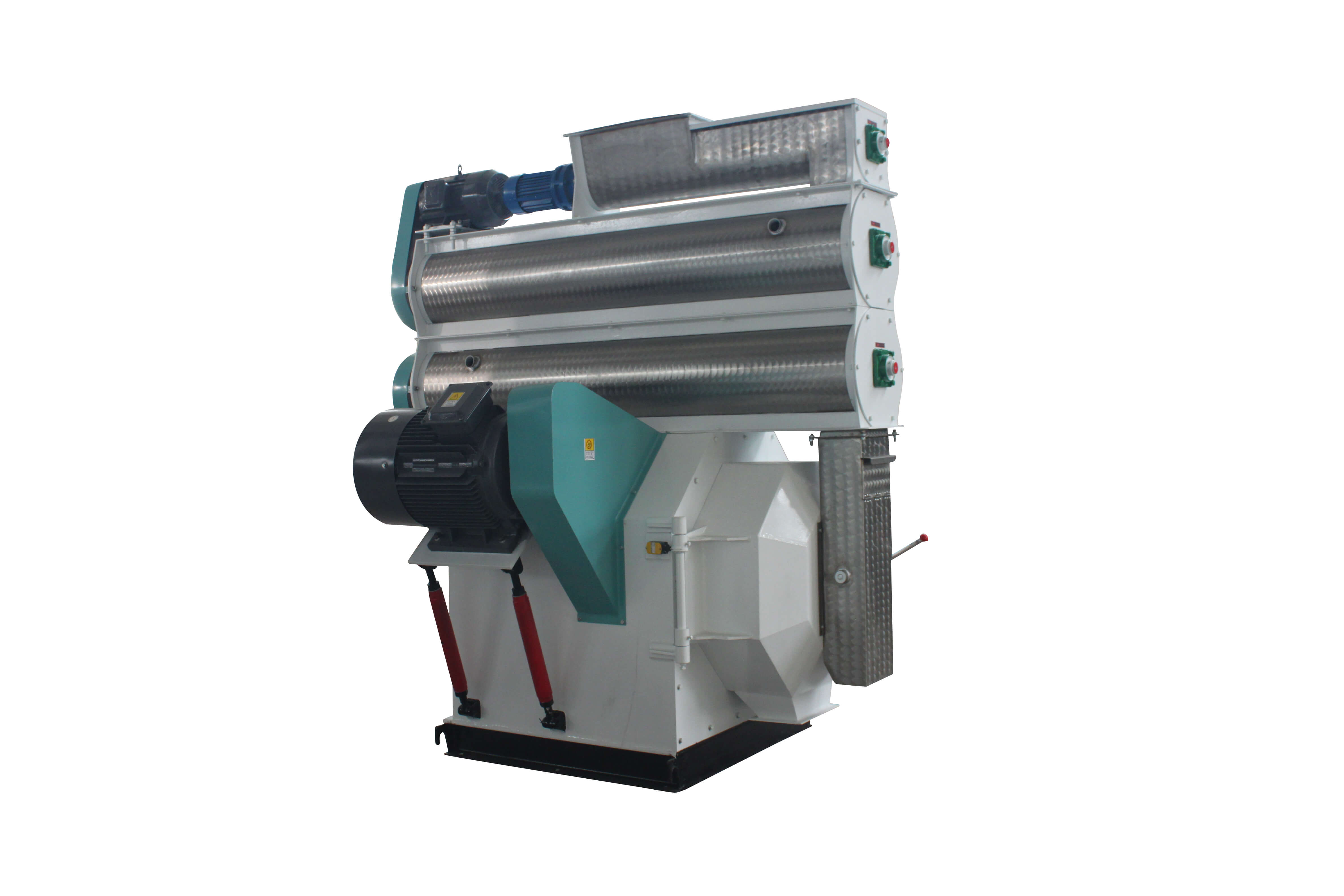
Why a Small Feed Pellet Machine Still Matters in Modern Feed Production
Pelleted feed offers clear advantages over mash feed: better nutrient density, reduced feed waste, improved digestibility, and more consistent intake across flocks and herds. For small and mid-sized feed operations, a compact small feed pellet mill for animal feed provides these benefits without requiring the capital investment of a large-scale industrial plant. That is why demand for a dependable small feed pellet machine for poultry feed and cattle feed remains strong across Southeast Asia, Africa, the Middle East, South America, and Europe.
Small pellet machines are not simply scaled-down versions of large equipment. They must handle frequent formula changes, variable raw material quality, and shorter production batches while still maintaining stable pellet durability. A machine designed for this duty cycle needs a robust transmission system, a properly engineered ring die, and a feeder that responds smoothly to load changes. When these elements are correctly matched, a small line can produce pellets that meet commercial quality standards.
This is where supplier capability becomes decisive. A feed machinery manufacturer that designs the entire line — from hammer mill and mixer to pellet machine, cooler, crumbler, and packing system — can balance capacity at every stage. A supplier that only sells individual machines often leaves buyers with bottlenecks, mismatched motors, or conveying systems that cannot keep up.
What to Evaluate Before You Buy a Small Feed Pellet Machine
Price is important, but it should never be the first filter. Buyers comparing a small feed pellet machine price across several quotations frequently discover that the lowest offer excludes die spares, conditioners, motors, or installation support. A structured evaluation avoids this problem.
1. Transmission and drive design
The drive system determines vibration, noise, and long-term reliability. Belt-driven models with dual-motor strong narrow-belt transmission run smoothly and are easier to maintain in small plants, while gear-driven models suit higher continuous loads. Ask the supplier to explain why a specific drive configuration was selected for your capacity and raw material.
2. Ring die and roller assembly
The ring die is a consumable, so its quality directly affects operating cost per ton. Check die material, hole pattern options, compression ratio recommendations for different formulas, and how quickly the supplier can deliver replacement dies. A serious ring die pellet machine supplier keeps standard die specifications in stock and offers customized hole diameters.
3. Capacity matched to your real formula
Rated capacity is usually quoted on a standard formula. Poultry feed, high-fat aquatic feed, and high-molasses ruminant feed all behave differently. A professional supplier will ask for your formula targets and recommend capacity with a realistic margin rather than quoting a theoretical maximum.
4. Upstream and downstream compatibility
A pellet machine is only as good as the material feeding it. Verify hammer mill output, mixer uniformity, conditioning temperature, cooler retention time, and conveying capacity. Complete line design prevents the common problem of a machine running below its rated output because the upstream mixer cannot keep pace.
5. Documentation, spares, and commissioning support
Request mechanical drawings, electrical schematics, operation manuals, and a spare parts list before ordering. Confirm whether the supplier provides on-site installation, commissioning, operator training, and remote technical support after delivery.
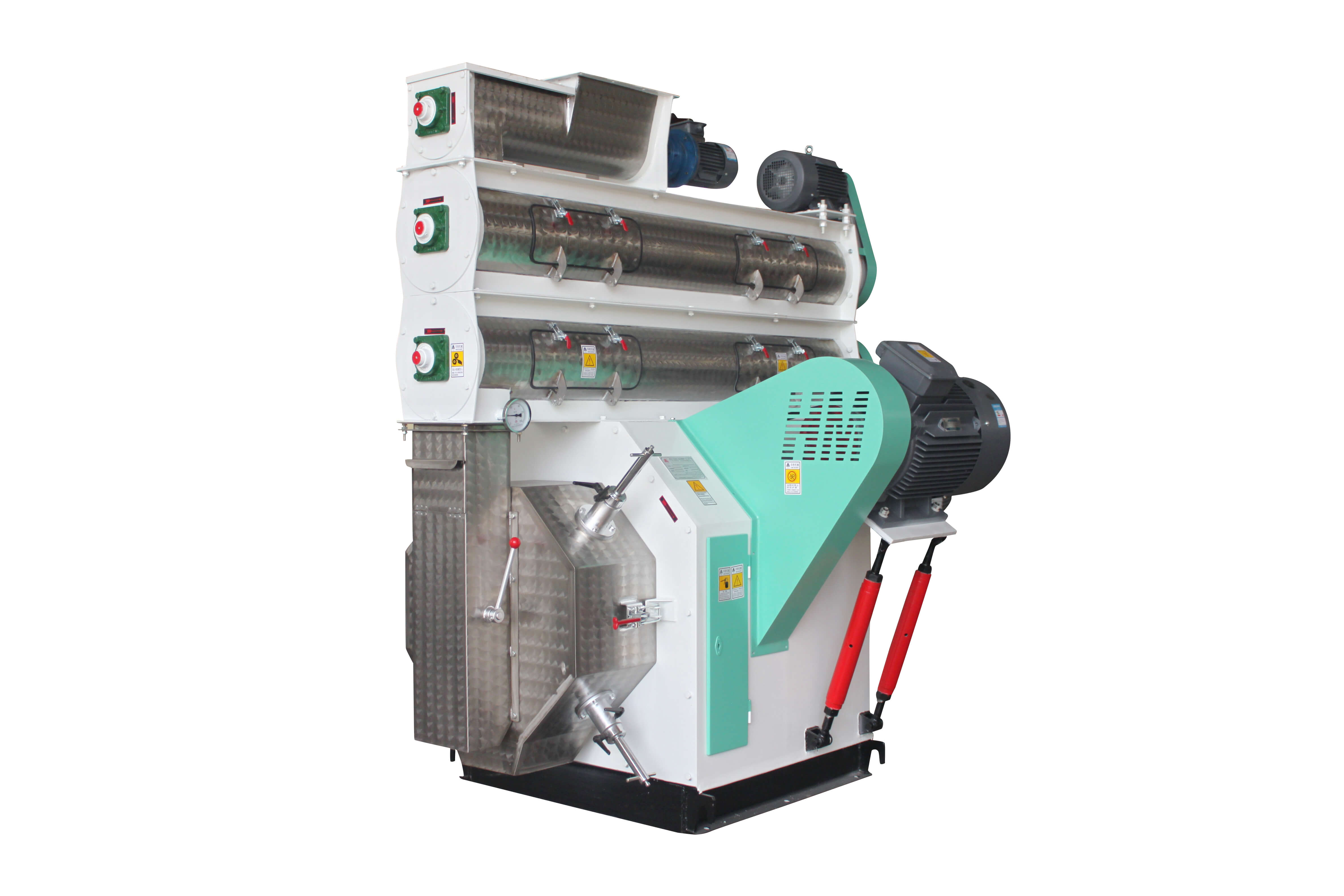
Core Technical Advantages of Huamu Feed Pellet Machines
Jiangsu Huamu Machinery Co., Ltd. is a feed machinery manufacturer based in Xibei Town, Wuxi City, Jiangsu Province, an area with well-developed transport links and a strong equipment manufacturing base. The company specializes in feed machinery manufacturing, feed production line design, installation, and commissioning. It holds ISO 9001 quality system certification, operates a 10,000 square meter production site with registered capital of RMB 10 million, and was recognized as a Jiangsu Provincial Specialized, Refined, Differentiated and Innovative (SRDI) SME in 2024. Products are exported to more than 50 countries and regions.
Huamu’s main pellet machine range focuses on small and medium belt-driven models using dual-motor strong narrow-belt transmission. These units are designed for stable operation, high output, and low noise, with annual production and sales reaching 500 sets. The product family also includes waterdrop hammer mills, double-shaft mixers, coolers, stabilizers, crumblers, extruders, dryers, packing machines, bucket elevators, conveyors, and dust collectors — allowing a single supplier to deliver a coordinated turnkey project.
| Equipment | Key Design Feature | Practical Benefit |
|---|---|---|
| Belt-driven ring die pellet machine | Dual-motor strong narrow-belt transmission | Smooth running, low noise, high output, simpler maintenance |
| Waterdrop hammer mill | Waterdrop grinding chamber with “M”-shaped secondary impact structure | Reported output improvement of 25%; coarse, fine and micro grinding in one unit |
| Double-shaft paddle mixer | 30-90 second mixing cycle, optional atomized spraying system | CV ≤ 5% uniformity, no segregation, even molasses and oil distribution |
| Complete turnkey line | Custom design for 1-30 t/h powder, premix, pellet and aquatic feed | Single-source design, manufacture, installation and commissioning |
Application Scenarios for Small Feed Pellet Machines
A small poultry feed pellet making machine is used far beyond simple chicken feed. Because pellet diameter, die compression ratio, and conditioning parameters can be adjusted, one platform can serve multiple product categories across the year.
- Poultry feed: broiler starter, grower and finisher pellets, plus layer feed with controlled crumble structure.
- Ruminant feed: cattle, sheep and goat pellets formulated with high fiber and molasses inclusion.
- Aquatic feed: floating and sinking pellets for fish and shrimp, requiring careful conditioning and die selection.
- Swine feed: high-grade piglet and grower pellets with fine grinding and stable durability.
- Premix and concentrate: small batch production where formula changeover frequency is high.
- By-product processing: raw material grinding for alcohol plants, citric acid plants and similar industrial users.
For buyers planning a new plant, Huamu can design a complete small feed production line covering reception, grinding, mixing, pelleting, cooling, crumbling, screening, and packing. For existing plants, the same engineering team can carry out retrofit and capacity expansion work — replacing an undersized pellet machine, adding a conditioner, or rebalancing conveying capacity so that the whole line operates at its intended rate.
How to Contact a Small Feed Pellet Machine Supplier and What to Prepare
Buyers often ask how to choose a small feed pellet machine supplier and how to contact one efficiently. The fastest route to an accurate quotation is to prepare a short technical brief before reaching out. This reduces back-and-forth and helps the supplier recommend the correct configuration on the first response.
Information to send in your first inquiry
- Target output in tons per hour, and whether this is finished feed or pellet output.
- Feed types and formula outline: poultry, ruminant, aquatic, swine, or premix.
- Required pellet diameters and any crumble requirement.
- Raw materials used: corn, soybean meal, wheat bran, fish meal, molasses, oil addition rate.
- Available workshop dimensions, ceiling height, and power supply specifications.
- Whether you need a single machine or a complete turnkey line including installation.
With this information, a manufacturer can propose a specific model, estimate the small feed pellet machine price range, and outline the auxiliary equipment required. Reputable suppliers will also flag site preparation requirements, such as foundation design, ventilation, and dust collection, before shipment. For buyers who want to visit before ordering, factory inspection of the production workshop, machining capability, and assembly quality is strongly recommended.
Installation, Operation and Maintenance Best Practices
Even a well-built machine underperforms if installation and daily operation are handled casually. The following practices consistently improve pellet quality and extend die and roller life.
Installation stage
Mount the machine on a level, rigid foundation to prevent vibration transfer. Verify motor alignment and belt tension according to the supplier’s manual. Confirm that the conditioner, feeder, and conveying equipment are electrically interlocked so the pellet machine cannot start without material flow. Test run with an empty die first, then with soft material before moving to full formula production.
Daily operation
Maintain consistent steam quality and conditioning temperature; unstable steam is one of the most common causes of soft, dusty pellets. Keep the feeder speed matched to the die load rather than pushing the machine to its limit. Record die pressure, motor current, and pellet durability daily so that trends become visible before a failure occurs.
Maintenance routine
Check roller gap and die wear weekly, lubricate the main shaft and roller bearings on schedule, and inspect belts for tension loss and cracking. Replace worn dies as a set with matched rollers, and keep at least one spare die on site to avoid unplanned downtime. Clean the cooling system and dust collector regularly to maintain airflow efficiency.
FAQ
What capacity can a small feed pellet machine achieve?
Small and medium belt-driven pellet machines are typically selected for feed plants in the range of 1 to 30 tons per hour for the complete line, depending on model and formula. The exact pellet output depends on die specification, raw material composition, and conditioning conditions. Huamu designs each project around the customer’s target formula and required output rather than a single theoretical figure.
Can one small feed pellet machine produce poultry, cattle and aquatic feed?
In most cases yes, provided the ring die, compression ratio, and conditioning parameters are matched to each formula. Poultry and ruminant feed generally require different die specifications from high-fat aquatic feed. Buyers producing multiple feed types should request a die set plan covering each product category at the quotation stage.
What factors affect small feed pellet machine price?
Price is influenced by capacity, drive type, motor brand, die and roller material, conditioning system, control configuration, and whether auxiliary equipment such as cooler, crumbler, and packing line are included. A complete turnkey project also includes design, shipping, installation, and commissioning. Comparing suppliers on identical technical scope is essential for a fair cost comparison.
How long does delivery and installation take for a complete feed line?
Delivery time depends on line capacity, equipment scope, and customization level. After arrival, installation and commissioning typically require a coordinated schedule agreed in advance. Huamu provides design, production, and installation teams and can dispatch engineers for on-site commissioning and operator training.
Does the supplier provide spare parts and technical support after delivery?
Yes. A complete spare parts list is provided with the equipment, including ring dies, rollers, belts, bearings, and wear plates. Technical support is available remotely, and replacement consumables can be shipped according to the agreed schedule. Keeping recommended spares on site significantly reduces unplanned downtime.
Can an existing feed plant be upgraded instead of replaced?
In many cases it can. Common upgrades include replacing an undersized pellet machine, adding a conditioner or stabilizer, improving cooling capacity, and rebalancing conveying equipment. A site assessment determines which components can be retained and which should be replaced to achieve the target output.
Summary
Selecting a small feed pellet machine supplier is a technical decision, not a purely commercial one. The right partner understands your formula, matches capacity across the entire line, supplies quality dies and rollers, and supports installation and maintenance after delivery. Buyers who evaluate drive design, die quality, capacity matching, documentation, and service depth — rather than price alone — consistently achieve better pellet quality and lower operating cost per ton.
Jiangsu Huamu Machinery Co., Ltd. combines feed machinery manufacturing, complete line design, and on-site installation and commissioning for powder, premix, pellet, and aquatic feed projects from 1 to 30 tons per hour. With ISO 9001 certification, provincial SRDI recognition, a 10,000 square meter production base, and equipment operating in more than 50 countries, the company supports both new feed plant construction and existing plant upgrades. For buyers seeking a small feed pellet machine for sale with full engineering support, sharing your capacity, formula, and site details with the manufacturer is the most efficient first step.